






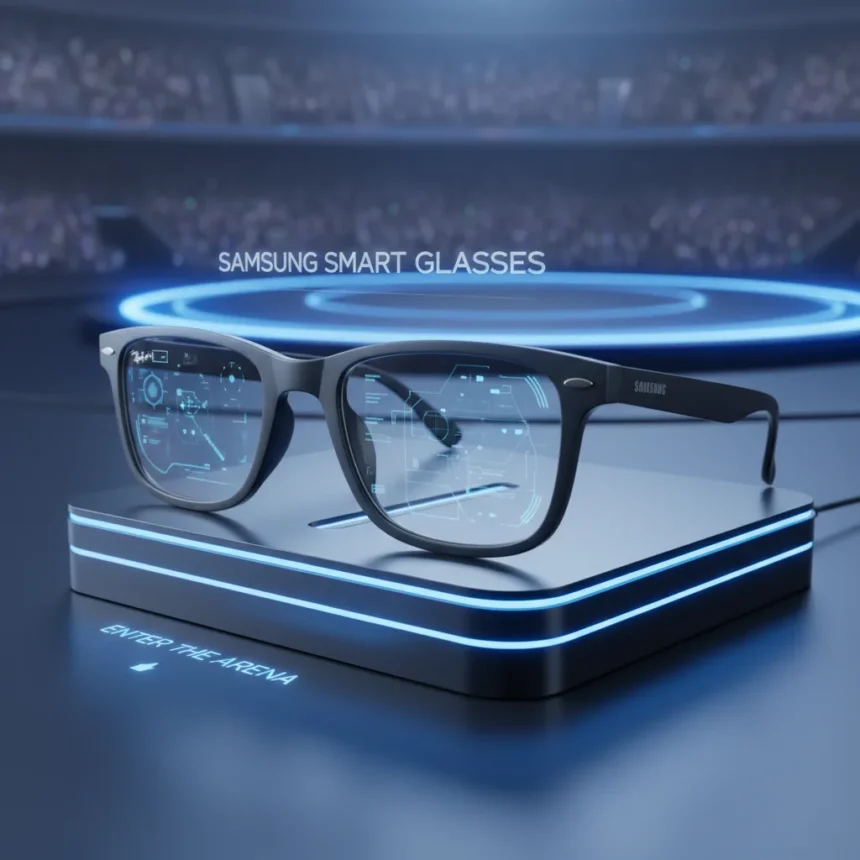
Samsung smart glasses are coming — and the first leaked footage suggests they’re going to be a conversation starter for all the wrong reasons. Samsung smart glasses refer to the company’s upcoming AR eyewear category, currently at the R&D stage, developed in partnership with fashion brands Warby Parker and Gentle Monster as part of Samsung’s broader Android XR wearables push. No pricing or release date has been confirmed.
Key Takeaways
- Leaked video shows Samsung AR glasses with a bulky design that leakers compared to Ray-Ban Wayfarers submerged in wet cement.
- Samsung is developing the glasses on Android XR in partnership with Warby Parker and Gentle Monster.
- Twitter leaker WalkingCat, known for reliable Microsoft and Samsung leaks, labeled the glasses a possible “R&D Vision Concept”.
- The glasses are positioned as Samsung’s answer to Meta Ray-Ban smart glasses and Apple’s rumored AR eyewear.
- No confirmed specs, pricing, or launch timeline have been announced for the glasses.
What the Samsung Smart Glasses Leaks Actually Show
The leaked ads, shared by WalkingCat on Twitter, depict two products labeled “Samsung AR Glasses” and “Glasses Lite AR”. The designs are thick-framed and unmistakably chunky — described in one characterization as what happens when “Ray Ban Wayfarers fell into wet cement and gained a few pounds”. That’s not a flattering comparison, and it’s the kind of first impression that sticks.
WalkingCat, who has a credible track record on both Microsoft and Samsung leaks, suggested the images may represent an “R&D Vision Concept” rather than a finalized consumer product. That caveat matters. Early-stage concept hardware routinely looks nothing like the shipping version, and Samsung has both the industrial design talent and the fashion-brand partnerships to course-correct before any launch.
The partnership angle is genuinely interesting. Warby Parker brings mainstream optical credibility, and Gentle Monster is one of the most design-forward eyewear brands in the world. If those collaborations shape the final hardware, the chunky prototype look could be a distant memory by the time Samsung ships something real.


How Samsung Smart Glasses Compare to Meta Ray-Ban
The Meta Ray-Ban smart glasses set the current benchmark for wearable eyewear: a design that passes as ordinary glasses, basic camera and audio functionality, and a price point that doesn’t require a second mortgage. Samsung’s leaked design doesn’t clear that bar yet — the bulk is the obvious problem.
The Meta Ray-Ban glasses succeed largely because they don’t look like tech. They look like glasses. That’s a harder design problem than it appears, and it’s one Samsung hasn’t solved in these early images. Whether the final product narrows that gap depends entirely on how much the Warby Parker and Gentle Monster partnerships influence the hardware, not just the branding.


Elsewhere in the smart glasses space, Even Realities’ Even G2 targets a different niche — real-time conversation coaching, prompts, and prep notes via a subtle interface controlled by gesture and ring inputs. The Rayneo Air 4 Pro takes yet another approach, projecting a 100-inch screen equivalent and functioning as an external display rather than a true AR overlay. Samsung is entering a market that’s already fragmenting into distinct use cases, and it will need a clearer value proposition than “it’s like Meta Ray-Ban but from Samsung.”
Samsung’s Broader XR Ambitions and Why This Matters Now
The smart glasses leak didn’t arrive in isolation. Samsung revealed its Android XR strategy at its Worlds Wide Open event, where the Warby Parker and Gentle Monster partnerships were officially announced alongside the glasses development. That event also gave a clearer picture of Samsung’s XR headset — a separate device featuring 4K micro-OLED displays, a Snapdragon XR2+ Gen 2 chip, an external battery pack, and eye tracking, positioned as a lighter alternative to Apple Vision Pro.
The XR headset and the smart glasses serve different ends of the market. The headset is an immersive computing device competing with Apple Vision Pro. The glasses are an ambient wearable competing with Meta Ray-Ban. Samsung is essentially trying to cover the entire AR/XR spectrum at once, which is ambitious — and risky. Spreading hardware resources across two very different form factors while both products are still in development is a significant execution challenge.
Android XR itself is described as resembling Apple’s visionOS in its interface approach. That’s a double-edged observation: it suggests polish and familiarity, but it also invites the “copycat” label that Samsung has spent years trying to shake in the smartphone space. The smart glasses design leak doesn’t help that narrative.


Is the smart glasses market ready for Samsung to enter?
The market is ready, but Samsung‘s timing depends on execution. Meta Ray-Ban has proven consumer appetite exists for glasses that don’t look like gadgets. Samsung has the brand scale and the fashion partnerships to compete — but only if the final hardware looks nothing like the current leaked prototype.
Will Samsung smart glasses work with Android phones only?
The glasses are being developed on Android XR, which strongly suggests Android compatibility will be central to the experience. No official compatibility details have been confirmed, and no launch specs are available yet.
Are Samsung AR glasses the same as the Samsung Galaxy XR headset?
No. The Samsung Galaxy XR headset is a separate immersive computing device with 4K micro-OLED displays and a Snapdragon XR2+ Gen 2 chip, designed for full XR experiences. The smart glasses are a lighter, ambient wearable in the Meta Ray-Ban category — two distinct products targeting very different use cases.
Samsung smart glasses have the partnerships, the platform, and the brand muscle to be a genuine challenger in smart eyewear. What they don’t yet have is a design that earns the right to sit on someone’s face all day. That’s the only problem that matters — and until Samsung solves it, the comparison to Meta Ray-Ban will remain unflattering rather than aspirational.
Where to Buy
This article was written with AI assistance and editorially reviewed.
Source: T3