




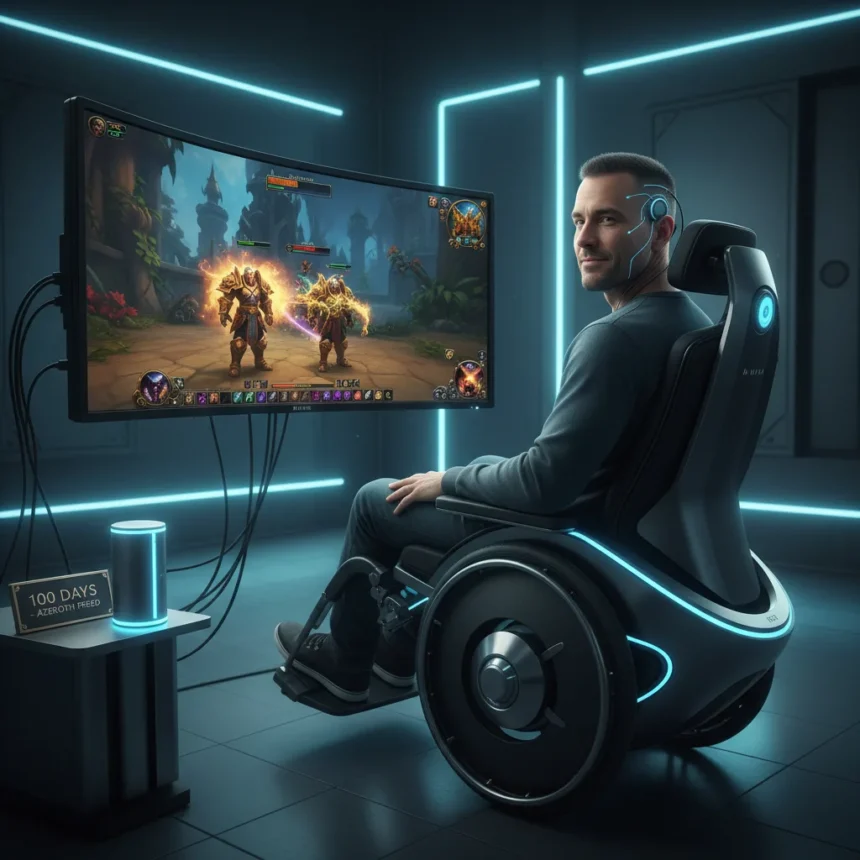
Jon L. Noble, a British Army veteran paralyzed below the neck from a C4 spinal injury, is now playing World of Warcraft hands-free using a Neuralink brain implant that translates his thoughts directly into game commands. At 100 days post-surgery, Noble has become patient number 18 in Neuralink’s early human trials, offering a rare glimpse into how brain-computer interface (BCI) technology is moving from laboratory demonstrations into functional daily life for people with severe mobility loss.
Key Takeaways
- Neuralink N1 implant inserted 1,024 ultra-thin threads into Noble’s motor cortex using a robotic surgical system.
- By day 80, Noble achieved full-speed World of Warcraft raiding and Azeroth exploration using intention alone.
- Recovery was rapid: surgical scar fading by day 7, cursor control feeling natural by week 3.
- Noble describes the experience as pure magic, with freedom that feels addictive after months of paralysis.
- The implant demonstrates BCI technology translating neural signals to digital commands without mouse or keyboard.
From Surgery to Cursor Control: The First 100 Days
The Neuralink N1 implant procedure itself was straightforward. Noble underwent general anesthesia while a robotic system carefully inserted 1,024 ultra-thin threads directly into his motor cortex—the brain region controlling voluntary movement. The incision was small, and he was discharged the next day. By day 3, Noble reported feeling much better; by day 7, the surgical scar was already fading. Recovery moved faster than expected for a procedure involving direct brain surgery.
The real acceleration began in week 2, when Noble paired his implant with a MacBook and completed calibration. After the system learned to translate his neural signals, he could move the cursor simply by thinking about moving it. By week 3, cursor control felt second nature—no conscious effort required. His brain had already begun adapting to the interface, bridging the gap between intention and digital action.
World of Warcraft at Full Speed: The Breakthrough Moment
On day 80, Noble launched World of Warcraft for the first time with the implant. The initial raid felt clunky—the synchronization between his brain activity and the BCI system was still settling. But within hours, something clicked. His brain and the interface reached full synchronization, and suddenly he was raiding and exploring Azeroth at complete speed, using only his thoughts. No mouse. No keyboard. Just intention.


Noble’s own description captures the magnitude of the moment. As he posted on X: The first raid felt clunky, but once my brain and the BCI synced, it was pure magic. I’m now raiding, and exploring Azeroth hands-free at full speed—no mouse, no keyboard, just intention. It’s honestly brilliant. The freedom is addictive. For someone paralyzed below the neck, the ability to control a complex real-time game at full competitive speed represents not just a technological achievement but a restoration of agency and play.
How Neuralink’s Brain Implant Works in Practice
The Neuralink N1 implant functions as a bridge between neural activity and digital commands. The 1,024 threads sit in Noble’s motor cortex, detecting electrical signals from neurons as he thinks about movement. These signals are interpreted by the system and translated into cursor movements, clicks, and other inputs. Unlike external electrodes or older BCI systems, the implant’s direct placement in the motor cortex allows for high-resolution signal detection, enabling the precision and speed needed for complex tasks like raiding in World of Warcraft.



What distinguishes this from earlier BCI research is the integration into daily life. Noble isn’t visiting a lab for supervised sessions—he’s playing games, controlling his computer, and living with the implant as a functional part of his nervous system. The implant is owned and developed by Neuralink, Elon Musk’s neurotechnology company, which has positioned this early human trial as proof that BCI technology can move beyond academic research into real-world utility.
Why This Matters for Paralyzed Individuals
For people with severe spinal injuries or paralysis, the Neuralink brain implant represents a fundamentally different approach to restoring function. Rather than attempting to repair the damaged spinal cord—a goal still decades away—the implant bypasses the injury entirely, creating a new neural pathway from brain to computer. Noble’s ability to play World of Warcraft at full speed is not just entertainment; it demonstrates that the system can handle the cognitive demands of real-time decision-making, hand-eye coordination, and complex spatial reasoning.
The psychological impact is equally significant. Noble describes the freedom as addictive, and that language matters. For someone who has lived with total paralysis below the neck, regaining the ability to control something—anything—at full speed is transformative. It is not a cure, but it is a restoration of agency and choice that many thought impossible.
What Happens Next for Neuralink’s Human Trials?
Noble is patient number 18 in Neuralink’s early human trials, meaning at least 17 others have received the implant. Each patient’s experience feeds into the company’s understanding of long-term biocompatibility, signal stability, and the brain’s capacity to adapt to the interface. The fact that Noble reached full-speed gaming by day 80 suggests the learning curve is steep but manageable—his brain adapted faster than many expected.



The broader question is whether this success scales. Can other paralyzed patients achieve similar results? Will the implant remain stable over years, or will signal degradation require replacement? These questions remain unanswered in the published record, but Noble’s 100-day milestone provides evidence that the implant can deliver on its core promise: restoring functional control for people who have lost it.
Does the Neuralink implant hurt during surgery?
Noble described the surgery as surprisingly easy, and he was discharged the next day. While any brain surgery carries risks, the robotic insertion system appears to minimize trauma. Noble’s rapid recovery—feeling much better by day 3 and seeing the scar fade by day 7—suggests the procedure is less invasive than traditional neurosurgery.
How long did it take for the Neuralink implant to work?
Noble achieved basic cursor control by week 2 after calibration with his MacBook. Full-speed World of Warcraft gameplay came by day 80, when his brain and the BCI system reached complete synchronization. The adaptation was not instantaneous, but the timeline from surgery to functional gaming is remarkably fast.
Can the Neuralink implant be used for other tasks besides gaming?
The research brief does not detail other applications Noble has used the implant for beyond World of Warcraft and basic computer control. However, the underlying technology—translating neural signals into digital commands—could theoretically support any task a cursor and keyboard can perform, from communication to work software to accessibility tools.
Jon L. Noble’s 100-day journey with the Neuralink brain implant demonstrates that BCI technology has crossed a critical threshold: it is no longer confined to research labs or theoretical demonstrations. A paralyzed British Army veteran is now raiding dungeons in World of Warcraft at full speed using only his thoughts. That is not science fiction anymore. It is functional reality, and it suggests that for people living with severe paralysis, the future of restored agency may arrive sooner than anyone anticipated.
Edited by the All Things Geek team.
Source: Tom's Hardware