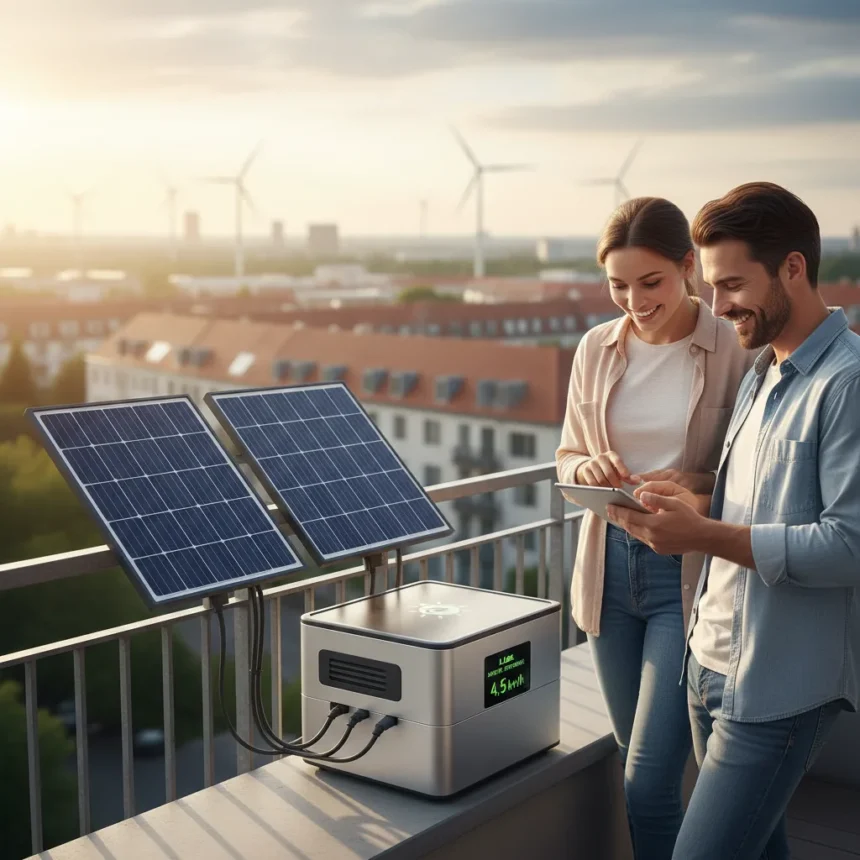
Lidl is bringing a solar balcony battery to market, positioning itself as one of the most affordable ways to store renewable energy at home. The move signals that plug-in solar storage is shifting from niche products toward mainstream retail distribution, making home energy independence more accessible to everyday households.
Key Takeaways
- Lidl’s solar balcony battery targets affordability in the home energy storage market.
- Balcony solar systems are gaining mainstream retail presence across European markets.
- Anker’s competing Solarbank 4 E5000 Pro costs €1,999 with a 25% launch discount available.
- Plug-in solar systems require minimal installation and connect via standard interfaces.
- Regulatory barriers still limit availability in some regions, including the UK.
What is a solar balcony battery?
A solar balcony battery is a plug-in energy storage system designed for residential use, allowing households to capture and store excess electricity generated by rooftop or balcony solar panels. These systems sit between your solar installation and your home‘s electrical grid, acting as a buffer that lets you use solar power even when the sun isn’t shining. Unlike traditional grid-tied systems that feed excess power back to the utility, balcony batteries keep that energy within your home, reducing reliance on purchased electricity and lowering energy bills.
The appeal of balcony solar batteries lies in their simplicity. They require minimal installation compared to traditional battery systems, often plugging directly into a standard outlet or connection point. The systems are designed for renters and homeowners alike, making them accessible to households that cannot install permanent solar infrastructure.
How Lidl’s offering compares to existing alternatives
Lidl’s entry into the solar balcony battery market represents a direct challenge to premium manufacturers already serving European households. The most direct competitor is Anker’s Solarbank 4 E5000 Pro, which offers 5,000W solar input, 5,000Wh storage capacity, and a 10,000-cycle lifespan. That system starts at €1,999 in European markets, with a 25% launch discount available through Anker’s website. Backup power switching occurs within 10 milliseconds during a power cut, providing seamless energy continuity.


Lidl’s positioning as a discount retailer suggests the company intends to undercut these premium price points significantly. By leveraging its supermarket distribution network across Europe, Lidl can reach households that might otherwise view home energy storage as a luxury product. The strategic move mirrors Lidl’s approach in other categories—offering functional alternatives to brand-name products at fraction-of-the-price positioning. However, without confirmed specifications or pricing from Lidl, direct feature-for-feature comparison remains limited.
The broader shift toward mainstream solar storage
Balcony solar and plug-in storage systems are moving beyond early-adopter circles into mainstream retail channels. This transition matters because it democratizes home energy independence. Previously, household battery storage required significant upfront investment and professional installation, putting it out of reach for most families. Plug-in systems change that equation by reducing both cost and complexity.



The regulatory environment remains fragmented. In European markets where balcony solar is permitted, systems like Anker’s are already available, and expansion is planned for regions like the UK once regulations align. Lidl’s entry into this space could accelerate regulatory acceptance by demonstrating consumer demand at scale. When a major retailer stocks a product category, it signals to policymakers and utilities that the market is serious and requires clear rules.
Why affordability matters for home solar adoption
The cost barrier has historically prevented widespread adoption of home battery storage. A household considering solar panels faces a difficult calculus: invest heavily in panels, then add an equally expensive battery system to maximize savings. Breaking that cost barrier—even by 30 or 40 percent—could shift adoption curves significantly. Lidl’s positioning as a budget alternative to premium brands like Anker suggests the company recognizes this opportunity.
Affordability also matters politically. As governments push households toward renewable energy independence, the technology must be accessible to middle-income and lower-income families, not just wealthy early adopters. Lidl’s supermarket presence in dozens of European countries means the solar balcony battery could reach households that would never walk into a specialized solar retailer.
What happens next for home solar storage?
The entry of major retailers into the solar battery market will likely trigger price competition and accelerate product innovation. Manufacturers will need to defend premium positioning through superior specifications, durability guarantees, or ecosystem features—or accept margin compression as the category matures. For consumers, this competition is welcome: it drives down costs and forces companies to improve products rather than rely on brand prestige alone.



Regulatory clarity remains the wild card. Balcony solar systems sit in a gray zone in many regions, with utilities and grid operators uncertain how to handle distributed storage at scale. As adoption grows, regulators will need to develop standards for interconnection, safety, and grid impact. Lidl’s move to mainstream retail could accelerate this regulatory reckoning by creating political pressure to clarify the rules.
Is a solar balcony battery worth buying?
A solar balcony battery makes sense if you already have solar panels and want to maximize the value of the energy you generate. The payback period depends on your local electricity rates and how much excess solar energy your system produces. In regions with high grid electricity costs, the return on investment can be attractive within 5-7 years. For renters or homeowners with limited roof space, balcony batteries offer a practical alternative to full home battery systems.
How much does a solar balcony battery cost?
Pricing varies significantly by manufacturer and capacity. Anker’s Solarbank 4 E5000 Pro, a comparable system, starts at €1,999 in European markets, with promotional discounts available. Lidl’s pricing has not been confirmed in available sources, but the company’s market positioning suggests a lower price point than premium competitors. Exact costs depend on your local market and any current promotional offers.
Can I install a solar balcony battery myself?
Yes, one of the key advantages of balcony solar systems is minimal installation requirements. These systems are designed to plug into standard outlets or connection points, making them accessible to homeowners without professional installation. However, you should consult local regulations and your utility provider before installation, as rules vary by region and may require notification or approval.
Lidl’s solar balcony battery launch reflects a genuine shift in how households approach energy independence. When a major discount retailer enters a product category, it signals maturity and mainstream acceptance. For households tired of rising energy costs and interested in renewable power, this competitive pressure means better prices and more choices—finally making home solar storage accessible beyond the wealthy early-adopter crowd.
Where to Buy
Edited by the All Things Geek team.
Source: T3