




The Steam March 2026 survey released by Valve reveals PC gaming hardware is shifting in ways that defy expectations. The monthly trend report, compiled from opt-in participants, shows dramatic swings in system RAM adoption, a resurgence of ancient Intel integrated graphics, and measurable changes in VR headset preferences—all driven by inflated hardware prices forcing gamers to downgrade or reach for budget solutions.
Key Takeaways
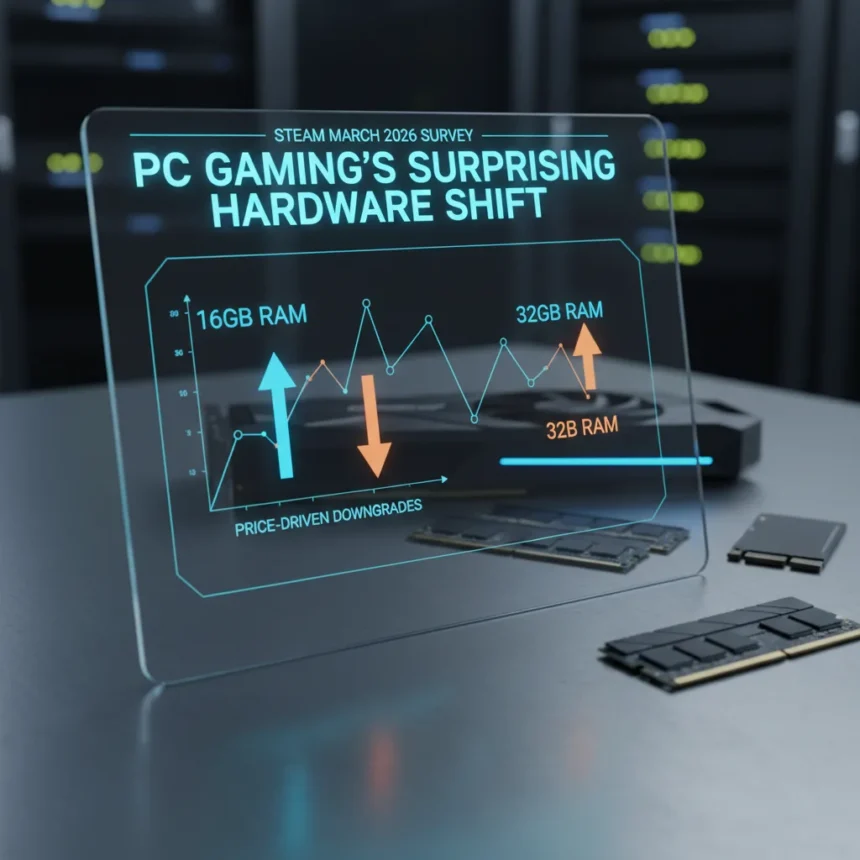
- 16GB RAM jumped to 40.97% (+13.50% change), becoming the plurality choice as prices drive budget builds
- 32GB RAM dropped sharply to 36.62% (-20.31% change), reversing its prior dominance among mainstream builders
- Intel integrated GPUs like Q965/Q963 Express surged to 31.58%, signaling new budget-conscious users entering Steam
- DirectX 12 GPUs reached 94.14% adoption (+3.53%), showing continued ecosystem maturation
- Meta Quest 3 leads VR at 27.66%, with Valve Index gaining ground at 12.92% (+1.63%)
The RAM Reversal: Price-Driven Downgrades Reshape Gaming Builds
The most striking shift in the Steam March 2026 survey is the inversion of RAM adoption patterns. Sixteen gigabytes of system memory has jumped to 40.97% of surveyed systems, gaining 13.50 percentage points in a single month. Meanwhile, 32GB RAM—which dominated gaming builds just months earlier—has collapsed to 36.62%, losing 20.31 percentage points. This is not a natural market evolution. This is price shock forcing gamers to recalibrate their budgets downward.
DDR5 memory costs remain elevated in 2026, making 32GB configurations prohibitively expensive for budget-conscious builders. The surge in 16GB adoption suggests that many gamers are choosing to stay within that tier rather than upgrade, while others who previously purchased 32GB systems are not upgrading their older 16GB machines. Niche configurations like 24GB (1.98%), 48GB (1.14%), and 60GB (0.93%) remain marginal, indicating that gamers still see 16GB and 32GB as the practical ceiling.
Intel’s Integrated Graphics Boom: When Budget Trumps Discrete GPUs
Perhaps the most unexpected trend in the Steam March 2026 survey is the surge of integrated Intel graphics in the hardware baseline. Intel Q965/Q963 Express integrated GPUs have reached 31.58% of surveyed systems, while Intel G33/G31 Express sits at 26.32%. These are not latest components. These are integrated GPUs from systems that are over a decade old, yet they are appearing in Steam’s hardware survey at scale.



This phenomenon reflects two forces at work. First, high discrete GPU prices are keeping older systems in active use longer than typical hardware refresh cycles would suggest. Second, new budget-conscious users entering PC gaming are choosing older pre-built systems or integrated graphics solutions over purchasing discrete graphics cards at inflated prices. The discrete GPU market, dominated by NVIDIA, continues to see RTX 4060 at 3.71% of the survey—down from 7.46% in February—indicating that even entry-level discrete cards are pricing out new entrants.
VR Headset Shifts Amid Market Uncertainty
Among VR-enabled Steam users, the Meta Quest 3 leads at 27.66%, though it lost 0.89 percentage points from the prior month. The Oculus Quest 2 remains competitive at 22.74%, declining only 0.41 points. More notable is Valve’s Index, which gained ground to 12.92% (+1.63%), suggesting that enthusiast PC gamers are investing in higher-end VR experiences even as mainstream hardware stagnates.


The Meta Quest 3S, Valve’s newer entry, sits at 12.75% with minimal monthly change. These shifts are subtle compared to the RAM and GPU trends, but they indicate that VR adoption among Steam users remains fluid and price-sensitive. With mainstream discrete GPUs expensive and integrated graphics rising, the pool of gamers capable of running demanding VR titles is shrinking—yet those who do commit to VR are choosing Meta’s ecosystem or Valve’s own hardware.
CPU Clock Speeds and Resolution Stability
CPU clock speed distribution shows relative stability with minor declines across categories. The 2.3-2.69 GHz bracket holds 20.38% (-1.14%), while 2.7-2.99 GHz represents 8.58% (-1.06%), and 3.3-3.69 GHz accounts for 12.01% (-1.12%). These small monthly shifts suggest that CPU replacement cycles are less volatile than GPU and RAM markets. Resolution preferences remain predictable, with 1920×1080 at 58% of the user base, maintaining its dominance as the practical standard for gaming.
What These Swings Actually Mean
The Steam March 2026 survey paints a picture of a market under stress. High hardware prices are not merely slowing upgrades—they are reversing them. Gamers are choosing 16GB over 32GB, integrated graphics over discrete cards, and older systems over new builds. This is not a preference shift. This is economic constraint reshaping the gaming PC landscape in real time.
For hardware manufacturers, the message is clear: price matters more than specs in 2026. NVIDIA’s discrete GPU dominance persists, but its market share is fragmenting as older and integrated alternatives gain relevance. Meta’s VR ecosystem is stable but not growing, while Valve’s Index is quietly gaining among enthusiasts. The RAM market is bifurcating between budget 16GB builds and premium 32GB+ systems, with little middle ground.


Is the Steam March 2026 survey representative of all PC gamers?
The Steam survey relies on opt-in participation from users who enable the hardware survey option. This introduces selection bias—enthusiasts and technically inclined gamers are more likely to participate than casual players. VR adoption figures, in particular, may overrepresent VR-capable systems since the survey tracks VR users separately. The data is a reliable snapshot of Steam’s active user base, but not necessarily the entire PC gaming market.
Why did 32GB RAM adoption drop so sharply?
The 20.31 percentage point decline in 32GB RAM reflects inflated DDR5 memory prices in early 2026. Gamers building new systems are choosing 16GB as a cost-effective baseline, while those with existing 32GB systems are not upgrading. As DDR5 prices stabilize, this trend may reverse, but for now, price is driving the downgrade.
Will Intel’s integrated GPU surge continue?
The rise of integrated graphics is a temporary market response to high discrete GPU costs. As GPU prices normalize or new entrants opt for budget discrete cards, integrated graphics may decline. However, the trend reflects real economic pressure in the market—budget-conscious gamers are choosing older systems or integrated solutions over expensive discrete cards.
The Steam March 2026 survey captures a moment of market realignment driven by hardware inflation. Gamers are adapting by choosing budget components, holding onto older systems, and prioritizing value over performance. For the industry, the message is that high prices are not sustainable—the market will downgrade rather than pay inflated costs. Whether manufacturers respond with price cuts or accept a shrinking market for premium hardware remains to be seen.
Edited by the All Things Geek team.
Source: Windows Central