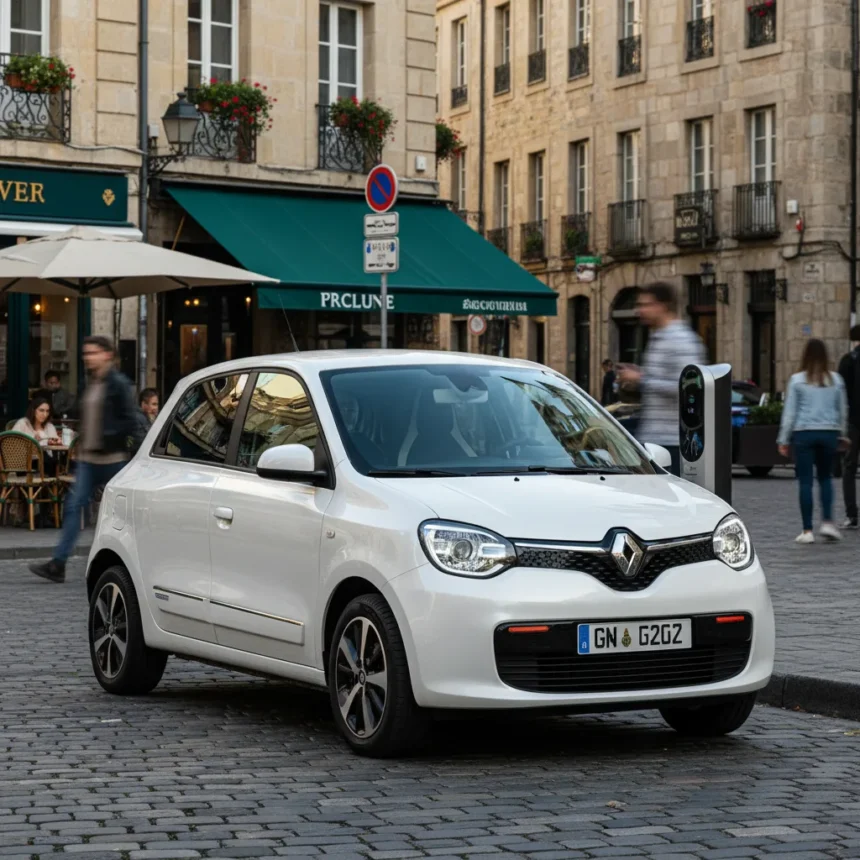
The Renault Twingo E-Tech is a 3.79-meter electric city car designed to prove that affordable EV motoring doesn’t require compromise on character, practicality, or efficiency. Launching in 2026 across Europe, the Twingo E-Tech will start under €20,000 (roughly £17,000 or $23,000 equivalent) before subsidies, with leasing targeted under €100 per month. It’s the third electrified retro reimagining in Renault’s Ampere division, following the R5 and R4, and represents a deliberate counter to Chinese EV makers who have flooded the affordable segment with compromise-laden designs.
Key Takeaways
- Renault Twingo E-Tech starts under €20,000, undercutting rivals like Dacia Spring and Leapmotor T03.
- 27.5 kWh battery delivers 163 miles of WLTP range with best-in-class thermal management efficiency.
- Just over 80 horsepower powers a lightweight urban EV with retro design and modern tech.
- Developed in record two years from concept to production, matching Chinese OEM speed.
- Europe-only launch in 2026; unlikely for U.S. market but could influence Nissan via partnership.
Why the Twingo E-Tech Actually Matters Right Now
The Renault Twingo E-Tech arrives at a critical moment for affordable EV adoption. European carmakers face relentless pressure from Chinese competitors who have mastered low-cost production. Renault CEO Luca de Meo calls the Twingo a “silver bullet for sustainable mobility,” and the speed of its development proves the company is serious about competing on economics, not just rhetoric. Developed in just two years from concept to production start, the Twingo matches the speed of Chinese OEMs—a stunning achievement for a European legacy automaker. This is not a slow, committee-designed compromise. It’s a direct response to the threat posed by Dacia Spring and Leapmotor T03, which dominate the ultra-budget segment despite being, frankly, compromise on wheels.
What sets the Twingo E-Tech apart is that it refuses to sacrifice character for price. The retro design isn’t nostalgia for its own sake—it’s a practical acknowledgment that smaller cars feel less cramped when they have visual personality. Buyers choosing a €20,000 EV are not looking for German minimalism or Japanese restraint. They want something that looks intentional, feels special, and doesn’t scream “budget.” The Twingo delivers exactly that.
Renault Twingo E-Tech Specs and Real-World Efficiency
The Twingo E-Tech packs a 27.5 kWh battery, just over 80 horsepower, and achieves 163 miles of range under WLTP testing standards. That translates to approximately 140 miles by U.S. EPA equivalency, with an efficiency rating of 6.2 miles per kWh thanks to advanced battery thermal management. For an urban car, these numbers are genuinely impressive. The thermal management system—similar technology found in far more expensive vehicles like the VW ID.4—keeps the battery operating at optimal temperature, maximizing efficiency across seasons. In practical terms, most city dwellers will charge twice weekly, making the 163-mile range more than adequate for daily commutes and weekend trips.


At just 3.79 meters long (roughly 12.4 feet), the Twingo E-Tech uses significantly less raw material than larger EVs, which reduces both environmental impact and production cost. This is not a technical detail—it’s the entire philosophy. Renault’s Ampere division explicitly targets making electric and connected cars affordable for all, addressing energy transition imperatives while competing with Chinese brands that have already proven the market exists.
How Renault Twingo E-Tech Compares to Rivals
The Dacia Spring and Leapmotor T03 are the Twingo’s closest competitors in price and segment, but both have been criticized as compromises on wheels—less practical and less characterful than what Renault is offering. The Twingo’s retro design and modern in-car tech give it an edge in appeal without inflating cost. Compared to the Nissan Leaf, which starts around $23,000 in the U.S., the Twingo delivers similar pricing but with a smaller, more efficient package optimized for urban use rather than highway cruising. The Twingo is not trying to be everything. It’s deliberately engineered for city living, where most affordable EV buyers actually drive.



Renault’s partnership with Nissan means the Twingo’s design language and efficiency innovations could eventually influence Nissan’s ultra-budget EV strategy, even if the Twingo itself never reaches U.S. shores. For now, Europe gets the first-mover advantage, and that matters—early adopters of affordable, efficient EVs will set the tone for how the segment develops globally.
Ampere’s Ambitious Play Against Chinese Competition
The Renault Twingo E-Tech is part of a larger strategic bet. Luca de Meo positioned Ampere as “an ambitious, holistic, and structural response of the European industry to the challenges coming from East and West”. This is not corporate speak—it’s a declaration that European carmakers must move faster and cheaper, or lose the affordable EV market entirely. The Twingo proves Renault understands this. Two years from concept to production is remarkable for a European legacy automaker. Chinese OEMs have set the pace; Renault is now matching it.
Ampere is engineered to make electric and connected cars affordable for all, explicitly addressing both energy transition goals and growth opportunities in markets where price sensitivity is highest. The Twingo E-Tech is the smallest, most affordable expression of that vision, and it’s arriving at exactly the right moment—when European consumers are ready to switch to electric but refuse to pay premium prices for basic transportation.
Is the Renault Twingo E-Tech worth the wait until 2026?
If you’re in Europe and shopping for an affordable EV, yes. The Twingo E-Tech delivers genuine character, practical efficiency, and a price point that makes electric ownership accessible without requiring subsidies (though they will help). The retro design is not gimmicky—it’s a smart aesthetic choice that justifies the premium over Chinese rivals while keeping total cost under control. The two-year development timeline proves Renault is serious about competing, not just talking about it.



Will the Renault Twingo E-Tech come to the United States?
Not directly. Renault has no plans to import the Twingo E-Tech to the U.S. market. However, the design philosophy and efficiency innovations could influence Nissan’s affordable EV lineup via their partnership, potentially leading to a U.S.-market ultra-budget EV in the coming years. For now, American buyers will need to watch from the sidelines.
What makes the Twingo E-Tech different from the Dacia Spring?
Both target the sub-€20,000 segment, but the Twingo E-Tech offers superior practicality, more character in its retro design, and modern in-car technology that the Spring lacks. The Twingo feels intentional; the Spring feels like a compromise. For buyers willing to wait until 2026, the Twingo is the better choice.
The Renault Twingo E-Tech arrives at a moment when European EV makers must prove they can compete on speed and price without sacrificing quality or character. This car does exactly that. It’s not revolutionary—it’s something better. It’s practical, affordable, and genuinely appealing. In a segment dominated by compromise, that’s enough to matter.
Edited by the All Things Geek team.
Source: TechRadar