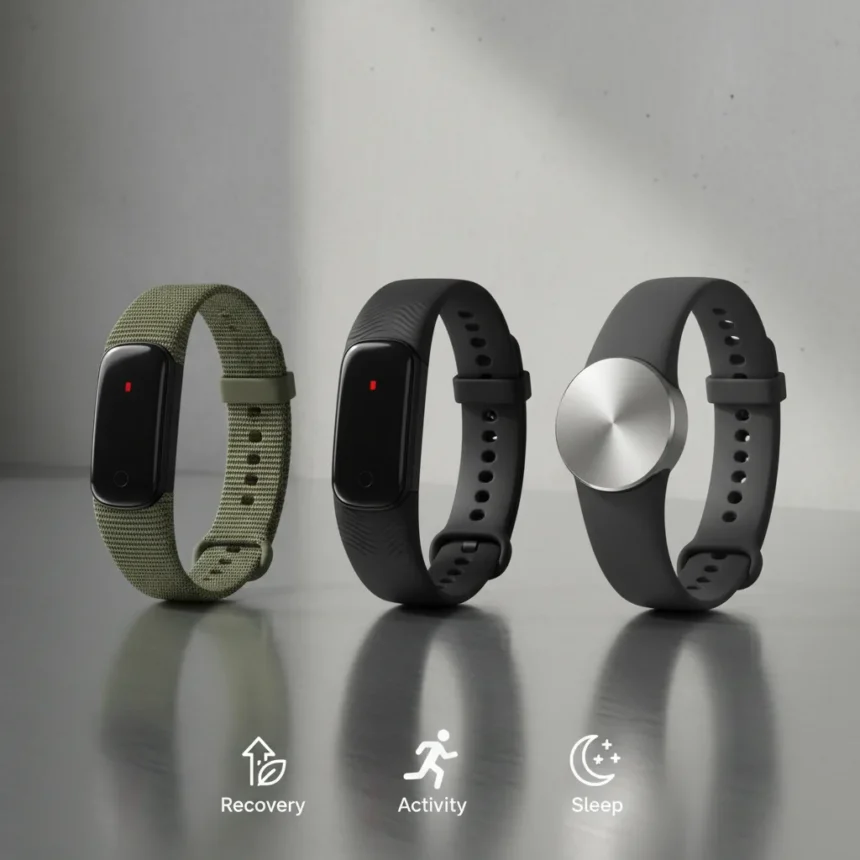
Screenless fitness trackers have quietly become the alternative to smartwatches, stripping away displays to focus on what actually matters: your heart rate, recovery metrics, and sleep data. The three strongest contenders right now are Whoop 5.0, Polar Loop, and Amazfit Helio Strap, each taking a different philosophy on what data you need and how much you should pay for it.
Key Takeaways
- Whoop 5.0 offers the longest battery life (10-14 days) and most advanced recovery metrics, but requires a subscription.
- Polar Loop delivers simplicity and no-subscription tracking with up to 8 days battery in standard use.
- Amazfit Helio Strap balances affordability with modern sensors, achieving roughly 10 days battery without fees.
- All three track heart rate, HRV, sleep, and recovery with similar accuracy in real-world testing.
- Wearable placement matters: wearing any tracker on your bicep improves accuracy over wrist wear.
Screenless Fitness Trackers: What Sets Them Apart
Screenless fitness trackers eliminate the display entirely, ditching notifications and social features to focus on continuous biometric monitoring. All three devices track heart rate, heart rate variability (HRV), sleep, recovery, activity, respiratory rate, skin temperature, and blood oxygen (SpO2). The Whoop 5.0 adds ECG capability in its MG model, giving it the deepest insight into cardiac function. The real differences emerge in battery endurance, subscription costs, and how the apps present your data.
The Whoop 5.0 weighs just 26.5 grams and measures 34.7 × 24 × 10.6 mm, making it one of the smallest options available. Polar Loop comes in at approximately 29 grams, while the Amazfit Helio Strap is noted as the lightest of the three, though exact weight isn’t specified. All three are IP68-rated for water resistance and can be worn on the wrist or, in Whoop’s case, on the bicep for better accuracy.
Battery Life: The Endurance Winner Is Clear
Whoop 5.0 dominates battery longevity, delivering 10 to 14 days per charge in real-world use, with an optional PowerPack accessory extending that even further. The Amazfit Helio Strap achieves roughly 10 days in standard use but drops to 7 to 8 days when all sensors run at maximum settings. Polar Loop claims up to 8 days, though heavy use typically reduces that to around 6 days.


Battery performance matters less if charging is frictionless, but Polar Loop requires removing the band entirely and using a proprietary charging cable, adding friction to the experience. Whoop and Amazfit both use standard wireless charging or simpler connectors, making top-ups less of a hassle. If you’re tracking across a week-long trip without access to a charger, Whoop’s endurance is a genuine advantage.
Accuracy in Real-World Testing
All three trackers deliver remarkably similar heart rate accuracy when tested against reference monitors during gym sessions. In upper-body workout testing, the Whoop 5.0 matched reference heart rate monitors almost exactly, while the Polar Loop ran slightly lower—for example, reading 104.5 bpm when other devices registered higher. The Amazfit Helio Strap over-reported by roughly 1 bpm on average.



These differences are negligible for fitness tracking purposes. More importantly, all three improved accuracy when worn on the bicep rather than the wrist, suggesting optical sensor placement matters more than the sensor itself. If you’re chasing precision for serious athletic training, wearable location trumps brand choice.
Apps and Data Presentation
The Amazfit Helio Strap pairs with the Zepp app, which offers a modern, visually polished interface with straightforward workout and sleep data. Polar Loop connects to the Polar Flow app, which prioritizes simplicity and ecosystem integration for users already invested in Polar’s coaching and sports watch ecosystem. The Whoop 5.0 app is strongest on recovery and training load metrics, displaying detailed HRV analysis and daily readiness scores that appeal to athletes obsessing over optimization.
Whoop’s subscription model unlocks deeper algorithmic insights into your sleep architecture and recovery trajectory, but that premium analysis comes at a monthly cost. Polar and Amazfit keep everything free, making them more attractive to users who want health data without recurring fees. If you’re indifferent to recovery science and just want to see steps, sleep hours, and resting heart rate, Polar’s simplicity wins. If you want actionable daily load recommendations, Whoop justifies its subscription.
Design and Premium Feel
Whoop 5.0 commands a premium price, but reviewers noted a disconnect between cost and perceived quality. One tester remarked: “Whoop is probably my biggest design disappointment… at that price I expect it to feel and look the part. Unfortunately, it didn’t give me that feeling”. The device is functional and durable, but it doesn’t feel as polished as its price tag suggests.



Polar Loop and Amazfit Helio Strap feel more proportional to their cost, offering solid build quality without pretension. The Amazfit’s modern sensor package and lighter weight give it a slight edge in everyday wearability compared to Polar’s chunkier form factor.
Subscription vs. Subscription-Free
This is the defining split. Whoop 5.0 requires a subscription to unlock its full feature set, including recovery metrics, training load, and advanced HRV analysis. Polar Loop and Amazfit Helio Strap charge nothing ongoing, making them better choices for budget-conscious buyers or those skeptical of recurring fees.
The subscription model isn’t inherently bad—Whoop’s algorithms genuinely deliver insights that free apps cannot. But if you’re new to fitness tracking and unsure whether you’ll use recovery data consistently, starting with a subscription-free option like Polar or Amazfit is the safer bet.
External Sensor Pairing
All three devices can pair as external heart rate sensors to sports watches, fitness apps, and gym equipment. This flexibility matters if you’re already invested in a Garmin watch or use a specific training app that demands a dedicated HR sensor. Amazfit and Whoop handle this pairing smoothly, while Polar’s integration depends on your existing Polar ecosystem.
Which Screenless Fitness Tracker Should You Buy?
Choose Whoop 5.0 if you’re willing to pay for a subscription and want the deepest recovery insights, longest battery life, and most advanced biometric analysis. It’s built for athletes and biohackers who obsess over daily readiness scores and HRV trends.
Choose Polar Loop if you want simplicity, no subscription fees, and tight integration with Polar’s broader sports ecosystem. Accept that the band removal charging process is annoying and that you’re trading some advanced metrics for straightforward, no-fuss tracking.
Choose Amazfit Helio Strap if you want a balanced middle ground: modern sensors, no subscription, lighter weight, and a cleaner app without Whoop’s premium pricing or Polar’s charging friction.
Are screenless fitness trackers better than smartwatches?
Not necessarily better, just different. Screenless trackers excel at passive 24/7 monitoring and battery life, while smartwatches offer notifications, music control, and quick-glance information. If you check your phone frequently anyway, a screenless tracker reduces screen time and distractions. If you want standalone functionality, a smartwatch is more practical.
Can you use screenless fitness trackers for swimming?
All three are IP68-rated, meaning they handle submersion in fresh water for swimming and showering. Saltwater and chlorine exposure may degrade the materials over time, so rinse after ocean or pool use. None are rated for diving or high-pressure water sports beyond recreational swimming.
Do screenless fitness trackers work without a smartphone?
Technically yes—the trackers record data continuously regardless of phone connection. But you cannot view your data or adjust settings without pairing to the Zepp, Polar Flow, or Whoop app on a smartphone. Syncing happens automatically when your phone is nearby, but you need the app to access insights.
The screenless fitness tracker market has matured beyond Whoop’s early dominance, with Polar and Amazfit offering compelling alternatives for different priorities. If battery life and recovery depth matter most, Whoop wins. If you want simplicity and no fees, Polar and Amazfit both deliver. Test them if you can—comfort and design feel are personal, and the best tracker is the one you’ll actually wear every day.
Where to Buy
Whoop 5.0 | Amazfit Helio Strap
Edited by the All Things Geek team.
Source: TechRadar