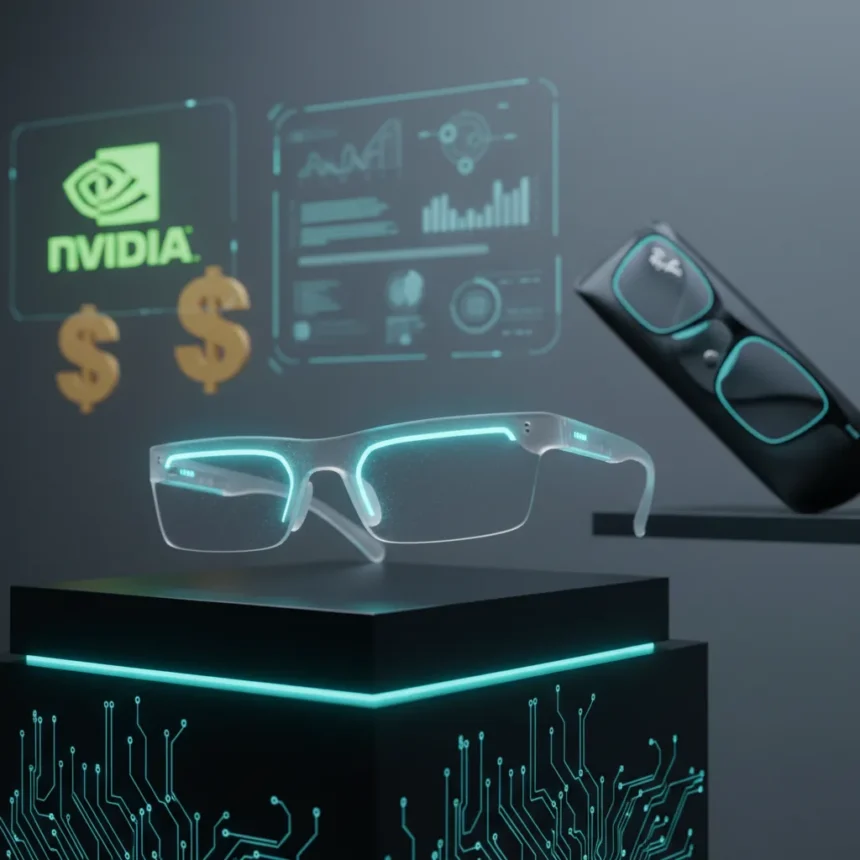
Viture’s invisible AI glasses represent a fundamental shift in how the company approaches augmented reality, moving away from tethered USB-C devices toward standalone Bluetooth-connected eyewear designed to rival Meta’s Ray-Ban glasses. The co-founders are planning a CES 2025 launch of their first true AI glasses, marking a decisive pivot in the competitive AR landscape.
Key Takeaways
- Viture plans standalone invisible AI glasses launching at CES 2025, shifting from tethered to Bluetooth connectivity.
- Company captured over 52% of the U.S. display glasses market in Q4 2024, per IDC research.
- Total funding exceeded $200 million by February 2026, with backing from Legend Capital and partnerships with NVIDIA and Stanford Medicine.
- Next-gen AR glasses feature larger screens, wider field of view, and dynamic tint control for lens privacy.
- Retail expansion includes Best Buy, broadening accessibility beyond direct-to-consumer channels.
The invisible AI glasses challenge to Meta
Viture’s invisible AI glasses mark a direct challenge to Meta’s Ray-Ban strategy, but with a crucial architectural difference. Where Meta’s glasses focus on social media content capture and sharing, Viture is positioning its devices around immersive 3D experiences powered by artificial intelligence. This distinction matters: Meta’s ecosystem prioritizes connectivity and social features, while Viture’s NVIDIA partnership enables professional-grade AI workflows that shift from basic 2D screen mirroring to fully immersive three-dimensional environments.
The term invisible is key. Rather than relying on birdbath optics—the reflective display technology common in current AR glasses—Viture’s FCC filings suggest the company is exploring advanced display technology designed to improve brightness and field of view in real-world lighting conditions. This approach could deliver a more natural-looking device that doesn’t broadcast its function the moment you put it on.
Funding surge and professional ambitions
Viture raised $100 million in additional funding by February 2026, bringing total capital to over $200 million in just six months. Legend Capital led the latest round, signaling serious institutional confidence in the company’s roadmap. That money is earmarked for next-generation XR and AR glasses development, global expansion, and AI integrations—a roadmap that extends well beyond consumer gaming.



The October 2025 joint initiative with NVIDIA and Stanford Medicine illustrates where Viture’s ambitions lie. The collaboration integrates AR and AI specifically for laboratory workflows, a use case that demands precision, reliability, and seamless 3D visualization. NVIDIA CEO Jensen Huang featured the partnership in his October keynote, positioning Viture as a serious player in enterprise AR rather than just another consumer gadget maker.
The Beast and next-gen AR glasses
Viture launched The Beast in late 2025, a product positioned explicitly as a gaming monitor killer with upgraded optical architecture and next-gen display technology. The device represents a cornerstone of the company’s 2026 roadmap, suggesting that gaming performance and visual quality remain central to Viture’s identity even as it pursues professional applications.



Separately, next-generation AR glasses are in advanced testing stages. These devices feature a bigger screen, higher picture quality, wider field of view, and built-in functionalities not present in earlier models. A standout feature is dynamic tint control for lens privacy—the ability to darken the lenses on demand, addressing one of the most persistent privacy concerns with always-on AR eyewear. A full reveal is planned for July, though specific pricing and exact availability remain unconfirmed.
Market position and retail strategy
Viture’s 52% share of the U.S. display glasses market in Q4 2024 gives the company serious leverage. That dominance came from products like the XR4, which iterated steadily on screen size, image quality, and field of view—incremental improvements that competitors like Xreal also pursued, but Viture executed more aggressively. Now, with Best Buy retail partnerships confirmed, Viture is moving beyond niche enthusiast channels to reach mainstream consumers.
This retail expansion matters because it signals confidence. Best Buy doesn’t stock experimental hardware—it stocks products the company believes will sell. For Viture, that validation comes at a critical moment, just as the company pivots toward standalone AI glasses and professional workflows.
How do invisible AI glasses differ from Meta’s Ray-Bans?
Meta’s Ray-Ban glasses prioritize social sharing and content capture, integrating tightly with Meta’s social ecosystem. Viture’s invisible AI glasses emphasize immersive 3D experiences and professional applications, with architecture designed for advanced AI workloads rather than social connectivity. The optical approach also differs—Viture is exploring alternatives to birdbath technology to improve real-world brightness and field of view.



When will Viture’s invisible AI glasses launch?
Viture plans to launch its first invisible AI glasses at CES 2025, though final consumer availability dates have not been announced. The next-generation AR glasses are expected to receive a full reveal in July, with pricing and broader availability details to follow.
What is The Beast, and why does it matter?
The Beast is a gaming-focused AR display device launched in late 2025 with upgraded optics and next-generation display technology. Viture positions it as a monitor replacement for gaming, representing the company’s commitment to high-performance visual experiences. It anchors the 2026 product roadmap alongside the new invisible AI glasses.
Viture’s pivot toward invisible AI glasses, professional partnerships, and retail expansion signals a company no longer content to compete on incremental hardware improvements. With $200 million in funding and backing from NVIDIA and Stanford Medicine, Viture is betting that the future of AR belongs to devices that disappear into everyday life while unlocking immersive 3D experiences. Whether that vision can dethrone Meta’s social-first approach remains to be seen, but the company now has the resources and partnerships to make a serious run at it.
Edited by the All Things Geek team.
Source: Tom's Guide