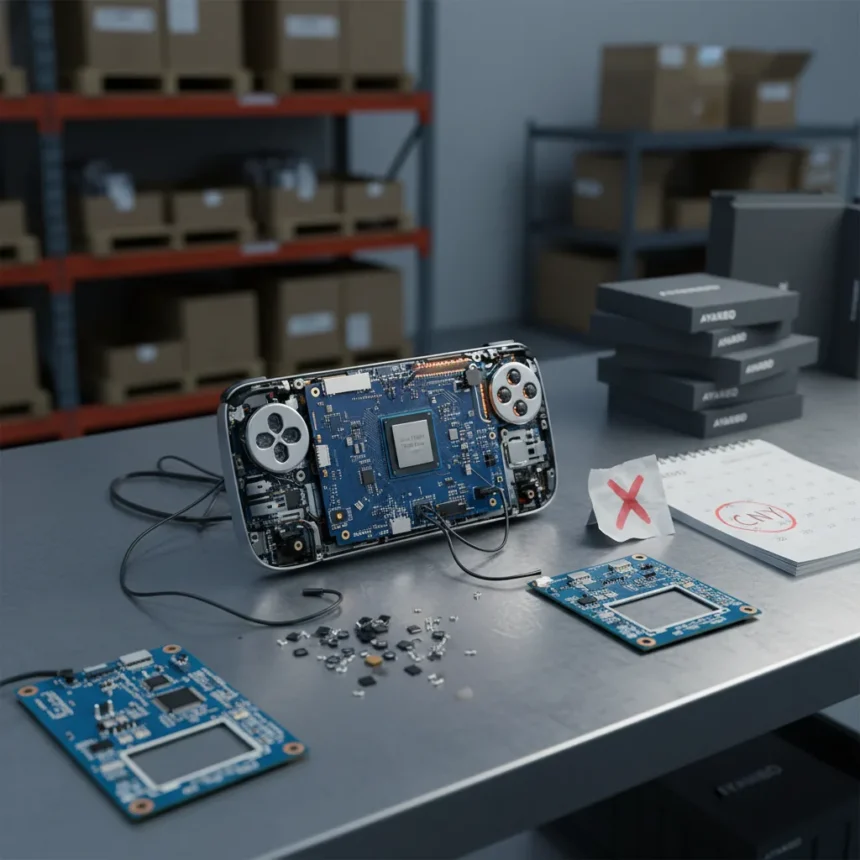
The AYANEO Next 2 shelved its preorder campaign this week after component costs became untenable, forcing the company to halt sales of what was supposed to be 2026’s most ambitious Windows handheld gaming device. The suspension came after the Chinese New Year break, when storage vendor quotes ballooned, making the originally planned $1,799 starting price impossible to sustain.
Key Takeaways
- AYANEO Next 2 preorders suspended due to post-CNY storage cost surge affecting production feasibility.
- Flagship Ryzen AI Max+ 395 (Strix Halo) handheld featured 116Wh battery, up to 128GB RAM, 9.06-inch OLED display.
- Original pricing ranged from $1,799 to $4,299 USD before suspension announcement.
- Existing preorders will be honored; June 2026 shipment timeline now uncertain.
- Supply chain vulnerability exposes risks for premium handheld gaming in 2026.
What Happened to the AYANEO Next 2
AYANEO Next 2 shelved production after procurement costs for storage components spiraled beyond control following the CNY break. The company had originally announced the device in November 2025 with an ambitious specification sheet and a June 2026 launch target. Vendor quotes jumped dramatically, rendering the economics of the project unworkable at the planned price points. The company confirmed that existing preorders will still be honored, but new sales have stopped entirely.
This is a rare move in the handheld gaming space. Premium devices like the Steam Deck and Asus ROG Ally X have managed relatively stable pricing, but the Next 2’s combination of latest components—particularly the massive 116Wh internal battery and up to 128GB of LPDDR5X RAM—created a supply chain vulnerability that the post-holiday component shortage exposed. The device’s weight of 3.14 pounds already positioned it as heavier than its direct competitors, and the cost pressures have now made it unshippable at the promised price.
The Specs That Made This Device Ambitious (and Expensive)
The AYANEO Next 2 was designed to be a flagship-tier handheld built around AMD’s Ryzen AI Max+ 395 processor with an integrated Radeon 8060S GPU. The device featured a 9.06-inch OLED display capable of 60Hz, 120Hz, 144Hz, or 165Hz refresh rates with up to 1155 nits peak brightness and 5280Hz PWM dimming for flicker-free visuals. The build included TouchTAPMagic dual touchpads flanking the display, four rear buttons, floating eight-direction D-pad controls, and Hall-effect linear triggers with dual-mode operation. A lower-spec variant paired the Ryzen AI Max 385 with 32GB RAM and 1TB storage for those seeking a less expensive option.

The 116Wh battery represented the largest internal cell in any handheld gaming device and required airline clearance due to exceeding typical 99Wh laptop limits. This ambitious power capacity, combined with the sheer number of high-end components—dual-fan cooling with a massive heatsink, premium display panel, and top-tier memory modules—created a bill of materials that was always going to be cost-sensitive. When storage vendors raised quotes after CNY, the entire financial model collapsed.
Why This Matters for the Handheld Gaming Market
The AYANEO Next 2 shelved serves as a stark reminder that even well-funded companies with enthusiast audiences cannot insulate themselves from supply chain shocks. The handheld gaming market has grown competitive, with devices like the OneX APEX and GPD Win 5 offering alternatives, but most rely on external battery solutions rather than the internal 116Wh pack that the Next 2 attempted. This internal battery approach, while more convenient for users, exposed AYANEO to component cost volatility in ways competitors with modular designs avoided.

The timing is particularly brutal because the Next 2 was positioned to launch during a window when the Strix Halo processor would have represented a genuine performance advantage over existing handhelds. By the time preorders resume—if they do—newer competitors may have already launched with comparable specs, eroding the device’s differentiation. The company’s decision to honor existing preorders suggests confidence in eventual production, but the indefinite timeline creates uncertainty for customers who locked in early-bird pricing.
What Happens to Existing Preorders
AYANEO confirmed that preorders already placed will be honored at their original prices, ranging from $1,799 for the base 32GB/1TB configuration up to $4,299 for the maxed-out 128GB/2TB variant. This commitment is significant—it means the company is absorbing the cost pressure internally rather than passing it to early backers. However, the suspension of new sales and the lack of a concrete restart date leave the market in limbo. Customers who pre-ordered have security, but potential buyers face an indefinite wait with no visibility into when (or at what price) the device will return to market.
The company’s Smart Control Center software, Snowfield task-freezing engine, and advanced control customization features—designed to differentiate the Next 2 from competitors—remain unproven in real-world use. When production eventually resumes, these software advantages will need to justify the premium positioning, especially if component costs force a price increase that wasn’t originally announced.
Can AYANEO Recover From This
Supply chain pressures typically ease once initial shock periods pass, so the post-CNY spike may not be permanent. However, the damage to momentum is real. The Next 2 had built anticipation over months, and a multi-month suspension risks shifting buyer attention to competing devices or next-generation alternatives. AYANEO’s decision to stop preorders rather than raise prices suggests the company believes costs will normalize, but that’s a bet with significant downside risk if storage components remain elevated through 2026.


The handheld gaming market has proven it can support premium pricing—the Steam Deck OLED and ROG Ally X both command high prices—but those devices had established communities and proven software ecosystems backing them. The Next 2, despite its impressive specs, remains unproven in consumer hands. A successful restart will require not just stable component costs but also a marketing campaign that rebuilds momentum and convinces buyers the wait was worth it.
Is the AYANEO Next 2 still happening in 2026?
AYANEO has not canceled the Next 2, only suspended preorders and production due to component cost issues. The company stated that existing preorders will be honored, implying the device will eventually ship. However, the June 2026 launch timeline is now uncertain, and no revised date has been announced. Customers should expect delays but not assume the project is abandoned.
What makes the AYANEO Next 2 different from the Steam Deck or ROG Ally X?
The Next 2 features a significantly larger 116Wh internal battery—the largest in any handheld—compared to smaller packs in competitors, and offers up to 128GB of RAM with a 9.06-inch OLED display capable of 165Hz refresh rates. It is also considerably heavier at 3.14 pounds, positioning it as a desktop-alternative device rather than a portable one. The Ryzen AI Max+ 395 processor is newer than chips in current-generation competitors, though real-world performance remains untested.
Should I wait for the AYANEO Next 2 or buy a different handheld now?
If you already pre-ordered, your original price is locked in. If you are considering buying now, the indefinite suspension makes waiting risky—you could purchase an established device like the Steam Deck OLED today with proven software support, or wait for clarity on the Next 2’s timeline and revised pricing. The Next 2’s premium specs are compelling on paper, but unproven in real-world gaming, and the supply chain uncertainty suggests AYANEO itself is not confident in near-term availability.
The AYANEO Next 2 shelved is ultimately a cautionary tale about ambition meeting supply chain reality. A device designed to push boundaries in battery capacity, memory, and display technology hit a wall the moment component costs spiked. For buyers, the lesson is clear: premium handheld gaming remains subject to the same supply vulnerabilities that have plagued the broader electronics industry. For AYANEO, the path forward depends on whether component costs normalize quickly enough to salvage the 2026 launch window. Until the company announces a concrete restart date, the Next 2 remains a promise, not a product.
Edited by the All Things Geek team.
Source: Tom's Hardware