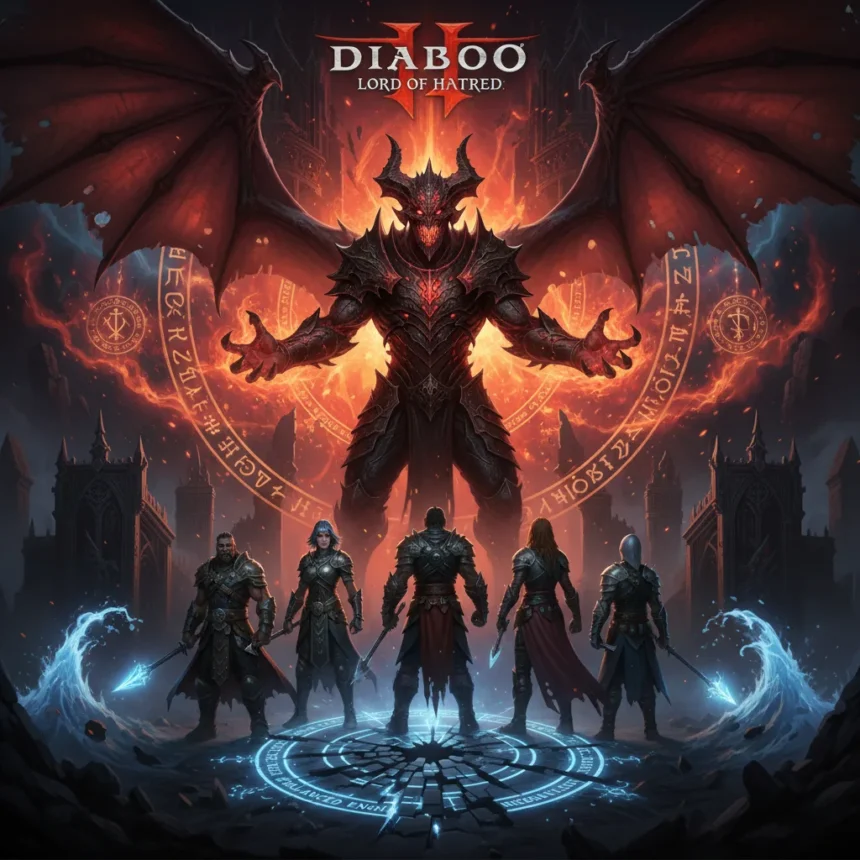
Diablo 4: Lord of Hatred arrived on April 28, 2026, and proved that skepticism about the expansion’s design direction was misplaced. After years of watching Diablo 4 stumble, recover, and finally reach its strongest form in Season 11, the worry was legitimate: could Blizzard really deliver a final confrontation with Mephisto without dismantling the carefully tuned endgame loop that finally made the game feel complete?
Key Takeaways
- Diablo 4: Lord of Hatred released April 28, 2026, serving as the final confrontation with Mephisto.
- Pre-release fears centered on system overhauls causing choice paralysis or mechanical complexity overcorrection.
- Diablo 4 peaked with Season 4 (Loot Reborn) and Season 11, establishing the strongest foundation for an expansion.
- The base game suffered a rocky 2023 launch, review bombing to 4.8 on Metacritic after Patch 1.1 nerfs.
- Vessel of Hatred, the first expansion, offered 4-6 hours of story but received mixed reception for its underbaked mercenaries.
Why The Skepticism Was Reasonable
Diablo 4’s journey to this moment reads like a redemption arc nobody expected to believe in. The 2023 launch was rough. Season of the Malignant in mid-July 2023 delivered Malignant Hearts that felt un-aspirational, and Patch 1.1 sparked review bombing that tanked the user score to 4.8 on Metacritic. Players felt blindsided by major changes without adequate testing. The roadmap reveal generated backlash over borrowed power mechanics, a design philosophy that had already worn thin.
By the time Vessel of Hatred released as the first expansion, the game had clawed back credibility. But that expansion only reinforced the fear that Blizzard might overcorrect. It offered 4-6 hours of story and introduced mercenaries that felt underbaked compared to the base game’s endgame depth. The abrupt ending, teasing Mephisto’s return, felt like setup for a sequel that might undo everything Season 11 had built.
Diablo 4: Lord of Hatred Delivers The Confrontation Without The Collapse
What makes Diablo 4: Lord of Hatred remarkable is not that it added new systems or mechanics—it is that it understood what made Season 11 work and expanded within those boundaries. The expansion delivers the final confrontation with Mephisto, continuing from Vessel of Hatred where he was trapped in a soul stone. Instead of shattering the loop with borrowed power mechanics or choice paralysis, it deepens the existing endgame without reinventing it.


This is the lesson Blizzard learned the hard way: a live-service ARPG thrives on iteration, not revolution. Diablo 4 requires new seasonal characters, similar to Diablo 3 but with MMO-adjacent elements. That structure demands that expansions enhance the seasonal experience rather than replace it. Diablo 4: Lord of Hatred respects that constraint and emerges stronger for it.
The Series Peak, Not A Stumble
Diablo 4 now stands as the pinnacle of the franchise, a statement that would have seemed delusional two years ago. The arc from Season 1’s missteps through Season 4 (Loot Reborn) and Season 11’s refinement to Diablo 4: Lord of Hatred’s execution represents the most complete version of this game. It is also available on Xbox Game Pass, broadening access to what is now the franchise’s strongest entry.



The comparison to Diablo 3 is instructive. That game took years to find its footing post-launch, with the Reaper of Souls expansion finally delivering what players wanted. Diablo 4 compressed that timeline and, more importantly, learned from it. Rather than another expansion that teases deeper problems, Diablo 4: Lord of Hatred feels like closure—the confrontation players have been waiting for, executed with the discipline the game’s endgame finally deserves.
Was The Fear Justified?
Yes. Blizzard’s track record gave reason to worry. The Patch 1.1 nerfs, the roadmap backlash, the underbaked mercenaries in Vessel of Hatred—these were not minor stumbles. They signaled a studio still learning how to balance live-service design with player expectations. The fear that Diablo 4: Lord of Hatred would overcorrect, or worse, repeat past mistakes, was reasonable.
But reasonable fear and accurate prediction are not the same thing. Sometimes a team gets it right. Diablo 4: Lord of Hatred proves that Blizzard understood the assignment this time.
Does Diablo 4: Lord of Hatred change the endgame loop?
No. Diablo 4: Lord of Hatred deepens the existing endgame rather than overhauls it, respecting the balance Season 11 established. The expansion adds content and a narrative climax without dismantling the seasonal structure that finally made the game work.


Is Diablo 4: Lord of Hatred worth buying after Vessel of Hatred?
Yes, especially if you reached endgame in Season 11. Vessel of Hatred had merit but felt underbaked in places. Diablo 4: Lord of Hatred delivers the payoff that expansion was setting up, with the polish and depth Vessel of Hatred lacked.
How does Diablo 4: Lord of Hatred compare to the base game?
The base game launched rough and took years to reach its current form. Diablo 4: Lord of Hatred represents the franchise at its peak, building on the foundation that Season 11 perfected rather than starting from scratch.
The skepticism was earned. Blizzard had given players every reason to doubt. But Diablo 4: Lord of Hatred proves that redemption arcs are possible—that a studio can learn, iterate, and finally deliver on the promise of a franchise. That is rarer than it should be, and worth acknowledging.
Edited by the All Things Geek team.
Source: Windows Central