





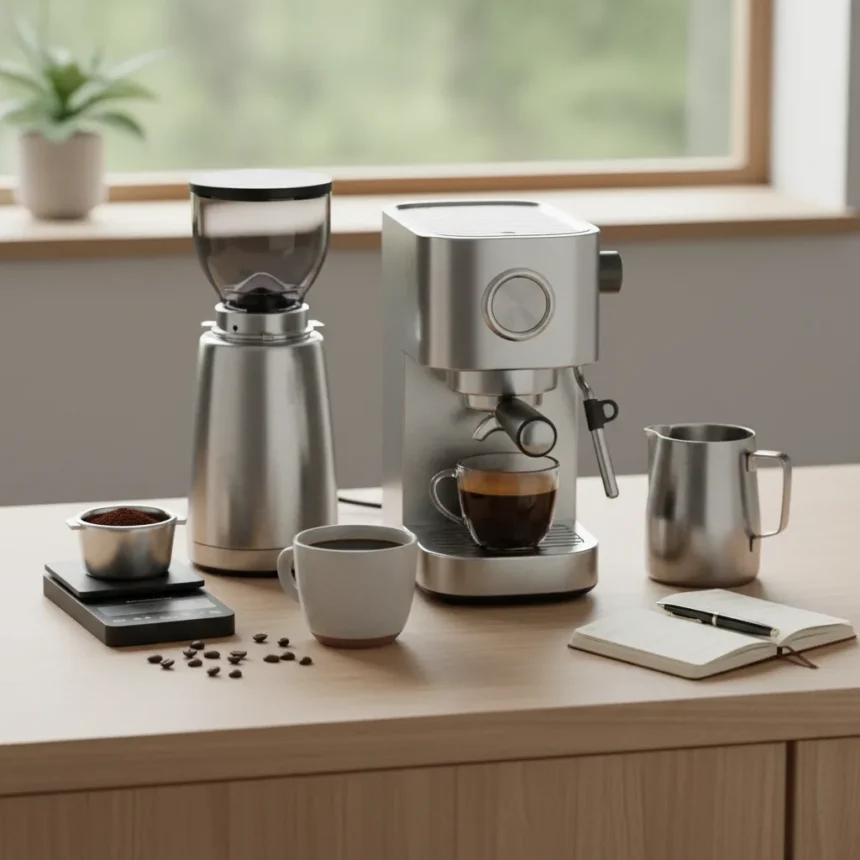
A budget espresso setup under $650 can produce professional-quality shots without the inflated price tags coffeefluencers push across social media. Erin Bashford, an ex-barista writing for Tom’s Guide, argues that most home coffee enthusiasts waste money on unnecessary upgrades and premium machines when smarter equipment choices deliver better results at half the cost.
Key Takeaways
- Budget espresso setups can compete with machines costing $1,000 or more when you prioritize the right components.
- Grinder quality matters far more than machine brand or flashy features for shot consistency.
- Essential upgrades like portafilters and tampers can transform cheap machines into reliable brewers.
- Coffeefluencers often promote expensive gear without disclosing affiliate relationships or actual necessity.
- Complete setups under $650 are achievable with strategic equipment selection and research.
Why Budget Espresso Setup Obsession Misses the Point
The coffee influencer ecosystem thrives on expensive recommendations. High-end machines, boutique grinders, and premium accessories generate affiliate commissions and sponsorships, creating financial incentives to push costly gear onto audiences who may not need it. A budget espresso setup requires rejecting this narrative and instead focusing on what actually impacts shot quality: grind consistency, dose precision, and basic machine reliability.
Bashford’s argument centers on a simple principle: most home brewers overspend on the machine itself while underinvesting in the grinder. This backwards allocation wastes money. An inexpensive espresso machine paired with a quality grinder outperforms an expensive machine paired with a mediocre grinder every time. The budget espresso setup philosophy flips conventional spending priorities, directing dollars toward components that directly affect taste rather than brand prestige.
What Actually Matters in Your Budget Espresso Setup
Building a budget espresso setup requires understanding which components drive quality and which are marketing noise. The grinder is non-negotiable—it must produce consistent particle size across shots. The machine itself needs reliable pressure delivery and temperature stability, but these basics exist in machines well below the $1,000 mark. Upgrades like a quality portafilter, precision tamper, and scale transform even budget machines into capable brewers.

The budget espresso setup approach prioritizes function over aesthetics. Stainless steel bodies, digital displays, and premium finishes add cost without improving extraction. A simpler machine with solid mechanical fundamentals will brew better espresso than a feature-laden model with inferior pressure stability. Bashford’s recommendations focus on machines that deliver the essentials: consistent 9-bar pressure, reliable heating, and compatibility with standard portafilters that allow aftermarket upgrades.
Accessories matter strategically. A basic kitchen scale, a distribution tool, and a decent tamper cost under $50 combined but dramatically improve consistency. These small investments in a budget espresso setup yield disproportionate returns compared to expensive machines that promise automation but deliver mediocre results. The ex-barista perspective cuts through marketing language and identifies what actually works in real kitchens.

Budget Espresso Setup vs. Premium Machines: Where the Real Difference Lies
Premium espresso machines marketed to home users often include features that complicate rather than improve brewing. Dual boilers, rotary pumps, and programmable pre-infusion sound sophisticated but require skill to use effectively and add thousands to the price. A budget espresso setup with a single boiler and manual pressure control forces the brewer to develop technique—and that skill transfer directly improves shot quality more than any automated feature.
The cost difference between a budget espresso setup and a $1,500 machine rarely translates to proportional quality gains. A $300 machine and a $1,000 machine, when paired with identical grinders and upgraded with the same accessories, produce shots that most drinkers cannot reliably distinguish blind. The budget espresso setup philosophy rejects the assumption that price correlates with performance. Instead, it identifies the threshold where diminishing returns begin—usually around $400-500 for the machine itself—and invests remaining budget in grinder quality and accessories.
Building Your Budget Espresso Setup: Component Strategy
Start with a reliable entry-level machine. Bashford’s research identifies models that consistently deliver under $300, offering basic features without unnecessary complexity. These machines have proven track records among home baristas and community support for troubleshooting. Next, allocate $200-300 to a grinder capable of espresso-range consistency. This is where the budget espresso setup separates from casual coffee makers—the grinder is not an afterthought but the centerpiece of your investment.
Remaining budget covers essentials: a precision scale ($30-50), distribution tool ($10-20), quality tamper ($20-40), and a knock box for spent pucks ($15-30). These additions to your budget espresso setup cost under $150 combined but eliminate guesswork and accelerate the learning curve. Bashford emphasizes that this allocation—roughly 40% machine, 40% grinder, 20% accessories—consistently outperforms setups that flip the ratio by prioritizing expensive machines with cheap grinders.

The Hidden Cost of Coffeefluencer Recommendations
Influencers promoting $1,000+ espresso machines rarely disclose affiliate relationships or explain why their recommendations cost three times what a budget espresso setup requires. This opacity matters because it shapes purchasing decisions for audiences without barista experience. A budget espresso setup built on transparent reasoning—grinder first, machine second, accessories third—gives buyers confidence that their money targets actual quality, not influencer commission.
Bashford’s ex-barista credibility stems from years of hands-on experience rather than sponsorship deals. She has brewed thousands of shots on machines across the price spectrum and can articulate why a budget espresso setup delivers consistent results. This perspective cuts through hype and speaks directly to home brewers tired of being sold unnecessary upgrades. The recommendation to spend $650 instead of $1,000 is not a compromise—it is a smarter allocation of limited resources toward proven components.
Is a budget espresso setup really worth building instead of buying an expensive machine?
Yes. A budget espresso setup under $650 built with intentional component selection will brew shots competitive with machines costing twice as much, provided you invest in grinder quality and learn proper technique. The cost savings allow you to experiment with different beans and develop skills without financial pressure. If you later decide espresso is not for you, a budget setup represents a manageable loss rather than a regretted $1,500 purchase.
What’s the most important upgrade for a cheap espresso machine in a budget espresso setup?
The grinder. A quality grinder transforms a basic machine into a reliable brewer by ensuring consistent particle size, which directly controls extraction. Upgrading the grinder in a budget espresso setup yields more improvement than any other single change. Portafilter upgrades rank second, as they improve contact between water and coffee grounds.
Can you really pull good espresso shots on a budget espresso setup under $400 for the machine?
Yes, if you pair it with a capable grinder and proper technique. Many machines in the $200-400 range deliver stable pressure and temperature control sufficient for quality shots. The budget espresso setup philosophy proves that machine price does not determine shot quality—grind consistency, dose precision, and brewer skill matter far more than brand prestige or cost.
The coffeefluencer economy thrives on convincing people that more expensive is always better. A budget espresso setup proves otherwise. By prioritizing function over brand, investing in grinder quality, and rejecting unnecessary features, home brewers can achieve professional results at a fraction of influencer-promoted prices. The real skill lies not in buying the most expensive machine but in understanding which components actually matter and allocating limited resources accordingly.
Where to Buy
Breville Bambino: | Comandante C40 MK4: | Wacaco Exagram Pro: | MHW-3BOMBER Mini Coffee Scale
Edited by the All Things Geek team.
Source: Tom's Guide




