





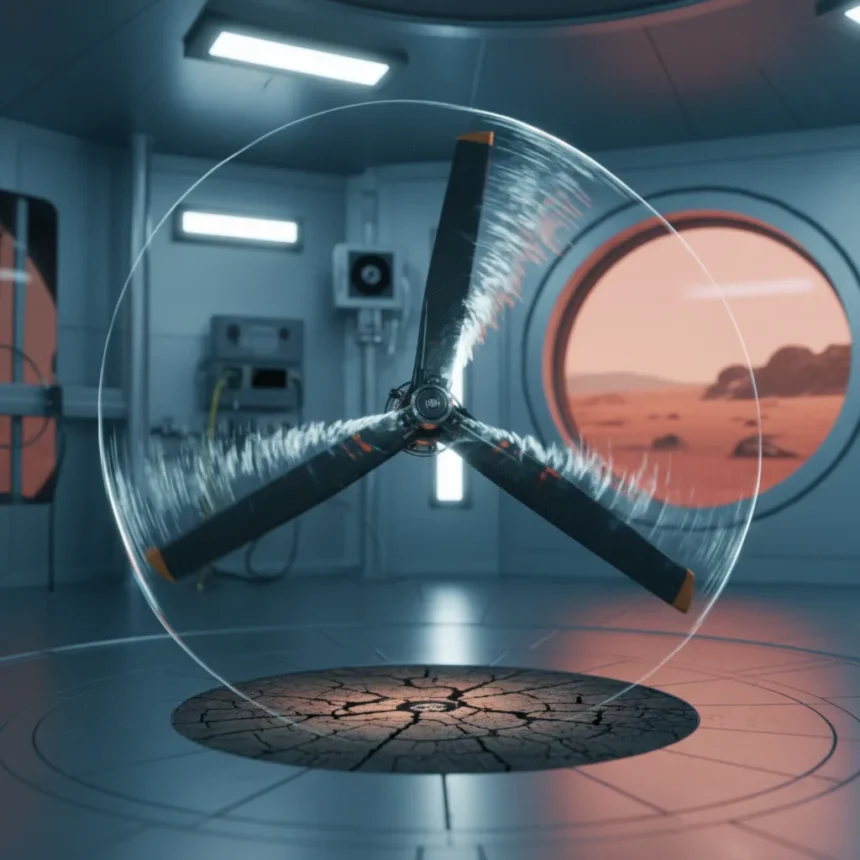
NASA’s Mars helicopter rotors just did something no one had done before: they broke the sound barrier. In tests conducted at NASA’s Jet Propulsion Laboratory (JPL), rotor blades for next-generation Mars aircraft reached Mach 1.08—faster than sound itself—marking a critical breakthrough for exploration on the Red Planet.
Key Takeaways
- Mars helicopter rotors achieved Mach 1.08 (supersonic speed) at 3,750 RPM in vacuum chamber tests simulating Martian conditions.
- The three-bladed rotor, developed by AeroVironment, exceeded the Martian speed of sound (~540 mph or 869 kph).
- Supersonic rotors deliver 30% more lift, enabling heavier payloads like advanced sensors and larger batteries.
- Predecessor Ingenuity was capped at 2,700 RPM to avoid sound barrier unpredictability and dust devil encounters.
- JPL conducted 137 test runs in the 25-Foot Space Simulator between March and November 2025.
How NASA Pushed Mars Helicopter Rotors Past Mach 1
The tests took place in the 25-Foot Space Simulator, a vacuum chamber at JPL designed to replicate Martian atmospheric conditions—thin air at roughly 1% of Earth’s density, made of carbon dioxide, at frigid temperatures. Engineers installed a three-bladed rotor manufactured by AeroVironment in Simi Valley, California, modified with carbon dioxide sheet-metal to withstand Martian physics. The blade design itself was critical: longer blades on the two-bladed SkyFall rotor design achieved supersonic tips at 3,570 RPM, while the three-bladed version hit 3,750 RPM.
The acceleration sequence was methodical. Rotors began at Mach 0.75, then engineers introduced stronger headwinds to test structural resilience near the sound barrier threshold. On final runs, the rotors punched through to Mach 1.08. Jaakko Karras, rotor lead at JPL, offered perspective on the milestone: “If Chuck Yeager were here, he’d warn you that things can get unpredictable around Mach 1”. The team logged 137 test runs total, monitoring for structural integrity, turbulence, and lift generation at each stage.
Why Mars Helicopter Rotors Can Fly Faster Than Earth Ones
The Martian atmosphere is so thin that sound travels at only ~540 mph (869 kph), compared to ~760 mph (1,223 kph) on Earth. This means rotor tips can reach supersonic speeds with far lower RPM than Earth helicopters would need. Standard Earth helicopters operate around 300-500 RPM—ten times slower than the Mars rotor speeds tested. The thinner air also generates less drag and structural stress at high rotation rates, enabling engineers to push boundaries that would snap conventional helicopter blades.


Shannah Withrow-Maser, an aerodynamicist from NASA’s Ames Research Center and test team member, reflected on the unexpected success: “We thought we’d be lucky to hit Mach 1.05, and we reached Mach 1.08 on our last runs. We’re still digging into the data, and there may be even more thrust on the table”. The 30% lift increase translates directly into mission capability—heavier scientific instruments, larger batteries for extended flights, and sensors that current Mars helicopters simply cannot carry.
From Ingenuity to SkyFall: The Next Generation
NASA’s Ingenuity Mars Helicopter, which arrived on Mars in 2021, was deliberately capped at 2,700 RPM for safety reasons. Engineers did not know how rotors would behave near or past the sound barrier in Martian dust devils and extreme conditions, so they built in a conservative margin. Ingenuity proved that helicopters could fly on Mars at all—a stunning achievement. But it was always meant as a proof of concept, not a full-capability platform.



The new rotor designs unlock the potential for SkyFall, a proposed next-generation Mars helicopter with heavier payloads and longer flight endurance. According to Withrow-Maser, “The successful testing of these rotors was a major step toward proving the feasibility of flight in more demanding environments, which is key for next-gen vehicles”. SkyFall remains conceptual at this stage, but the rotor tests confirm that the physics works. Larger aircraft can now carry advanced spectroscopy equipment, ground-penetrating radar, and extended-range batteries that could enable exploration of inaccessible terrain and deeper scientific discovery across the Red Planet.
What This Means for Mars Exploration
Breakthrough rotor performance does not automatically mean a SkyFall mission will launch tomorrow. Development, funding, and mission planning take years. But the JPL tests eliminate a critical unknown: whether rotors could safely exceed the sound barrier without catastrophic failure. Engineers confirmed structural integrity across 137 runs, proving that the physics of supersonic rotation on Mars is not only survivable but controllable.
The implications extend beyond Mars. Understanding how rotors behave at extreme speeds in thin atmospheres informs design for future aerial vehicles on Venus, Titan, or other low-density environments. Each world has its own speed of sound and atmospheric density, but the fundamental engineering principles—blade stress, lift generation, stability near sonic thresholds—now have real-world validation from Martian conditions.
Can Mars helicopter rotors really hit Mach 1?
Yes. JPL’s tests confirmed rotor tips reaching Mach 1.08 in simulated Martian conditions, exceeding the Martian speed of sound (~540 mph or 869 kph). The thinner atmosphere and lower sound speed on Mars make this achievable at rotation rates (3,750 RPM) that would snap Earth helicopter blades.



How much more lift do supersonic rotors generate?
The supersonic rotor designs deliver approximately 30% more lift than subsonic predecessors like Ingenuity. This increase enables heavier payloads, larger batteries, and extended mission durations—critical advantages for exploring remote Martian terrain.
Why was Ingenuity limited to 2,700 RPM if rotors can go faster?
Ingenuity was designed as a technology demonstrator with a conservative safety margin. Engineers did not know how rotors would behave near the sound barrier in Martian dust devils and extreme conditions, so they capped RPM to avoid unpredictable aerodynamic effects. The new tests remove that uncertainty for future missions.
NASA’s rotor breakthrough is not just a speed record—it is a license to build heavier, more capable Mars helicopters. The Red Planet’s thin atmosphere and low sound speed create unique engineering opportunities that Earth-based aviation cannot replicate. With rotors now proven beyond Mach 1, the next chapter of Martian exploration just got significantly more ambitious.
Edited by the All Things Geek team.
Source: Tom's Hardware




