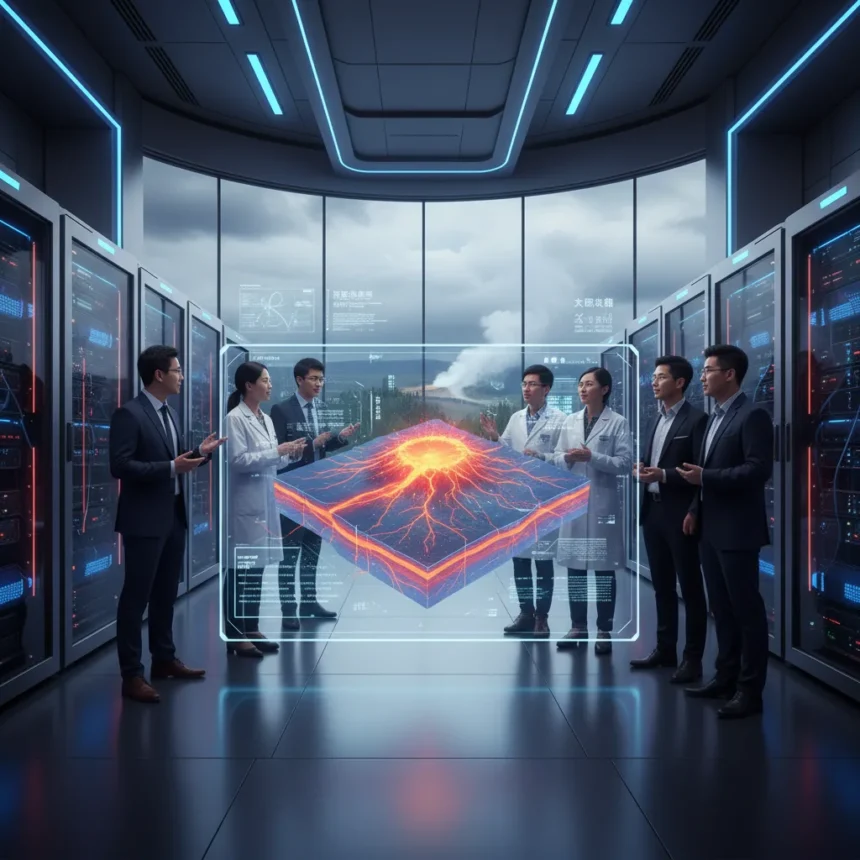
The Yellowstone magma system has puzzled geologists for decades, but a groundbreaking 3D model built on Chinese supercomputers just rewrote the textbook. Researchers from the Institute of Geology and Geophysics at the Chinese Academy of Sciences and the University of Illinois published findings in Science on April 10, 2026, revealing that the Yellowstone magma system forms not from a deep mantle plume, as long believed, but from tectonic forces tearing the lithosphere.
Key Takeaways
- Chinese supercomputers modeled the Yellowstone magma system spanning Earth’s surface to the core-mantle boundary, integrating geological and geophysical data.
- The study overturns the vertical mantle plume theory, showing instead that tectonics tear the lithosphere into tilted channels.
- Magma rises through a southwest-dipping translithospheric system originating near the base of the North American lithosphere, approximately 100 km deep.
- The model’s predictions match real-world observations from seismic imaging, rock chemistry, and gravity measurements.
- Researchers aim to extend this approach to create a digital twin of Earth for volcanic eruption forecasting similar to weather prediction.
How Tectonics, Not Plumes, Built Yellowstone
For decades, the prevailing explanation held that Yellowstone’s magma came from a deep, vertical mantle plume rising from Earth’s interior like a blowtorch. The new model demolishes this idea. Instead, the research shows that an eastward flow of hot mantle material—what researchers call a “mantle wind” originating from Farallon Plate subduction remnants—squeezes hot asthenosphere through the lithosphere. This pressure, combined with westward continental motion, creates tension that tears the lithosphere into tilted, chimney-like channels. Magma then rises along these pre-cut pathways, accumulating in crustal mushes before erupting at the surface.
Lead researcher Cao Zebin and corresponding author Liu Lijun built a three-dimensional numerical geodynamic model that spans from Earth’s surface to the core-mantle boundary. The model integrates geological, geophysical, geochemical data, topography, stress patterns, and seismic observations across western North America. This level of computational complexity required Chinese supercomputers operating at scales unavailable elsewhere, enabling researchers to simulate the intricate interplay of mantle flow, lithospheric stress, and magma generation that traditional models could not capture.
The Yellowstone Magma System Matches Reality
What makes this model credible is not just its elegance but its fidelity to observation. The predictions align with geophysical imaging, rock chemistry, and gravity measurements gathered from Yellowstone over decades. Seismic and magnetotelluric data show the tilted geometry beneath the eastern Snake River Plain that the model predicts. This convergence of computational theory and field evidence suggests researchers have finally cracked how the Yellowstone magma system actually works.


The implications extend beyond Yellowstone. The same tilted translithospheric magma plumbing system likely operates beneath other supervolcanoes, including Toba in Southeast Asia, Kamchatka in Russia, and the Altiplano-Puna complex in South America. Even Jingpohu in northeastern China may follow the same pattern. If true, this single mechanism could explain volcanism across multiple continents, unifying disparate geological observations under one framework.
From Yellowstone Model to a Digital Earth Twin
The real ambition extends far beyond understanding Yellowstone’s past. Liu Lijun and his team envision extending this modeling approach to create a digital twin of the entire Earth, capable of forecasting volcanic activity in a way similar to weather prediction. Such a system could help authorities anticipate eruptions and reduce associated risks, particularly as climate change and seismic activity complicate volcanic monitoring. Yellowstone’s most recent super-eruption occurred 630,000 years ago, yet the volcano remains one of Earth’s most closely watched geological features. A predictive model could transform how scientists assess supervolcano hazards globally.



The challenge is staggering. A full Earth model would require integrating tectonic, thermal, fluid, and chemical processes across the entire planet at computational scales that dwarf even today’s most powerful systems. Yet the Yellowstone breakthrough demonstrates that such ambition is no longer purely theoretical. Chinese supercomputing infrastructure has enabled what Western computational resources could not, raising uncomfortable questions about where the next generation of Earth science discoveries will originate.
Why This Overturns Decades of Volcanic Theory
The mantle plume model for Yellowstone had dominated geology textbooks since the 1970s. It was intuitive: a hot plume rises from deep in the mantle, punching through the lithosphere and creating a trail of volcanism as the North American plate moves westward over it. The model explained the age progression of calderas along the Snake River Plain and matched seismic observations of low-velocity zones beneath Yellowstone. But it never fully explained the chemistry of Yellowstone’s rocks, the gravity anomalies, or the precise geometry of the magma system. The new tectonic model resolves these inconsistencies by recognizing that shallow asthenospheric flow, driven by subduction remnants and crustal stress, does the heavy lifting. Depth matters less than geometry.
What About Yellowstone’s Eruption Risk?
Understanding how Yellowstone’s magma system forms does not directly answer whether an eruption is imminent. The volcano shows no unusual activity and poses no near-term threat. However, a mechanistic model that correctly explains magma generation and transport lays the groundwork for forecasting models. If researchers can predict when stress and magma flux will drive eruptions—the way meteorologists predict storms—Yellowstone monitoring becomes proactive rather than reactive. That is the long-term goal.
Can this model apply to other volcanoes?
Yes. The translithospheric magma plumbing system mechanism appears to operate beneath multiple supervolcanoes on different continents. Toba, Kamchatka, and the Altiplano-Puna all show similar tilted geometries and magma compositions consistent with shallow asthenospheric sources driven by regional tectonics rather than deep plumes. If the model generalizes, it could reshape how volcanologists interpret magma systems worldwide.



Why did Chinese supercomputers solve this problem first?
The 3D geodynamic modeling required for this study demands computational power at scales that were either unavailable or prohibitively expensive in Western institutions. Chinese supercomputers, state-funded and optimized for scientific research, provided the processing capacity needed to integrate disparate datasets and run millions of simulations. This represents a significant shift in where latest Earth science research happens.
The Yellowstone magma system study is not just a geological victory—it is a reminder that understanding Earth’s most dangerous phenomena increasingly depends on computational infrastructure and the vision to use it boldly. As volcanic and seismic risks rise alongside climate change, the race to build predictive Earth models will define the next generation of geoscience. China has just taken a decisive lead.
Edited by the All Things Geek team.
Source: TechRadar