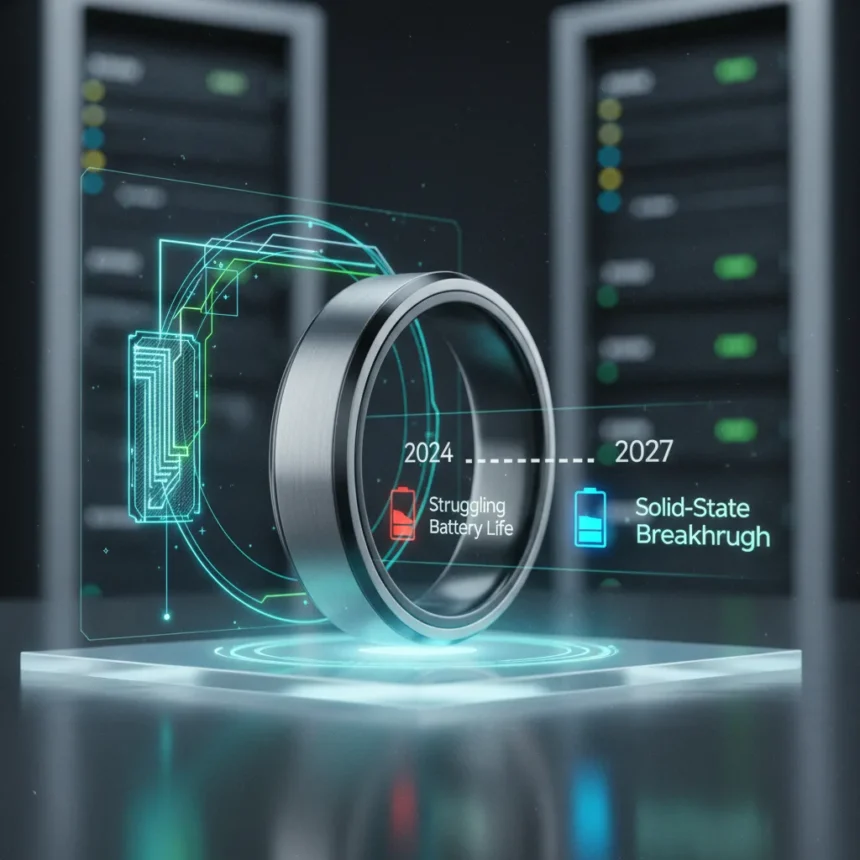
Samsung Galaxy Ring 2 battery technology could represent a meaningful leap forward for wearable power density, but Samsung is asking users to wait until 2027 for the upgrade. The company is reportedly considering solid-state battery technology—which replaces traditional liquid electrolytes with solid materials—to extend the Ring 2’s runtime beyond the current model’s 5–7 days of real-world use.
Key Takeaways
- Samsung Galaxy Ring 2 battery could use solid-state technology, increasing energy density from 200 Wh/L to 360 Wh/L.
- Solid-state batteries are safer, charge faster, and enable longer runtimes in the same tiny form factor.
- Ring 2 launch is not expected until 2027 at the earliest, leaving current Galaxy Ring owners waiting years.
- Original Galaxy Ring battery degrades significantly after one year of use, often requiring daily charging.
- Solid-state tech will likely increase Ring 2 pricing beyond the current $399 launch price.
Why Samsung Galaxy Ring 2 Battery Tech Matters Now
Smart ring battery life remains the category’s central weakness. The original Galaxy Ring claims up to 7 days between charges, but real-world testing reveals a different story. Users report approximately 5–6 days of actual usage, with some sizes delivering closer to 5 days with 15% battery remaining. More importantly, the battery degrades over time—after one year of ownership, many users find themselves charging daily, effectively halving the ring’s practical lifespan.
This degradation problem is not unique to Samsung. Ultrahuman Ring Air users experience gradual battery decline after 1–2 years, and the device’s 500 charging cycles represent a hard ceiling before capacity drops noticeably. Oura Ring delivers roughly 4 days per charge, marginally worse than Samsung’s real-world performance. None of these devices solve the fundamental problem: a tiny wearable with limited physical space cannot pack enough capacity to maintain week-long battery life for years.
Samsung Galaxy Ring 2 Battery: What Solid-State Could Change
Solid-state battery technology addresses this constraint directly. By replacing the liquid electrolyte found in traditional lithium-ion cells with a solid material, Samsung could increase energy density from the current 200 Wh/L to 360 Wh/L—an 80% jump in the same physical footprint. For a device as thin and compact as a smart ring, this density improvement translates to meaningful runtime gains.


The current Galaxy Ring uses a battery capacity between 18–23.5 mAh depending on ring size, constrained by the form factor’s extreme thinness. Unscientific estimates suggest the Ring 2 could reach 50–100 mAh with solid-state technology, still well below the Galaxy Watch 7’s 300–425 mAh or the Galaxy S25’s 4,000–5,000 mAh, but a significant improvement for wearables. Beyond capacity, solid-state batteries charge faster and eliminate the flammable liquid electrolyte present in traditional cells, making them safer for devices worn constantly against skin.
The 2027 Problem: Why Wait So Long?
Here is the frustration: Samsung is positioning the Galaxy Ring 2 as its first deployment of solid-state battery technology, with Galaxy Buds and Galaxy Watch following in later years. This rollout strategy makes sense from a manufacturing perspective—solid-state production is complex and expensive—but it leaves current Galaxy Ring owners in limbo. A user purchasing the original Ring today will face battery degradation for the next 2–3 years before any successor arrives.



The 2027 launch window is not an accident. Solid-state battery manufacturing requires entirely new production infrastructure, quality control processes, and supply chain partnerships. Samsung cannot simply swap components and ship Ring 2 in 2025. The company is betting that the technology premium justifies the wait, but early adopters will have already experienced the original Ring’s battery decline firsthand.
Price and Positioning: A Premium Gets Pricier
The original Galaxy Ring launched at $399, already expensive compared to most smart rings. Solid-state battery technology is costly to manufacture, and Samsung will almost certainly pass some of that expense to consumers. The Ring 2 will likely command a significant price increase, positioning it as a luxury wearable rather than a mainstream alternative to Oura or Ultrahuman.
This pricing pressure creates an interesting market dynamic. Oura Ring lacks a monthly subscription requirement (unlike Oura’s optional premium tier), and the Galaxy Ring ecosystem integrates tightly with Samsung devices. But if Ring 2 pricing climbs to $500 or beyond, Samsung risks alienating the price-conscious segment that views smart rings as niche health gadgets, not premium accessories.
What About Original Galaxy Ring Owners?
If you own a Galaxy Ring today, solid-state battery improvements offer no immediate benefit. Your device will continue to degrade, and Samsung has not announced trade-in programs or upgrade paths for early adopters. The company’s focus on 2027 means current users should expect to manage battery decline through careful charging habits—avoiding deep discharges, keeping the ring cool, and accepting that year two will require more frequent charging than year one.



Is Samsung Galaxy Ring 2 battery life worth the wait?
For new buyers, the answer depends on your timeline. If you can wait until 2027, solid-state technology will deliver meaningfully longer runtimes and better durability. If you need a smart ring now, the original Galaxy Ring still offers competitive battery performance relative to Oura Ring, despite its degradation curve. Ultrahuman Ring Air is cheaper but degrades faster; Oura is the established brand but lacks Samsung ecosystem integration.
When will Samsung Galaxy Ring 2 battery technology be available?
Samsung is not expected to launch the Galaxy Ring 2 until 2027 at the earliest. The company is using the Ring as its first testbed for solid-state battery technology before rolling it out to Galaxy Buds and Galaxy Watch in subsequent years. This phased approach reflects the manufacturing complexity of solid-state production.
How much longer will Samsung Galaxy Ring 2 battery last compared to the original?
Samsung has not officially stated Ring 2 battery runtime, but the energy density improvement from 200 Wh/L to 360 Wh/L suggests meaningful gains. Current Ring users see 5–6 days in real-world use; Ring 2 could plausibly reach 10–14 days before the first charge, though battery degradation over time remains an open question.
The Samsung Galaxy Ring 2 battery story is ultimately one of promise delayed. Solid-state technology is real, the benefits are significant, and Samsung’s engineering is sound. But asking users to wait three years for a battery breakthrough while their current devices degrade is a tough sell. If you are considering a smart ring purchase, factor in the degradation timeline—your Ring will not perform in year two as it does today.
Edited by the All Things Geek team.
Source: Tom's Guide