





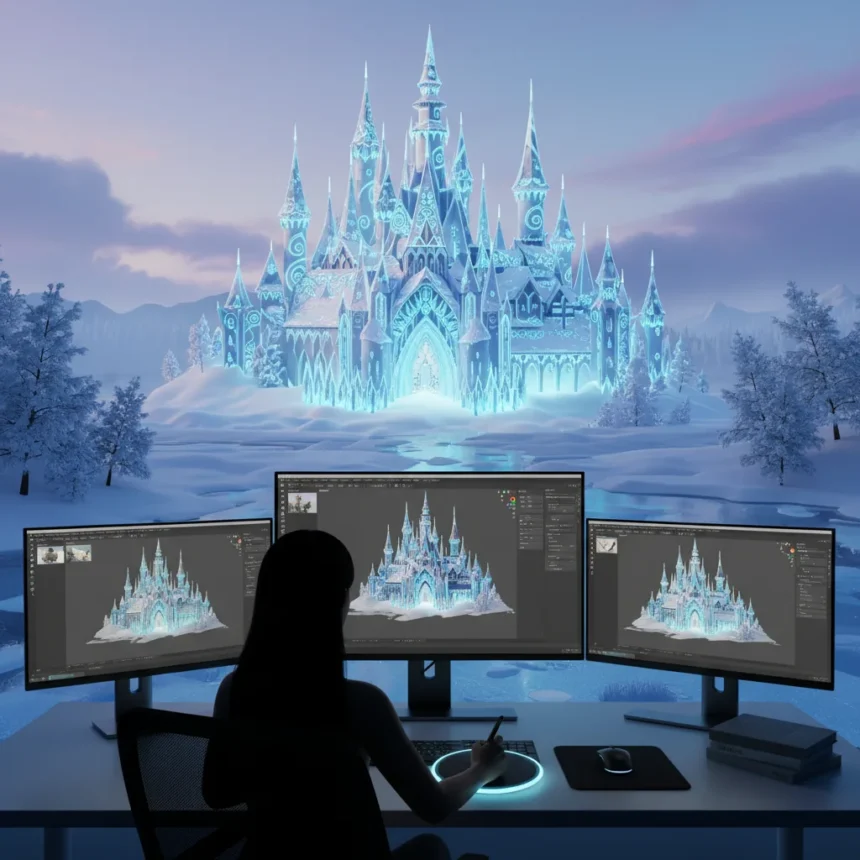
Yoojin Seong, a concept artist known for her work on Avatar, walks through her Blender 3D workflow concept art process for creating a tranquil winter fairy-tale castle scene. The project showcases how professional digital artists approach building immersive 3D environments from initial concept through final render, using Blender as the primary creative tool.
Key Takeaways
- Yoojin Seong demonstrates a complete Blender-based workflow for concept art castle creation
- The project focuses on establishing a calm, winter atmosphere in a fairy-tale setting
- The artist’s process emphasizes 3D modeling as a foundation for concept visualization
- Blender serves as the central tool for building, texturing, and lighting the scene
- Professional concept artists use 3D workflows to rapidly explore environmental design ideas
Why 3D Workflows Matter for Concept Artists
Concept artists increasingly rely on 3D tools rather than traditional 2D painting to explore environmental designs. A Blender 3D workflow concept art approach allows artists to iterate quickly on lighting, composition, and spatial relationships before committing to final artwork. Unlike 2D sketching, which requires manual perspective correction and lighting adjustments, 3D modeling lets artists rotate the camera, change lighting conditions, and test material properties in real time. This speed advantage is why studios now expect concept artists to be fluent in tools like Blender.
Seong’s approach demonstrates how a single artist can build complex castle environments without relying on pre-built asset libraries. By constructing geometry from scratch in Blender, she maintains full creative control over proportions, architectural details, and atmospheric qualities. This method contrasts with workflows that layer photographic textures or purchased 3D models, which can feel generic or disconnected from the artist’s original vision.
Building a Winter Fairy-Tale Castle in Blender
The castle scene Seong creates is deliberately tranquil—a departure from dramatic, imposing architectural renders often seen in fantasy concept art. Winter atmosphere is central to the mood: soft snow coverage, muted color palettes, and cool lighting create a sense of stillness rather than grandeur. This tonal choice reflects a broader shift in concept art toward quieter, more intimate environmental storytelling.


Creating a Blender 3D workflow concept art piece of this complexity requires balancing technical precision with artistic intuition. The artist must decide which architectural elements deserve detail and which should remain suggested through shadow and atmosphere. A fairy-tale castle doesn’t need photorealistic precision—it needs visual coherence and emotional resonance. Seong’s process shows how 3D tools enable this balance by allowing rapid material tests, lighting adjustments, and compositional refinements without starting over.
The winter setting adds specific technical challenges: snow geometry, icy surface properties, and atmospheric fog all demand careful shader work and rendering setup in Blender. Rather than painting snow onto a flat texture, a 3D approach lets the artist place actual geometry, control how light interacts with it, and adjust the overall color temperature of the scene to reinforce the cold aesthetic.



Blender 3D Workflow Concept Art vs. Traditional Approaches
Traditional concept art relies on 2D painting and digital brushwork to establish mood and design. This method is fast for rough ideation but becomes laborious when clients request camera angle changes or lighting adjustments. A professional must essentially repaint the scene from scratch. A Blender 3D workflow concept art process eliminates this friction—the 3D model exists in space, and the artist can generate infinite variations by moving the camera, adjusting lights, or modifying materials without rebuilding the underlying geometry.
For environmental concept work specifically, 3D workflows have become industry standard in game development and film production. Studios use 3D concepts to pre-visualize how players or cameras will navigate spaces, ensuring designs work from multiple angles and distances. Seong’s fairy-tale castle, rendered in Blender, can be viewed from any vantage point, making it far more useful to downstream teams than a single painted perspective would be.
The Role of Atmosphere in Seong’s Design
The tranquil quality of Seong’s winter castle emerges as much from atmospheric choices as from architecture. Fog density, color grading, and soft lighting create a dreamlike quality that elevates the scene beyond technical demonstration. This is where artistic sensibility separates strong concept work from competent modeling. A Blender 3D workflow concept art piece lives or dies on the artist’s ability to communicate mood through render settings, material choices, and compositional framing.
Winter atmosphere is particularly effective for fairy-tale imagery because it naturally suggests isolation, magic, and timelessness. Snow-covered landscapes feel removed from everyday reality. Cool color temperatures and soft, diffused lighting reinforce a sense of calm. Seong leverages these associations deliberately, using Blender’s lighting and shader systems to maximize emotional impact rather than simply demonstrating technical prowess.



What Concept Artists Learn from Seong’s Process
For artists considering a shift from 2D to 3D workflows, Seong’s work demonstrates that Blender competency is now a professional expectation. The learning curve is real, but the payoff—faster iteration, infinite camera angles, and client-ready renders—justifies the investment. Her castle project shows that 3D concept work doesn’t require photorealism or AAA-game-level asset detail. A strong artistic vision, executed cleanly in Blender, communicates design intent more effectively than a photobashed mess.
The project also illustrates how concept artists can use 3D tools to explore ideas that would be impractical in 2D. Testing different castle layouts, evaluating how snow accumulates on various surfaces, and adjusting atmospheric depth are all trivial in a 3D environment but would require multiple full paintings in traditional media.
How Does Yoojin Seong’s Process Compare to Other Concept Artists?
Professional concept artists vary widely in their Blender 3D workflow concept art approaches. Some artists use 3D purely as a foundation, painting heavily over renders to add stylization and detail. Others, like Seong, appear to leverage Blender’s rendering capabilities more directly, trusting the software to communicate design intent. Neither approach is inherently superior—the choice depends on the project’s needs, the studio’s pipeline, and the artist’s personal strengths. Seong’s work suggests a confidence in 3D rendering as a legitimate final deliverable, not merely a sketch tool.
Can I Learn Blender for Concept Art if I’m New to 3D?
Yes, but expect a learning curve. Blender is free and well-documented, making it accessible to beginners. However, concept art demands more than basic modeling—you need to understand lighting, materials, composition, and rendering. Start with simple objects, progress to architectural elements, then attempt complex scenes like Seong’s castle. Join communities, study professional work, and practice regularly. The payoff is a marketable skill that studios actively seek.
What Software Does Seong Use Besides Blender?
The research brief does not specify additional software in Seong’s pipeline. Her process is described as a Blender 3D workflow, suggesting Blender is the primary tool. However, professional concept artists often use complementary software for asset creation, texture work, or post-processing. Without explicit confirmation, no additional tools can be attributed to her workflow.
Yoojin Seong’s fairy-tale castle demonstrates that Blender 3D workflow concept art is not a niche skill—it is now central to professional environmental design. Her tranquil winter scene proves that 3D tools can communicate artistic vision and emotional resonance, not just technical capability. For concept artists still working primarily in 2D, her work is a clear signal that learning Blender is no longer optional—it is essential.
Edited by the All Things Geek team.
Source: Creativebloq




