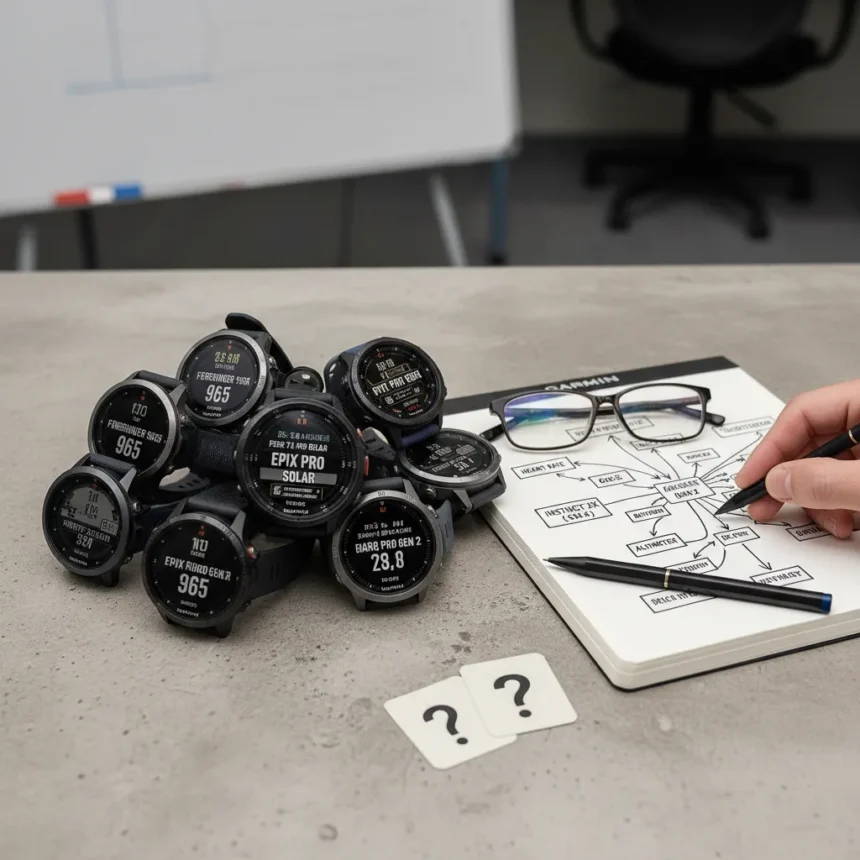
Garmin watch names are deliberately opaque. The Fenix 8 sounds powerful. The Vivoactive 6 sounds approachable. But without spending an hour cross-referencing specs, most buyers have no idea what either actually does—or which one fits their wrist and their training style. A TechRadar Garmin expert recently assembled a crossword-style quiz to expose just how confusing Garmin’s naming conventions have become, and the exercise reveals a real problem in the wearables market.
Key Takeaways
- Garmin’s model names do not clearly signal feature differences or target audience.
- The Fenix 8 is positioned as an advanced powerhouse for serious athletes.
- The Vivoactive 6 serves beginners and casual fitness enthusiasts.
- Similar model numbers across different product lines create genuine buyer confusion.
- A crossword-style quiz highlights why Garmin’s naming scheme needs clarity.
Why Garmin watch names confuse buyers
Garmin’s naming problem stems from a bloated lineup where product tiers overlap and model numbers do not map cleanly to capability. The Fenix 8, positioned as a mighty powerhouse, targets serious endurance athletes. The Vivoactive 6, by contrast, is beginner-friendly and aimed at casual fitness tracking. Both are current models. Both sound like they belong in the same family. Neither name tells you which one you actually need. The quiz format—where readers fill in watch model names using intersecting clues—exposes the absurdity: even people who follow Garmin closely struggle to differentiate between models that look similar but perform vastly differently. That confusion is not accidental. Garmin releases new versions regularly, keeps older models in circulation, and uses naming conventions that feel more like internal SKU codes than consumer-facing product names.
Compare this to Apple Watch, which uses generation numbers and size designations clearly. The Fenix 7 and Fenix 8 sound almost interchangeable, yet they represent different capability tiers. A buyer seeing both in a store has no immediate sense of what separates them. Garmin watch names fail the most basic test of product naming: they do not instantly communicate value or target user. That gap between technical specs and market positioning is where the confusion lives.
Garmin watch names across the lineup
The Fenix series dominates Garmin’s premium fitness watch ecosystem, with the Fenix 8 representing the current flagship for multi-sport athletes. The Vivoactive series occupies the entry-level to mid-range segment, with the Vivoactive 6 designed for users who want solid fitness tracking without the advanced features or price tag of a Fenix. Older models like the Garmin 920XT remain in circulation in used markets and specialist forums, adding another layer of naming confusion for secondhand buyers. The problem deepens when you realize that model numbers do not always indicate release order or capability hierarchy. A Fenix 7 is not necessarily older or simpler than every Vivoactive model—it is just a different product line. Garmin’s naming fails to communicate this distinction clearly. New buyers spend hours researching because the names themselves carry almost no information.


How Garmin watch names compare to competitors
The Fenix 7, when compared head-to-head with the Apple Watch 7, reveals how differently the two companies approach naming and positioning. Apple’s naming is transparent: a number indicates generation, and size variants are obvious. Garmin’s approach is more cryptic, relying on product line names (Fenix, Vivoactive, Forerunner, Epix) to segment the market, then using numbers that do not always correlate to release date or power. This architectural difference means that a casual shopper can instantly understand what an Apple Watch 7 is, but a Garmin Fenix 8 requires explanation. The quiz format highlights this gap by forcing readers to recall not just model names but the specific positioning and feature set each name represents. For a company that makes excellent fitness watches, Garmin’s naming convention is a marketing liability. The product deserves clearer positioning.
Why the quiz matters more than it seems
The crossword-style quiz is not just a fun exercise—it is a diagnostic tool. By asking readers to name specific Garmin watches based on clues about their features or target users, the quiz exposes where Garmin’s naming fails. A good product name should be memorable, distinctive, and informative. Garmin watch names are none of these consistently. The quiz ties performance to a humorous Readiness Score, a Garmin feature that normally measures whether your body is ready for training. Applying it to quiz performance is a clever editorial touch, but it also underscores the real issue: Garmin expects users to invest time in learning the ecosystem, when a clearer naming scheme would save that effort entirely. The quiz is entertaining. The underlying problem is structural.



How to navigate Garmin watch names yourself
If you are shopping for a Garmin watch, ignore the model numbers as a primary signal and focus instead on the product line and your use case. The Fenix series is for serious athletes who want advanced metrics and multi-sport support. The Vivoactive series is for fitness enthusiasts who want solid tracking without complexity or premium pricing. Forerunner models target runners specifically. Epix models add mapping and premium design. Once you know which line fits your needs, then compare specific models within that line. The numbers matter less than the category. Garmin’s naming will not change overnight, but understanding the logic behind the confusion—that model numbers do not correlate to power, and that similar-sounding names hide different purposes—helps you decode the lineup faster than most buyers do. The quiz is a humorous way to expose a real usability problem.
Can Garmin simplify its watch naming?
Garmin could adopt a clearer naming scheme tomorrow if it chose to. Tier-based names (Entry, Mid, Pro, Elite), generation numbers with clear upgrade paths, or even descriptive suffixes (Fenix Runner, Fenix Triathlete, Fenix Climber) would communicate value faster than the current system. The company has not done this, likely because its internal organization, retail positioning, and product roadmap are built around the current naming structure. Changing it would require coordination across marketing, sales, and product teams. For now, buyers are stuck decoding Garmin watch names themselves, and the TechRadar quiz is a clever way to highlight just how ridiculous that burden is.
Does the Fenix 8 have a clear upgrade path from the Fenix 7?
The Fenix 8 is positioned as an advanced powerhouse compared to the Fenix 7, but Garmin’s naming does not clearly signal this. You have to research specs to understand that the 8 is the newer, more capable model. A straightforward naming scheme would make this obvious instantly. The quiz exposes this gap by asking readers to recall and differentiate between models that sound similar but represent different generations.
Why does Garmin use product line names instead of simple generation numbers?
Garmin uses product lines (Fenix, Vivoactive, Forerunner) to segment the market by use case and price point. This approach allows the company to target different buyer groups simultaneously. However, it adds complexity because buyers must first understand the line hierarchy before choosing a specific model. A simpler system would combine line names with clear tier indicators, making the decision tree faster.



Is the Vivoactive 6 a good entry-level Garmin watch?
Yes. The Vivoactive 6 is designed specifically for beginners and casual fitness enthusiasts, offering solid tracking without the advanced features or premium pricing of a Fenix. If you are new to fitness watches and want to avoid overwhelming complexity, the Vivoactive line is where to start.
Garmin makes excellent hardware. Its naming conventions are the weak link. The TechRadar quiz is funny because it exposes a real problem: a company that excels at engineering fitness watches has failed to name them in a way that helps buyers understand what they are buying. Until Garmin simplifies its naming scheme, quizzes like this one will remain a necessary guide to decoding the lineup.
Edited by the All Things Geek team.
Source: TechRadar