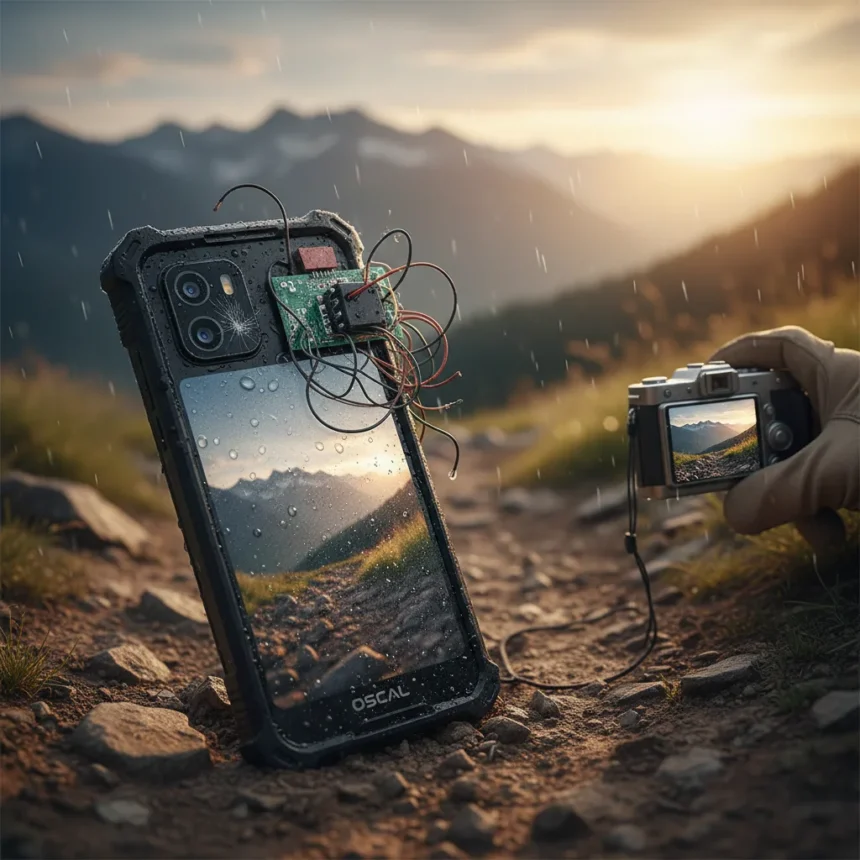
The Oscal Pilot 5 rugged phone is a budget-friendly durability-focused smartphone designed for outdoor, construction, and camping scenarios. Yet despite its positioning as a workhorse for demanding environments, the device makes baffling hardware choices that undermine its appeal to users who actually need reliable imaging in the field.
Key Takeaways
- Oscal Pilot 5 targets budget-conscious outdoor workers but compromises on camera hardware.
- Compared to Blackview ROCK 2 Pro and ROCK 1 Pro, the Pilot 5 lags in imaging capability.
- Odd design decisions suggest engineers prioritized durability specs over real-world usability.
- Battery and processor performance remain competitive in the budget rugged segment.
- Camera weakness is the Pilot 5’s critical flaw for construction and field documentation work.
Why the Oscal Pilot 5 Rugged Phone Misses the Mark on Imaging
The Oscal Pilot 5 rugged phone’s camera setup represents a step backward compared to its direct competitors. For workers documenting job sites, capturing damage assessments, or recording construction progress, a capable camera is non-negotiable. The Pilot 5’s imaging hardware falls short precisely where it matters most: low-light performance, detail retention, and optical stabilization. This is not a minor weakness—it is the core reason someone in a rugged phone category might choose a competitor instead.
Blackview’s ROCK 2 Pro and ROCK 1 Pro both offer more balanced camera implementations within the same price tier. The ROCK 2 Pro, in particular, delivers superior low-light capture and faster autofocus, making it the better choice for users who need their phone to double as a documentation tool. The Pilot 5’s hardware choices suggest the design team optimized for durability certifications rather than practical field use.
Durability and Battery Performance: Where the Pilot 5 Holds Its Ground
Away from the camera, the Oscal Pilot 5 rugged phone performs competently in the categories that define the rugged phone category. Battery life is solid for outdoor workers who cannot charge mid-shift, and the processor delivers adequate performance for mapping apps, communication tools, and heavy-duty work software. The device’s durability credentials—drop resistance, water sealing, and thermal tolerance—are legitimate strengths that justify its existence in the market.


The display, design, and storage options are reasonable for the price point. Where the Pilot 5 succeeds, it succeeds convincingly. The problem is that a rugged phone without a reliable camera is like a construction truck without a bed—technically functional, but missing its core purpose.
Oscal Pilot 5 vs Blackview ROCK 2 Pro: The Verdict
Head-to-head, the Blackview ROCK 2 Pro emerges as the stronger choice for most users in this segment. Both phones share similar processor power, RAM configurations, and battery endurance. But the ROCK 2 Pro’s camera system, charging speed, and multimedia capabilities give it a meaningful edge for workers who need more than just a tough phone—they need a tool that actually works in real conditions.



The Oscal Pilot 5 rugged phone remains viable for users who prioritize ruggedness above all else and rarely use their phone’s camera. Construction supervisors, warehouse managers, and outdoor enthusiasts who primarily rely on dedicated cameras or simply do not need imaging functionality might still find value. But for the growing segment of field workers who depend on their phone as a documentation device, the Pilot 5’s camera weakness is disqualifying.
Should You Buy the Oscal Pilot 5 Rugged Phone?
Only if durability is your sole priority and you have a separate device for imaging. The Oscal Pilot 5 rugged phone is a competent rugged phone that makes inexplicable sacrifices in the camera department. If you work in construction, mining, or outdoor trades and need reliable imaging, buy the ROCK 2 Pro instead. If you simply need an indestructible phone for calls, maps, and messaging, the Pilot 5 delivers on that narrower promise—but you are paying for ruggedness you might not fully utilize.
How does the Oscal Pilot 5 rugged phone compare to the Pilot 6?
The Pilot 6 is an upcoming model in the Oscal lineup alongside the Pilot 5 and Marine 3, positioned with similar specs and pricing for outdoor enthusiasts. Without full specifications available, direct comparison is premature, but the existence of multiple Pilot variants suggests Oscal is iterating on the formula. The Pilot 5 review should not be your final word if the Pilot 6 addresses the camera shortcomings.
Is the Oscal Pilot 5 rugged phone worth upgrading to from the ROCK 1 Pro?
No. The ROCK 1 Pro and ROCK 2 Pro both offer comparable or superior camera performance and durability within the same price range. Unless the Pilot 5 offers a significant price discount, the ROCK series is the safer choice.



What makes the Oscal Pilot 5 rugged phone unique in the budget segment?
The Pilot 5 differentiates through Oscal branding and specific durability configurations, but it does not meaningfully outperform Blackview’s established ROCK lineup in any category that matters to field workers. Its positioning as a budget option is valid, but budget alone does not excuse the camera compromise.
The Oscal Pilot 5 rugged phone is a competent device held back by a critical flaw. It proves that durability and practicality are not automatically aligned—a phone can be tough without being useful. For workers who need both, look elsewhere.
Where to Buy
Edited by the All Things Geek team.
Source: TechRadar