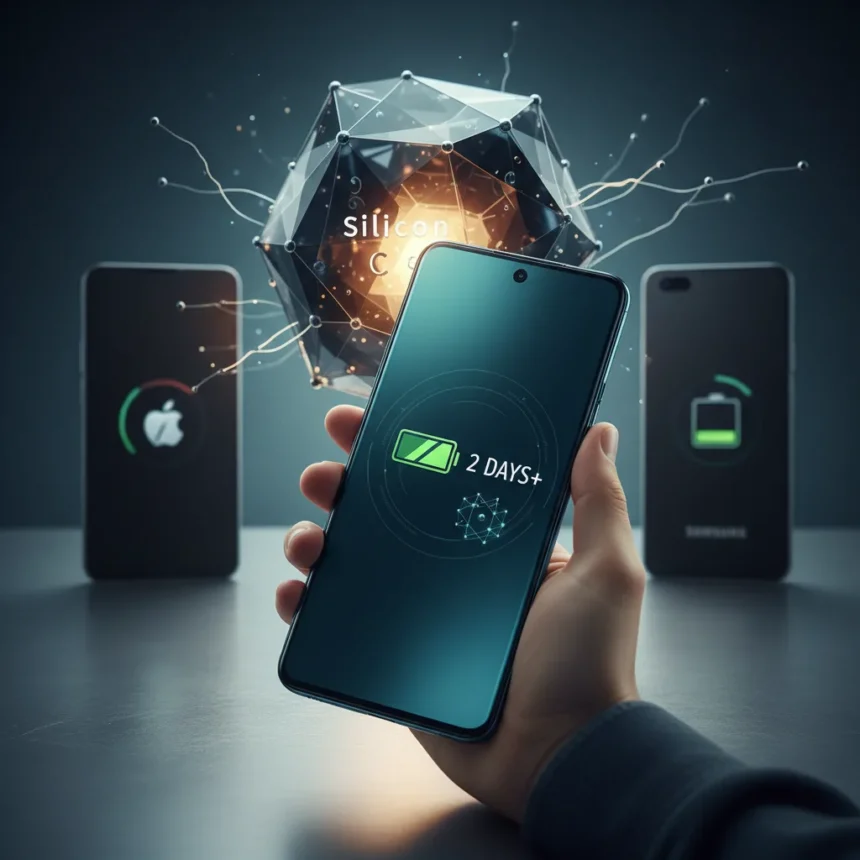
The Honor Magic8 Pro’s silicon-carbon battery technology is reshaping what smartphones can actually do. The device packs a 7,100mAh battery using silicon-carbon (Si-C) construction, delivering over two full days of battery life on a single charge—something flagship phones from Samsung and Apple simply cannot match.
Key Takeaways
- Honor Magic8 Pro’s 7,100mAh silicon-carbon battery lasts over 16 hours in testing, beating Galaxy S26 Ultra and Pixel 10 Pro XL.
- Silicon-carbon technology allows higher capacity without increasing thickness; Magic8 Pro Air is just 6.1mm thick with 5,500mAh.
- Charges at 100W wired and 80W wireless, with extreme weather resistance and 30% better durability than previous generations.
- Chinese brands dominate Si-C adoption; OnePlus 15 offers 7,300mAh, Realme P4 Power reaches 10,001mAh with 3+ days of active use.
- Samsung Galaxy S26 Ultra uses same Snapdragon 8 Elite Gen 5 chip but smaller battery; Apple iPhone Air’s 3,190mAh feels ancient by comparison.
Why Silicon-Carbon Battery Technology Matters Now
Silicon-carbon battery technology represents a genuine engineering breakthrough, not marketing hype. Unlike traditional lithium-ion batteries that rely on graphite anodes, Si-C batteries use a silicon-carbon anode paired with a lithium-based cathode, achieving significantly higher energy density. This means manufacturers can fit larger capacity into the same physical space—or create thinner devices without sacrificing runtime. The Honor Magic8 Pro Air demonstrates this perfectly: it squeezes a 5,500mAh Si-C battery into a 6.1mm chassis, delivering over a day of use in a phone thinner than most competitors’ flagships.
The technology excels in real-world conditions. Si-C batteries suppress silicon expansion stress during charge cycles, extending lifespan compared to conventional designs. Realme’s third-generation Si-C implementation in the P4 Power uses a biomimetic spherical honeycomb structure that increases cycle life by 30% while maintaining extreme weather resistance. For users in hot climates or cold regions, this durability advantage is tangible—not theoretical.
How Honor Magic8 Pro Compares to Samsung and Apple Flagships
The performance gap is stark. The Honor Magic8 Pro achieved over 16 hours in battery benchmarks, while the Samsung Galaxy S26 Ultra—powered by the identical Snapdragon 8 Elite Gen 5 chipset—managed 16 hours 10 minutes. The Pixel 10 Pro XL lagged further at 14 hours 20 minutes. More revealing: the Galaxy Z Fold7, Samsung’s most ambitious foldable, lasted only 10 hours 44 minutes. Apple’s approach is entirely different. The iPhone Air packs just 3,190mAh, relying on aggressive software optimization to eke out adequate daily life. It works, but barely—and the design philosophy prioritizes thinness over user convenience.


Samsung’s own Galaxy S25 Edge carries a 3,900mAh battery, still dwarfed by Honor’s 7,100mAh offering. Even OnePlus 15, a Western-market phone using Si-C technology, delivers 7,300mAh capacity with a slim premium design. The message is clear: Western manufacturers have treated battery capacity as secondary to industrial design constraints. Chinese brands have inverted that priority, proving that Si-C technology lets you have both.
Silicon-Carbon Adoption Across the Chinese Market
Honor did not invent silicon-carbon batteries—the company pioneered their use in mainstream flagships two years ago with the Magic 5 Pro, then continued the approach through Magic 6 Pro, Magic V2 and V3 foldables, and Magic 7 Pro (5,850mAh). But Honor’s persistence has paid off. The broader Chinese market now treats Si-C as standard. Oppo’s Find N6 foldable uses a 6,000mAh Si-C battery; the Find X9 Pro reaches 7,500mAh and delivers two days of use. Xiaomi’s 17 Ultra starts at 6,000mAh. Vivo X200 Pro achieves two-day battery life through Si-C construction.



The outlier is Realme P4 Power, which pushes the concept to its logical extreme: 10,001mAh of Titan Si-C capacity. The company claims 3+ days of active use and 13 days of standby on a single charge. While these figures exceed typical flagship use, they underscore how thoroughly silicon-carbon technology has matured in the Chinese market. Realme’s approach prioritizes battery life above all else, offering 80W wired charging (full charge in under an hour) and 27W reverse wireless charging. It is not a thin phone, but users willing to accept that trade-off gain genuine multi-day freedom from charging cables.
Why Western Brands Are Falling Behind
Samsung and Apple have chosen different strategies, both now exposed as outdated. Samsung chases thinness and folding innovation, allocating limited internal space to smaller batteries. Apple optimizes software ruthlessly to compensate for minuscule capacity—the iPhone Air’s 3,190mAh is nearly one-third the size of Honor’s offering. Neither approach addresses the core user frustration: phones need to last longer without becoming thicker. Silicon-carbon technology solves that exact problem, yet neither Western manufacturer has adopted it at scale. Why? Likely because retooling battery supply chains, securing new suppliers, and validating Si-C across their entire product line requires capital and time. Chinese manufacturers faced no such legacy constraints and moved faster.
The Honor Magic8 Pro is now available in Australia, marking the technology’s entry into Western markets. This matters. Consumers comparing the Magic8 Pro to Galaxy S26 Ultra or iPhone Air will immediately recognize the battery advantage. Once that awareness spreads, Samsung and Apple face mounting pressure to close the gap. Apple especially—the iPhone Air’s thinness is elegant, but two-day battery life is more useful than a 0.2mm reduction in thickness.
What Silicon-Carbon Technology Actually Does
Silicon-carbon batteries are not magic; they are engineering. The silicon anode provides higher energy density than graphite, allowing more lithium ions to store energy per unit volume. The carbon component stabilizes the silicon, preventing the expansion and contraction that degrades conventional lithium-ion cells. This dual approach yields measurable benefits: larger capacity in the same footprint, faster charging without capacity loss, and extended lifespan. Testing shows Si-C batteries exceed lithium-ion certification standards even under extreme conditions—heat, cold, physical stress. For a phone that might live in a car dashboard in Dubai or a ski pocket in Norway, this resilience is genuine value.



Should You Wait for Silicon-Carbon in Your Next Phone?
If you own an iPhone Air or recent Samsung Galaxy S25, the battery life difference will feel transformative. Two days between charges means fewer charging sessions per week, less anxiety about finding an outlet, and genuine freedom to travel without a power bank. The Honor Magic8 Pro proves this is achievable today, not five years from now. Realme’s P4 Power, while niche in Western markets, demonstrates that Si-C can scale to extreme capacities without becoming unwieldy. The question is not whether silicon-carbon technology works—it clearly does—but whether Samsung and Apple will adopt it before losing market share to brands that already have.
Does the Honor Magic8 Pro charge faster than competitors?
Yes. The Magic8 Pro supports 100W wired charging and 80W wireless charging (with a compatible charger), matching or exceeding most flagship competitors. Realme P4 Power achieves full charge in under an hour with 80W wired power. Apple iPhone Air and Samsung Galaxy S25 Edge charge more slowly due to smaller batteries and lower power delivery standards.
Is silicon-carbon battery technology safe?
Absolutely. Si-C batteries undergo extreme testing that exceeds standard lithium-ion certification. The silicon expansion suppression mechanism actually improves durability—Realme’s third-generation design increases cycle life by 30% compared to previous generations. Extreme weather resistance is a documented advantage, making Si-C particularly suitable for global markets with temperature extremes.
Will Apple and Samsung adopt silicon-carbon batteries soon?
Unknown, but unlikely in the near term. Western manufacturers have not publicly committed to Si-C adoption, and retooling supply chains requires significant investment and time. Chinese brands have a two-year head start with proven designs. If Samsung or Apple move forward, expect announcements within the next 12-18 months—but by then, the technology gap will have widened further.
The Honor Magic8 Pro’s silicon-carbon battery is not a gimmick. It is a reminder that battery life matters more than millimeter-thin profiles, and that Chinese manufacturers are willing to prioritize user experience over design constraints. Samsung and Apple have the resources to match this technology. The question is whether they will move fast enough before consumers decide that two days between charges is worth switching brands.
Where to Buy
Edited by the All Things Geek team.
Source: Tom's Guide