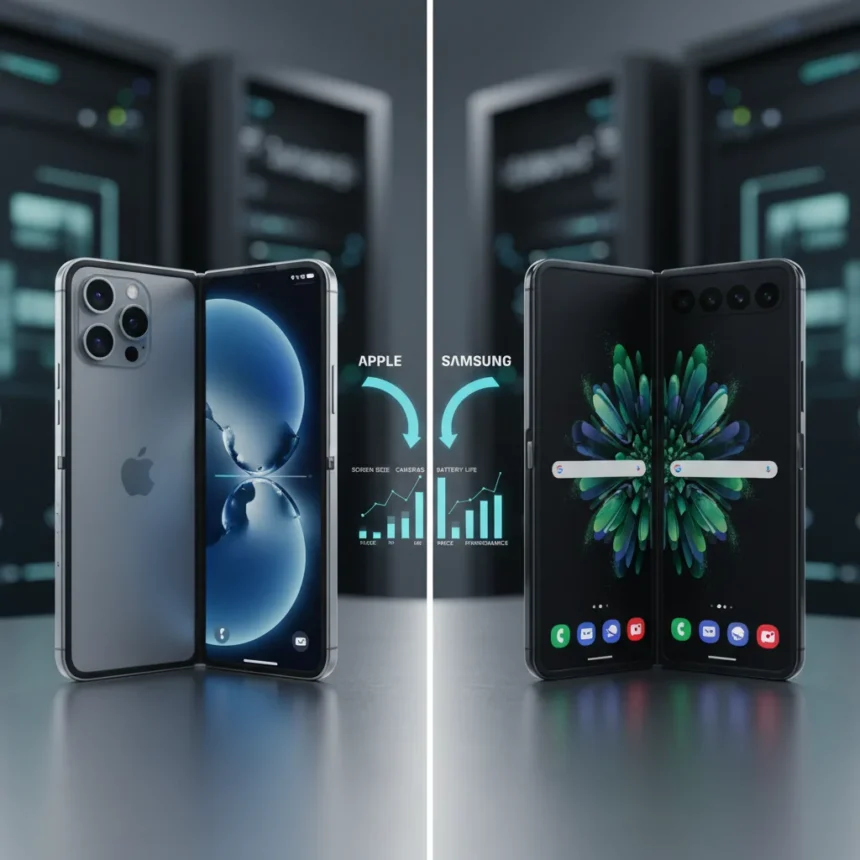
The iPhone Fold vs Galaxy Z Fold 8 battle is shaping up to be 2026’s most significant smartphone showdown. Apple’s rumored first foldable and Samsung’s next-generation Z Fold are poised to redefine what foldable phones can do—if the leaks prove accurate.
Key Takeaways
- iPhone Fold features a 7.8-inch inner display and 5.5-inch outer screen; Galaxy Z Fold 8 has an 8-inch inner display
- Both devices pursue crease-free displays using different technologies: Apple’s metal plate with liquid metal hinge versus Samsung’s fold-line reduction
- iPhone Fold rumored to launch September 2026 with A20 chip, Touch ID, and two rear cameras
- iPhone Fold measures 9.5mm folded and 4.5mm unfolded; Galaxy Z Fold 8 expected to use liquid-metal and titanium hinges
- Apple’s design philosophy emphasizes thinness and iPad mini-sized unfolded form factor versus Samsung’s wider display approach
Display Showdown: Size and Crease Technology
The iPhone Fold vs Galaxy Z Fold 8 begins with their screens. Apple’s rumored foldable will feature a 7.8-inch inner OLED display with a 4:3 wide aspect ratio—essentially iPad mini-sized when unfolded—paired with a 5.5-inch outer display. Samsung’s Galaxy Z Fold 8 will sport an 8-inch inner display, slightly larger than the iPhone Fold’s inner screen and matching the size of the Z Fold 7. This half-inch difference matters less than what each company claims to solve: the dreaded crease.
Both manufacturers are racing to eliminate or minimize the fold line. According to leaked information, the iPhone Fold uses a metal plate that disperses the bending pressure of the display combined with a liquid metal hinge for a creaseless appearance. The Galaxy Z Fold 8 focuses on improved fold-line reduction through its own liquid-metal and titanium hinge designs, though Samsung has years of foldable experience to build on. Neither device has shipped yet, so claims about crease-free technology remain unproven in production units.
Design and Thickness: Apple’s Thinness Advantage
The iPhone Fold vs Galaxy Z Fold 8 design philosophy diverges sharply. Apple’s rumored foldable will measure approximately 9.5mm thick when folded and just 4.5mm when unfolded, making it one of the thinnest book-style foldables ever designed. For context, the Oppo Find N5, currently the world’s thinnest foldable at around 4.2mm unfolded, sets a benchmark that the iPhone Fold would nearly match. When closed, the iPhone Fold resembles an iPhone mini in size—roughly 5.4 inches—a design choice revealed through case mold leaks.


Samsung’s Galaxy Z Fold 8 is expected to prioritize wider display shapes and material upgrades rather than dramatic thickness reductions. The Z Fold series has historically favored screen real estate over slimness, a trade-off that appeals to multitasking users but results in chunkier devices. The iPhone Fold’s pursuit of thinness aligns with Apple’s minimalist design language and suggests the company views portability as a key foldable advantage.
Performance and Features: A20 Chip Meets Established Foldable Experience
Apple’s iPhone Fold is rumored to pack the A20 chip, Apple’s latest processor, along with the company’s proprietary C2 modem. The device will feature Touch ID mounted on the side rather than under the display—a practical choice for a device with two screens. Camera setup includes two rear lenses, a conservative approach compared to flagship iPhones but appropriate for a first-generation foldable.



Samsung’s Galaxy Z Fold 8 will inherit years of foldable refinement. The Z Fold 7 already demonstrated how Samsung’s ecosystem handles large unfolded screens, though apps sometimes leave unused space on the 8-inch canvas. The Galaxy Z Fold 8 should improve software optimization for its wider displays, leveraging Samsung’s DeX ecosystem and years of foldable-specific tweaks. Neither device has confirmed pricing, though Galaxy Z Fold 8 is expected to cost more than its predecessor due to rising RAM prices.
The Timing Question: September 2026 Launch Window
The iPhone Fold vs Galaxy Z Fold 8 race hinges partly on launch timing. Apple’s rumored foldable is expected to debut in September 2026 alongside the iPhone 18 Pro models. Samsung has not confirmed Galaxy Z Fold 8 timing, but the foldable cycle typically aligns with the first half of the year, suggesting an earlier debut. This staggered launch could give Samsung a head start in the market, though Apple’s ecosystem integration and crease-free claims could offset any timing disadvantage.
Which Foldable Should You Wait For?
Predicting a winner between the iPhone Fold vs Galaxy Z Fold 8 is premature—all specs remain rumors sourced from analyst leaks and case molds rather than official confirmations. If crease-free technology works as advertised and the iPhone Fold’s thinness is real, Apple could disrupt a market Samsung has dominated for years. If the Galaxy Z Fold 8 refines its software experience and maintains its display size advantage, Samsung’s experience may prove decisive. The truth is that choosing between these devices depends entirely on ecosystem loyalty and whether you value Apple’s minimalist design philosophy or Samsung’s larger-screen approach.
Will the iPhone Fold actually be crease-free?
The iPhone Fold’s metal plate and liquid metal hinge are designed to disperse bending pressure, but no production unit has been tested yet. Crease-free claims are promotional until proven in real devices. Samsung has also pursued crease reduction for years without entirely eliminating the fold line, suggesting the problem is harder to solve than marketing suggests.



How much larger is the Galaxy Z Fold 8 inner display?
The Galaxy Z Fold 8’s 8-inch inner display is only 0.2 inches larger than the iPhone Fold’s 7.8-inch screen—a modest difference that matters more for app layout than for everyday usability. The real distinction lies in aspect ratio: the iPhone Fold’s 4:3 ratio is wider, while the Z Fold 8 likely maintains a taller, narrower shape.
When will the iPhone Fold launch?
Apple is rumored to announce the iPhone Fold in September 2026 alongside the iPhone 18 Pro lineup. Samsung’s Galaxy Z Fold 8 timing remains unconfirmed but is expected sometime in 2026 as part of the standard foldable refresh cycle. Until official announcements arrive, all launch dates remain speculation based on analyst forecasts and industry patterns.
The iPhone Fold vs Galaxy Z Fold 8 comparison reveals two fundamentally different approaches to foldable design. Apple prioritizes thinness, crease elimination, and ecosystem integration; Samsung emphasizes screen real estate and years of refined software. Both philosophies have merit, and the best choice depends on whether you value Apple’s minimalism or Samsung’s maximalist screen experience. For now, the real competition is between leaks and rumors—the actual devices won’t speak for themselves until 2026.
Edited by the All Things Geek team.
Source: Tom's Guide