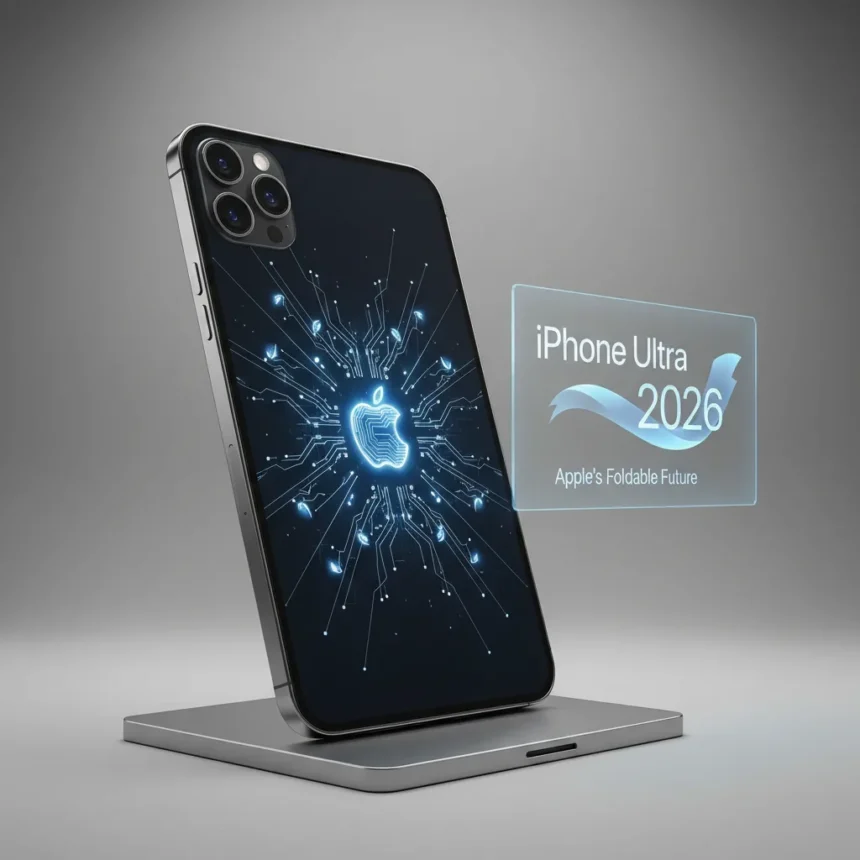
Apple’s first foldable iPhone may launch as iPhone Ultra, not iPhone Fold, according to leaks from Chinese sources claiming the company will differentiate from Samsung’s Galaxy Z Fold series with a premium branding strategy. The shift signals Apple’s confidence in pricing the device at $2,000–$2,500 when it arrives in fall 2026.
Key Takeaways
- Apple’s foldable iPhone expected to launch fall 2026 under iPhone Ultra branding, not iPhone Fold.
- Device features a wide, passport-sized cover screen and book-style foldable design to rival Samsung’s Galaxy Z Fold 8 Wide.
- Apple already uses Ultra branding for premium products: Apple Watch Ultra, M1 Ultra, M3 Ultra chips.
- Expected price range $2,000–$2,500 positions it as ultra-premium tier above iPhone Pro models.
- Android rivals considering matching Ultra rebrands for their wide foldables to compete with Apple’s entry.
Why iPhone Ultra Makes More Sense Than iPhone Fold
Apple has already established Ultra as its premium tier across hardware and silicon. The company uses Ultra branding for Apple Watch Ultra, M1 Ultra, M3 Ultra chips, and has signaled potential expansion to OLED MacBook and AirPods with cameras. Naming the foldable iPhone Ultra extends this ecosystem consistency rather than creating a confusing new product line.
Chinese leaker Digital Chat Station posted on Weibo in April 2026 that iPhone Ultra would be Apple’s official designation, breaking from years of media speculation about iPhone Fold. The naming choice also distances Apple from Samsung’s Galaxy Z Fold series, which has owned the Fold terminology since 2019. By claiming Ultra, Apple signals a different product philosophy: not a folding phone, but a premium category unto itself.
The device will feature an unconventionally wide cover screen in a passport-sized format, according to dummy unit leaks. This design differs fundamentally from Samsung’s narrower cover displays, justifying a distinct name rather than a direct Fold comparison.


The iPhone Duo Alternative and Why It Lost Out
Not everyone agrees iPhone Ultra is the right choice. Zac Hall of 9to5Mac proposed iPhone Duo as a stronger name, referencing Apple’s MagSuite Duo accessory and the device’s 2-in-1 form factor. Hall argued the name captures the spirit of the product better than Ultra, which implies top-tier specifications across the board.
Critics on MacRumors noted that Ultra suggests the best performance in every category, which the foldable iPhone may not deliver if its camera system or processor remains tied to standard iPhone Pro specifications. If Apple’s foldable uses the same chip as the iPhone Pro line, calling it Ultra could feel like marketing overreach rather than honest product positioning.



Still, Hall’s Duo proposal faced its own skepticism. The name risks confusion with Google’s Pixel Fold and Samsung’s Galaxy Z Fold, making it less distinctive in a crowded market. Ultra, while potentially misleading on specs, at least carves out a unique brand space for Apple’s entry into foldables.
How Android Rivals Are Reacting to iPhone Ultra
Samsung, OnePlus, OPPO, and vivo currently dominate the foldable market with devices carrying names like Galaxy Z Fold, OnePlus Open, and OPPO Find N. None of these brands use Ultra branding for their wide foldables. Apple’s iPhone Ultra announcement could trigger a rebranding wave among Android manufacturers seeking to compete at the premium tier.
If Android brands adopt Ultra for their own wide foldables, the market could fragment into Ultra-branded models at varying price points. Apple’s $2,000–$2,500 positioning would establish Ultra as a high-end tier, but competitors might undercut by offering Ultra models at $1,500–$1,800, diluting the brand prestige. This mirrors what happened with Pro and Max naming across the industry after Apple’s success with those tiers.
What the Wide Design Means for the iPhone Ultra Foldable
The iPhone Ultra will not be a traditional flip phone like Samsung’s Galaxy Z Flip. Instead, it adopts a book-style form factor with an unusually wide cover screen, making it more similar to a passport when folded. This design choice addresses a key complaint about Samsung’s Galaxy Z Fold: the narrow cover display limits usability for single-handed operation.



Apple’s wider cover screen should enable better typing, web browsing, and app navigation without requiring the full unfolded display. This architectural advantage justifies premium pricing and distinguishes the device from Samsung‘s narrower approach. The design philosophy suggests Apple views the foldable as a productivity device first, not merely a novelty form factor.
Expected Price and Launch Timeline
The iPhone Ultra foldable is expected to arrive in fall 2026 at $2,000–$2,500. This positions it above the iPhone Pro Max, which typically starts around $1,200. Apple has not confirmed regional availability details, but a global rollout is standard for flagship products. The price point assumes no major cost reductions between now and launch, though manufacturing improvements could shift the range downward.
Fall 2026 gives Apple roughly 18 months to finalize design, software integration, and supply chain logistics. Samsung’s Galaxy Z Fold 8 Wide is expected to arrive around the same timeframe, setting up a direct premium foldable rivalry. Whoever launches first may capture early adopter demand, making the 2026 fall window critical for both companies.
Is iPhone Ultra the final name or just another rumor?
Digital Chat Station’s Weibo leak carries credibility in the Apple supply chain community, but final product names often change between Chinese manufacturing sources and Apple’s US marketing team. The company could shift to iPhone Duo, a completely different name, or stick with Ultra closer to launch. Until Apple officially announces, all names remain speculation.
Could Apple use a different name entirely?
Possible alternative names include iPhone Fold (despite market differentiation concerns), iPhone Duo (proposed by 9to5Mac), or an entirely unexpected designation like MacBook Neo. Apple’s naming strategy for new product categories sometimes defies analyst predictions—the iPad, Apple Watch, and HomePod all arrived without heavy pre-launch name leaking. The iPhone Ultra rumor is credible but not confirmed.
How much will the iPhone Ultra foldable cost compared to iPhone Pro Max?
The iPhone Ultra is expected to cost $2,000–$2,500, roughly $800–$1,300 more than the iPhone Pro Max. This premium reflects the foldable’s new technology, durability engineering, and position as Apple’s flagship innovation device. Whether that price premium justifies the form factor depends on consumer demand for larger unfolded displays and productivity gains.
Apple’s decision to brand its first foldable as iPhone Ultra signals a strategic shift toward premium segmentation. By anchoring the name to existing Ultra products across its ecosystem, Apple can justify aggressive pricing while distancing itself from Samsung’s Fold legacy. Whether the name sticks until fall 2026 remains uncertain, but the iPhone Ultra branding strategy reveals Apple’s confidence that foldables represent the next premium tier, not a niche experiment.
Edited by the All Things Geek team.
Source: Tom's Guide