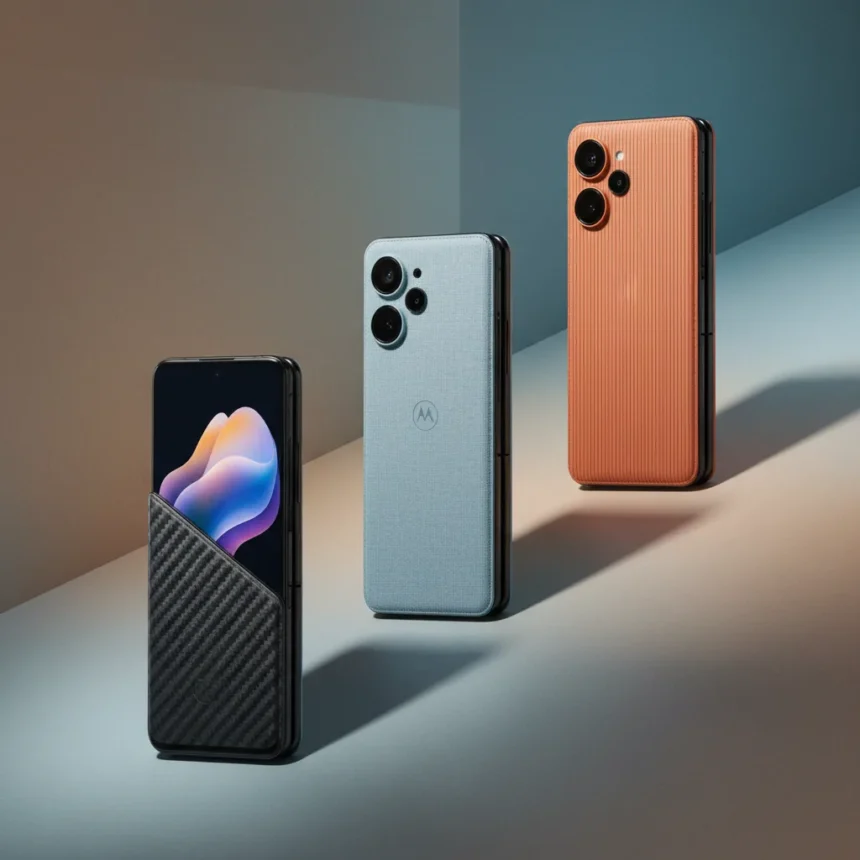
The Moto Razr 2026 textures are shaping up to be far more ambitious than standard color options, with leaked details revealing that each finish will feel distinctly different in hand. Motorola’s entry-level foldable—known as the Razr 70 internationally—is preparing to blur the line between gadget and lifestyle accessory by pairing Pantone color partnerships with tactile finishes that go beyond traditional plastic or metal backs.
Key Takeaways
- Moto Razr 2026 textures include carbon-fiber, fabric-like, and brushed finishes across three leaked colors
- Pantone Hematite features a warm gray fabric finish described as feeling like a premium hoodie
- Pantone Sparkling Green offers a carbon-fiber-like texture for a sportier aesthetic
- Pink variant uses a softer, brushed finish targeting lifestyle-conscious buyers
- Motorola controls roughly 50% of North America’s foldable market per IDC
Moto Razr 2026 textures redefine budget foldable aesthetics
The Moto Razr 2026 textures mark a deliberate shift away from the eco-leather backs featured on the 2025 model. Instead of uniform finishes, each color now carries its own tactile personality. Pantone Hematite arrives with a fabric-like texture described as warm gray, evoking the soft feel of a premium hoodie—a deliberate nod to lifestyle branding rather than pure tech spec chasing. This approach treats the phone’s exterior as a fashion statement, not an afterthought.
Pantone Sparkling Green leans into performance aesthetics with a carbon-fiber-like texture, appealing to users who want their phone to signal durability and sportiness. The third leaked color, a pink variant, adopts a brushed or softer finish altogether, positioning itself as the lifestyle-oriented option for buyers prioritizing feel over industrial appearance. The decision to vary textures rather than just colors is uncommon in the budget foldable segment, where most manufacturers treat color variants as cosmetic-only changes.
How Moto Razr 2026 textures compare to competitors
Most foldable competitors at this price point—including Samsung’s entry-level offerings—rely on uniform finishes across color variants. The Moto Razr 2026 textures strategy differs fundamentally by making tactile experience a selling point rather than a spec. This positions Motorola’s device as a fashion-forward alternative in a category typically dominated by raw performance comparisons. The Razr Ultra 2026, Motorola’s premium foldable sibling, takes a different approach with a thicker design and separate feature set, leaving the texture differentiation as an entry-level innovation.


Motorola’s market position supports this bet on differentiation. The company controls roughly 50% of North America’s foldable market, giving it room to experiment with design philosophy rather than chase specifications. By introducing Pantone partnerships and distinct finishes, Motorola is betting that texture matters as much as color to buyers shopping for an affordable foldable.
Moto Razr 2026 textures specs and availability
Beyond the textures, the Razr 2026 is expected to arrive with 8GB RAM and 256GB storage as the entry configuration, scaling up to 18GB RAM and 1TB for buyers wanting maximum capacity. The inner display measures 6.9 inches with a 1080×2640 OLED panel, while the cover screen spans 3.63 inches at 1056×1066 resolution. A 2.75GHz octa-core processor handles processing duties, though the specific chipset remains unconfirmed.



The Moto Razr 2026 textures and specs suggest no major redesign from the Razr 70 international variant, meaning the US and global versions are essentially identical. Launch timing remains unconfirmed, though the accelerating leak pace suggests availability is not far off. Motorola has not announced official pricing, but the entry-level positioning and texture-focused marketing hint at competitive positioning against Samsung’s Galaxy Z Flip series.
Why texture matters more than you think
Foldables spend significant time closed, meaning the back finish is what users actually touch most of the day. By making Moto Razr 2026 textures distinct, Motorola is acknowledging that daily tactile experience shapes perception of value and quality. A carbon-fiber feel signals durability; a fabric-like finish suggests premium lifestyle appeal; a brushed surface reads as refined and understated. This is smart segmentation without requiring different internal hardware—the same processor, display, and battery ship in all three variants, but each feels like a different product category.
This strategy also sidesteps the specification arms race that dominates mid-range foldables. Rather than competing on processor speed or RAM alone, Motorola is competing on how the phone feels, a dimension that cannot be easily benchmarked or copied without significant industrial design investment.
Will Moto Razr 2026 textures justify the foldable premium?
Texture differentiation alone cannot excuse the typical foldable price premium over traditional phones. However, for buyers already committed to the foldable form factor, the distinction between a fabric-like Hematite and a carbon-fiber Sparkling Green could be the deciding factor between models. Motorola’s strategy assumes that texture-conscious buyers exist—and that they value lifestyle positioning over raw specs. For a company holding half the North American foldable market, that assumption is not unreasonable.



Are all three Moto Razr 2026 colors confirmed?
The three leaked colors—Pantone Hematite, Pantone Sparkling Green, and pink—come from leaks reported by YTECHB and other sources, not official Motorola announcements. Pantone Sparkling Green has not been verified on Motorola’s or Pantone’s official sites, so additional colors or naming changes remain possible before launch. Pink is listed as a non-Pantone variant, suggesting it may carry a different branding approach.
What makes Moto Razr 2026 textures different from previous models?
The 2025 Razr relied on eco-leather backs, a material choice that emphasized sustainability and premium feel but offered limited variation across colors. The 2026 model abandons that approach entirely, embracing carbon-fiber, fabric, and brushed finishes instead. This shift signals Motorola’s intent to position the Razr line as a fashion-forward product category rather than a purely functional device.
The Moto Razr 2026 textures strategy is a calculated bet that tactile experience, paired with Pantone color partnerships, can differentiate an entry-level foldable in a crowded market. Whether buyers care enough about how their phone feels to justify the foldable premium remains the real question—but for Motorola, betting on texture is a smarter move than chasing specs it cannot match at this price point.
Edited by the All Things Geek team.
Source: Android Central