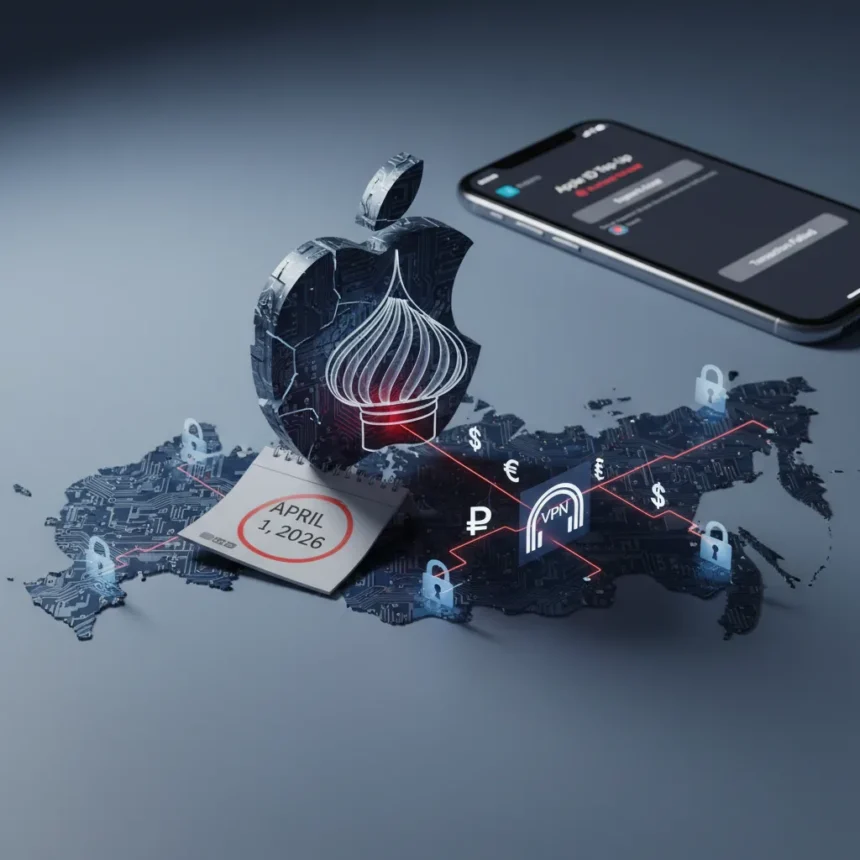
Russia Apple ID payments are now effectively cut off for millions of iPhone users after the Kremlin ordered major mobile operators to disable top-ups via phone balance starting April 1, 2026. The move represents an escalation in Moscow’s digital sovereignty push and a direct attack on VPN services, which reportedly account for over 80% of such mobile balance transactions.
Key Takeaways
- Russia Apple ID payments via mobile balance disabled from April 1, 2026, by government order
- Four major operators (MTS, Beeline, T2 Mobile, MegaFon) instructed during March 28, 2026 meeting with Minister Maksut Shadayev
- VPN services represent over 80% of these mobile balance transactions
- Users can still top up in advance via the Apple Store app
- Kremlin aims to pressure Apple into restoring Russian apps, installing RuStore, and complying with antitrust decisions
How Russia Apple ID Payments Became a Geopolitical Weapon
The Kremlin’s targeting of Russia Apple ID payments is not a random technical adjustment—it is a calculated pressure campaign. By cutting off a key payment channel, Russian authorities are attempting to make VPN access expensive and inconvenient, effectively throttling the tools that Russian citizens use to bypass state internet restrictions. The government instructed operators MTS, Beeline, T2 Mobile, and MegaFon to disable the service, with some operators already sending SMS warnings to users to top up their Apple ID balances in advance.
This move follows years of tension between Apple and the Russian government. Apple exited the Russian market in 2022 following international sanctions, but parallel iPhone imports have continued. The Kremlin has grown increasingly frustrated with Apple’s reluctance to comply with local demands, and cutting off Russia Apple ID payments is the latest lever in a broader campaign to force compliance. According to government sources, the temporary restrictions on mobile operators may encourage Apple to comply, as the lost revenue would otherwise be too significant.
The distinction between RuStore—Russia’s homegrown app marketplace—and the Apple App Store is crucial here. Russian authorities are pushing RuStore as a nationalist alternative, and they view Apple’s resistance to installing it as an act of defiance. By disabling Russia Apple ID payments, the Kremlin hopes to create enough economic pressure that Apple will capitulate and integrate RuStore into the iPhone ecosystem.


What Russia Apple ID Payments Disruption Means for VPN Users
For VPN users in Russia, the blocking of Russia Apple ID payments via mobile balance creates a genuine friction point. Previously, users could pay for VPN subscriptions through their phone bill—a seamless, low-friction transaction. Now, they must plan ahead and top up their Apple ID balances directly through the App Store app, which requires either a credit card, an existing balance, or advance payment.
The government’s own data suggests VPN payments account for more than 80% of mobile balance transactions to Apple ID accounts. This statistic, while unverified by independent sources, illustrates the Kremlin’s primary target: cutting off funding for tools that circumvent state censorship. The irony is sharp—by disrupting legitimate Apple service payments, the Kremlin is also harming users who pay for apps, games, cloud storage, and other Apple services that have nothing to do with VPNs.


Users who have already topped up their balances can continue using those funds. The operators began warning customers to do exactly this in the days leading up to April 1, 2026. But for new users and those whose balances deplete, the pathway to payment has narrowed considerably.
The Broader Digital Sovereignty Agenda Behind Russia Apple ID Payments Restrictions
Russia’s assault on Russia Apple ID payments is part of a much larger campaign to seize control of the digital ecosystem. The Kremlin is not satisfied with merely blocking VPN payments—it is demanding that Apple restore Russian apps to the App Store, install RuStore as a competing marketplace, comply with antitrust decisions, and allow alternative payment methods. These demands reflect a fundamental conflict: Russia wants to control what software runs on iPhones sold within its borders, and Apple wants to maintain a global App Store with consistent rules.
The government has also set an October 31, 2026 deadline for Apple to make Russian search engines the default on iPhones, with threats of fines or phased import bans if the company refuses. This deadline and the Russia Apple ID payments restriction are two parts of the same coercive strategy. Moscow is systematically closing off avenues through which Apple can operate independently in Russia, betting that economic pressure will force compliance.
Compared to RuStore, which Russian authorities position as a sovereign alternative, the Apple App Store represents a foreign-controlled gateway that the Kremlin cannot fully regulate. By disabling Russia Apple ID payments, Moscow is attempting to make that gateway less attractive and less functional. The Kremlin’s logic is transactional: if Apple loses enough revenue in Russia, it will eventually agree to hand over control.



Can Apple Survive Without Russia Apple ID Payments?
From Apple’s perspective, Russia represents a marginal market in global terms. The company exited officially in 2022, and the Russia Apple ID payments channel was never as significant to Apple’s bottom line as it might be to Russian users. However, the precedent is dangerous. If the Kremlin successfully forces Apple to capitulate through economic coercion, other governments will follow. The Russia Apple ID payments blockade is a test case for state power over tech platforms.
Apple’s options are limited. The company could theoretically negotiate with the Kremlin, but doing so would mean accepting RuStore integration, complying with antitrust decisions Apple disputes, and restoring apps the company removed for legal reasons (often VPNs flagged as illegal under Russian law or payment services hit by US sanctions). Alternatively, Apple could accept the loss of the Russia Apple ID payments channel and continue operating with reduced functionality in the market. Neither option is attractive.
What Happens to Users Who Can’t Top Up?
For iPhone users in Russia who do not top up their Apple ID balances before April 1, 2026, the practical impact is straightforward: they cannot purchase apps, pay for subscriptions, or access any paid Apple services through their phone bills. They must use credit cards, which many Russian citizens do not have due to international sanctions on Russian banks. This creates a second-order effect: Russia Apple ID payments restrictions effectively exclude a portion of the population from Apple’s ecosystem entirely.
Users who already have balances can continue using them. Operators like MTS and Beeline began sending advance warnings, allowing savvy users to top up for months or even a year in advance. But this workaround is temporary. Once those balances are spent, users face the same friction.
Will Other Countries Follow Russia’s Lead on Apple ID Payments?
The Russia Apple ID payments blockade raises a concerning question: will other governments attempt similar tactics? Countries with strong state control over telecommunications—China, Iran, North Korea—could theoretically apply the same pressure. The Kremlin is essentially demonstrating that a government can weaponize payment infrastructure to coerce tech platforms into compliance. If the strategy succeeds, expect imitators.
FAQ
Can Russian iPhone users still buy apps and subscriptions after Russia Apple ID payments are disabled?
Yes, but only through the Apple Store app directly, using credit cards or existing balances. Mobile balance top-ups are no longer available. Users can top up their Apple ID balances in advance through the app before their current balance depletes.
Why is the Kremlin targeting VPN payments specifically?
VPNs allow Russian users to bypass state internet censorship and access blocked websites and services. By disabling Russia Apple ID payments, which reportedly account for over 80% of VPN subscription transactions, the government aims to make VPNs more expensive and inconvenient to use.
Does the Russia Apple ID payments ban affect users outside Russia?
No. The restriction applies only to mobile balance top-ups within Russia. iPhone users in other countries can continue using mobile balance payments as usual.
The Russia Apple ID payments blockade is a watershed moment in the conflict between state power and tech platforms. By surgically cutting off a key payment channel, the Kremlin has demonstrated that it can inflict real economic pain on Apple without formally banning the company. Whether Apple will capitulate or hold firm remains unclear, but the precedent is now set: governments can weaponize payment infrastructure to force compliance. For Russian users, the immediate impact is friction and inconvenience. For Apple, it is a test of whether the company will defend its global principles or negotiate with state pressure on a market-by-market basis.
Edited by the All Things Geek team.
Source: TechRadar