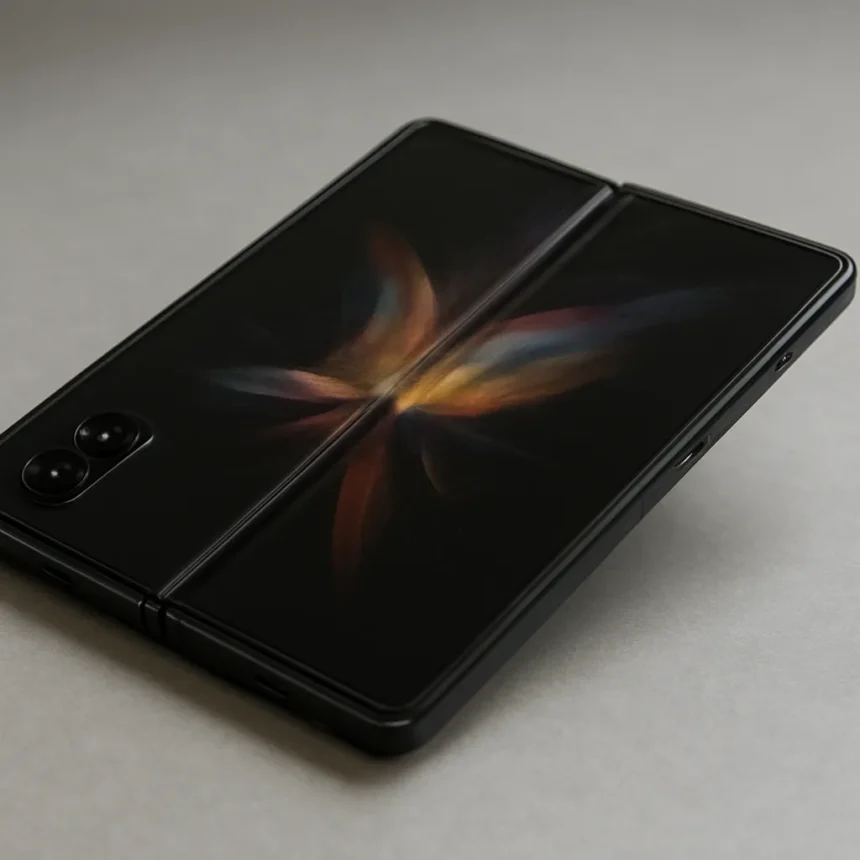
Samsung Galaxy Z TriFold is dead. The company’s ambitious first trifold smartphone, which launched in South Korea in late 2025 and reached the US in January 2026, is being pulled from shelves after just three months. Final restocks are happening this week in South Korea, and US sales will continue only until current inventory depletes—likely one or two more restock windows at most. No successor is planned for 2026.
Key Takeaways
- Samsung Galaxy Z TriFold launched in South Korea December 2025, US January 2026; sales ending after three months
- Price of $2,899 USD for base model positioned it as ultra-premium proof-of-concept, not mass-market device
- Sold out within minutes on every restock despite high cost; buyers paid up to 3x the price on secondhand markets
- Production costs and component shortages made the device unprofitable at Samsung’s asking price
- No Galaxy Z TriFold 2 planned; Samsung continuing with Z Fold 7, Z Flip 7, and other mainstream foldables instead
Why Samsung Is Killing the Galaxy Z TriFold
The Samsung Galaxy Z TriFold was always meant to be a limited experiment, not a sustainable product line. Samsung never positioned it as a mass-market phone—it was a proof-of-concept for what three-screen foldables could become. But the economics simply didn’t work. High production costs combined with RAM and storage component shortages tightened margins to the breaking point. At $2,899, Samsung was already asking customers to pay more than double the price of a flagship Galaxy S26, and the company still couldn’t make money on each unit sold.
The device’s architecture made manufacturing nightmares inevitable. A 6.5-inch external display, a 10-inch unfolded screen, and custom Snapdragon 8 Elite silicon meant Samsung had to source rare components in limited quantities while managing three separate display panels. Every unit required precision assembly that didn’t scale. Korean media reported that production constraints and the sheer complexity of the hinge mechanism made the TriFold a financial drain despite strong demand.
Demand Was Never the Problem—Supply and Profit Were
Here’s the irony: the Samsung Galaxy Z TriFold sold out instantly. Initial South Korean allocations of 3,000 units each vanished within minutes. Buyers couldn’t get them fast enough. On secondhand markets, the phone commanded prices up to three times its retail cost, with some units reselling for $8,000 or more. That kind of scarcity premium usually signals a hit product. But for Samsung, it was a warning sign.


Sellouts don’t equal profitability. When a device is so expensive and so hard to make that you lose money on each sale—even at $2,899—inventory velocity becomes irrelevant. Samsung’s decision to end production reflects a hard truth: the company would rather kill a hot product than keep hemorrhaging cash on it. The Samsung Galaxy Z TriFold was available only directly from Samsung, with no carrier or retailer partnerships, which limited distribution but also meant Samsung absorbed the full manufacturing cost on every unit.
Samsung’s Foldable Future Doesn’t Include Trifolds
Samsung isn’t abandoning foldables. The company is doubling down on the Z Fold and Z Flip lines instead, with the Z Fold 7, Z Flip 7, and upcoming Z Flip 8 and Z Fold 8 already in development. These phones are easier to manufacture, cheaper to produce, and have proven market demand at more reasonable price points. A new wide foldable is also rumored, possibly to compete with an eventual Apple foldable, but the three-screen format is being shelved indefinitely.



The Samsung Galaxy Z TriFold’s failure—if you can call a sold-out product a failure—suggests that even enthusiasts have limits. A $2,899 phone with no carrier support, limited availability, and unproven long-term durability was always going to be a niche curiosity. Samsung learned that lesson faster than expected and is pivoting to proven form factors where margins are healthier and manufacturing is simpler.
Is the Galaxy Z TriFold Worth Buying Before It’s Gone?
If you can still find one, the Samsung Galaxy Z TriFold is genuinely impressive hardware: 16GB of RAM, up to 1TB of storage, and Samsung DeX support for workstation-mode computing make it a powerful device. But at $2,899, you’re paying for exclusivity and engineering braggadocio, not everyday utility. The three-screen format is cool but impractical for most tasks. A Z Fold 7 will do 95 percent of what the TriFold does for half the price.
When will Samsung release the Galaxy Z TriFold 2?
Samsung has confirmed no Galaxy Z TriFold 2 is in development for 2026. The three-screen format is shelved. The company is focusing on the Z Fold and Z Flip lines, which remain profitable and easier to manufacture.
Can you still buy the Samsung Galaxy Z TriFold?
The Samsung Galaxy Z TriFold is still available through Samsung’s official website while inventory lasts, but stock is extremely limited. South Korea’s final restock happened around March 17, 2026. US sales will continue until the current production batch sells out, which Samsung estimates will take one or two more restocks. You can sign up for restock alerts on Samsung’s site, but availability is not guaranteed.



What specs does the Galaxy Z TriFold have?
The Samsung Galaxy Z TriFold features a 6.5-inch external display, a 10-inch unfolded screen, a custom Snapdragon 8 Elite processor, 16GB of RAM, up to 1TB of storage, a 5600mAh battery, and Samsung DeX support. It was designed as a workstation-capable flagship, not a mainstream phone.
The Samsung Galaxy Z TriFold’s three-month lifespan is a cautionary tale for the entire premium smartphone industry. Revolutionary hardware means nothing if the economics don’t work. Samsung proved that even a sold-out, critically acclaimed device can be killed if profit margins evaporate. For buyers who missed out, the lesson is clear: sometimes the most interesting phones aren’t the ones worth waiting for.
Edited by the All Things Geek team.
Source: Tom's Guide