





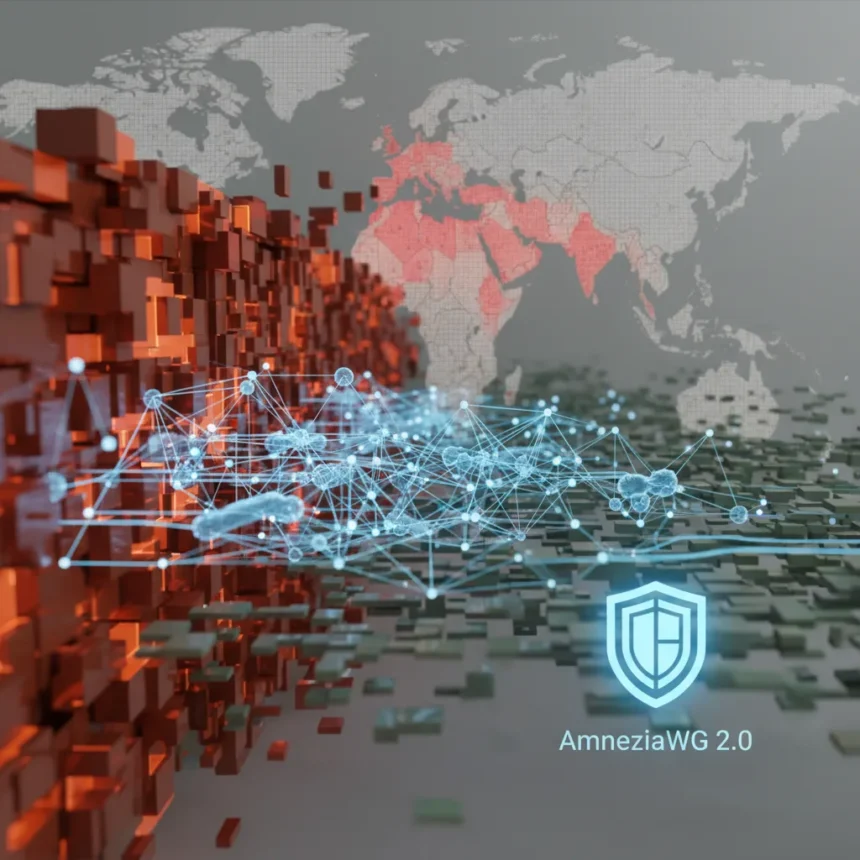
AmneziaWG 2.0 protocol is a modified WireGuard fork designed to defeat deep packet inspection and VPN blocking in the world’s most censored internet regions. As governments deploy smarter DPI systems to detect and block encrypted tunnels, Amnezia VPN’s latest obfuscation layer disguises traffic as ordinary UDP packets—keeping the speed advantage WireGuard is known for while hiding the fact that you are using a VPN at all.
Key Takeaways
- AmneziaWG 2.0 obfuscates VPN traffic to evade DPI in China, Iran, Turkmenistan, and other heavily censored regions.
- The protocol modifies packet headers, randomizes handshake sizes, and disguises traffic as popular UDP protocols.
- Backwards compatible with standard WireGuard when specific parameters are set to zero.
- Retains WireGuard’s speed advantage—1.5-2x faster than OpenVPN on compatible hardware.
- Amnezia VPN remains free and open-source with no registration or traffic limits required.
How AmneziaWG 2.0 Defeats Censorship Systems
The core innovation of AmneziaWG 2.0 protocol lies in multi-layer obfuscation that makes encrypted VPN traffic indistinguishable from normal network activity. Rather than sending recognizable WireGuard handshake packets, the protocol modifies packet headers, randomizes the size of handshake messages, and disguises the entire data stream to resemble popular UDP protocols. This approach works because censors cannot block all UDP traffic without breaking legitimate applications—video streaming, online gaming, DNS queries all rely on UDP.
The obfuscation technique also inserts junk packets before the actual handshake begins and embeds junk data within handshake exchanges themselves. These decoys force DPI engines to spend computational resources analyzing noise, making it economically impractical to inspect every packet in real time. When combined with user-defined obfuscation types, the protocol becomes a moving target that adapts to each deployment’s specific censorship landscape.
Governments have invested heavily in DPI technology precisely because basic VPN blocking failed—users simply switched protocols. AmneziaWG 2.0 protocol escalates the arms race by hiding not just the encryption keys but the fact that encryption is happening at all.


Speed Without Sacrificing Stealth
Most obfuscated VPN protocols trade performance for evasion. OpenVPN, the industry standard for censored regions, runs on TCP and adds overhead that slows throughput significantly. AmneziaWG 2.0 protocol avoids this penalty because it builds on WireGuard’s lean, modern design. Testing on Firewalla Gold hardware showed AmneziaWG running 1.5-2x faster than OpenVPN while simultaneously hiding from DPI systems.
This speed advantage matters in regions with already-limited bandwidth. Users in Iran or China cannot afford to lose half their connection speed just to access blocked websites. AmneziaWG 2.0 protocol lets them browse, stream, and work at near-native speeds while remaining invisible to censorship infrastructure.



Backwards Compatibility and Configuration
AmneziaWG 2.0 protocol remains backwards compatible with standard WireGuard if you set specific parameters to disable obfuscation: S1=0, S2=0, H1=1, H2=2, H3=3, H4=4. This flexibility allows administrators to run a single protocol stack that adapts to network conditions. If a user connects from an uncensored region, the protocol operates as standard WireGuard. The moment they move to a censored network, obfuscation activates.
For advanced deployments, parameters like Jc=3 (junk packet count), Jmin=50 (minimum junk size), Jmax=1000 (maximum junk size), and custom header values can be added directly to WireGuard configuration files. This granular control lets network administrators fine-tune obfuscation intensity based on the specific DPI tactics they face.
Real-World Adoption: NymVPN and Beyond
NymVPN, a privacy-focused VPN service, upgraded its Fast Mode to use AmneziaWG 2.0 protocol by default in 2025, providing private and unrestricted access to the internet for users in heavily monitored regions. This adoption signals that obfuscated protocols are moving from niche tools to mainstream privacy infrastructure.
Amnezia VPN itself supports AmneziaWG 2.0 protocol alongside OpenVPN, Shadowsocks, IKEv2, and Cloak—giving users multiple protocol options depending on which censorship tactics their ISP deploys. The service remains free and open-source, requiring no registration and imposing no traffic limits, making it accessible to users in regions where paid VPN subscriptions are blocked or unaffordable.



Clients include the official AmneziaWG app for Android, WG Tunnel (a third-party implementation), and the Amnezia VPN app itself, with source code publicly available on GitHub. This transparency is crucial for users in adversarial environments who need to audit the code themselves.
Comparing AmneziaWG 2.0 to Standard WireGuard
Standard WireGuard excels at speed and simplicity but offers zero obfuscation—it is trivial for a DPI system to identify and block. OpenVPN provides obfuscation through tools like Obfsproxy but at the cost of throughput. AmneziaWG 2.0 protocol splits the difference: it obfuscates like OpenVPN while maintaining WireGuard’s performance envelope.
The tradeoff is complexity. Configuring AmneziaWG 2.0 protocol requires understanding obfuscation parameters and how they interact with specific censorship systems. For users in uncensored regions, standard WireGuard remains the better choice. For users in China, Iran, Turkmenistan, or similar environments, AmneziaWG 2.0 protocol is not optional—it is the only WireGuard variant that works.
What Does AmneziaWG 2.0 Protocol Actually Hide?
AmneziaWG 2.0 protocol hides three things: the fact that you are using a VPN, the destination you are connecting to, and the content you are transmitting. It accomplishes this by disguising VPN packets as ordinary UDP traffic, which is ubiquitous on every network. A DPI engine scanning for VPN signatures finds nothing to block because the traffic looks like video streaming or gaming—activities that cannot be censored without breaking the entire internet.
Is AmneziaWG 2.0 Protocol Truly Uncensorable?
No technology is uncensorable forever. Governments continuously evolve their DPI tactics, and AmneziaWG 2.0 protocol will eventually face new countermeasures. However, the protocol’s design—with user-defined obfuscation parameters and junk packet randomization—allows rapid iteration. When censors identify a new attack, administrators can adjust configuration values and redeploy without waiting for a software update. This agility is why obfuscation-based protocols survive longer than static VPN implementations.
How Do I Use AmneziaWG 2.0 Protocol?
Download Amnezia VPN or NymVPN, enable Fast Mode (which defaults to AmneziaWG 2.0 protocol), and connect. For self-hosted deployments, enable AmneziaWG via environment variables in wg-easy, which auto-detects the kernel module or falls back to standard WireGuard. Configuration files support advanced obfuscation tuning for users who need fine-grained control.
Can I Use AmneziaWG 2.0 Protocol Outside Censored Regions?
Yes. AmneziaWG 2.0 protocol works everywhere, though obfuscation adds minimal overhead in uncensored networks where it is unnecessary. The protocol remains backwards compatible with standard WireGuard, so you can disable obfuscation features and run it as a standard tunnel. Most users outside heavily censored regions prefer standard WireGuard for its simplicity.
AmneziaWG 2.0 protocol represents the current frontier in the ongoing battle between privacy advocates and censorship infrastructure. It is not a silver bullet—no VPN protocol is—but it shifts the cost-benefit calculation in favor of users. By making VPN detection computationally expensive and obfuscation parameters user-configurable, it forces censors to choose between blocking legitimate traffic or allowing VPN use. In regions where internet freedom is under siege, that choice is everything.
Edited by the All Things Geek team.
Source: TechRadar




