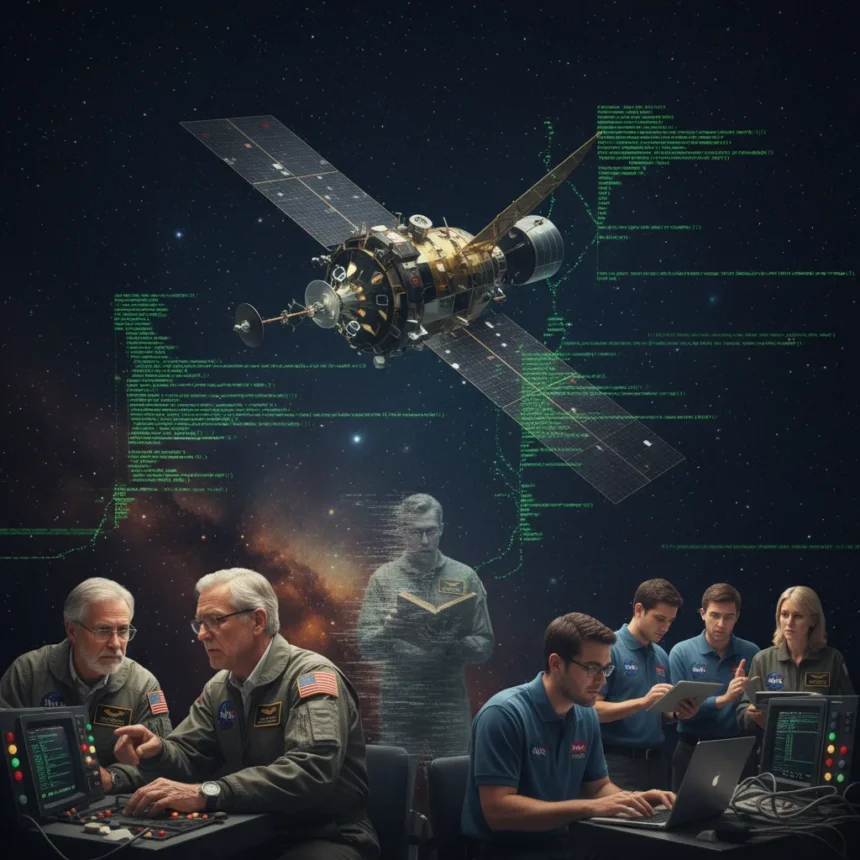
Voyager spacecraft code maintenance has become a quiet crisis at NASA, but not for the reason most people think. The popular narrative—that a handful of elderly engineers are the last humans alive who understand an impossibly archaic programming language—is a simplification that obscures a far more urgent problem: institutional memory is evaporating faster than anyone can document it.
Key Takeaways
- Voyager runs on assembly language written for custom General Electric processors designed in the early 1970s, not an unreadable alien code.
- Suzanne Dodd, a NASA Voyager program leader, stated in early 2024 that “the people that built the spacecraft are not alive anymore.”
- The current JPL Voyager flight team is small, and most members are not octogenarians, contrary to popular belief.
- The critical succession window is the next decade; after that, the question becomes academic because the spacecraft themselves will be gone.
- Much original documentation was paper-based and has been lost or fragmented as project offices relocated over five decades.
The Real Problem: Lost Documentation and Fading Memory
Voyager spacecraft code maintenance is not fundamentally about the programming language. Assembly code, while specialized, is learnable. The actual crisis is institutional amnesia. Much of the original Voyager documentation from the 1970s and 1980s was stored on paper. When project offices moved, some records vanished. Others sit in archives, unindexed and difficult to locate. Suzanne Dodd described the effort to recover these materials as “this archaeology dig to get documents”—a phrase that captures the reality more accurately than headlines about “unreadable code.”
The Voyager spacecraft code maintenance challenge stems from a generation gap in engineering expertise. Fluency in assembly language on custom hardware is no longer routine training in computer science programs. Younger engineers are certainly capable of learning it, but many are less inclined to invest in mastering a language for a mission with a defined endpoint. The spacecraft themselves will eventually fail. Once they do, the urgency to preserve this knowledge disappears.
The Succession Crisis Accelerates Over the Next Decade
NASA can still call on a list of retired engineers when problems arise, but that roster shrinks every year. The Voyager spacecraft code maintenance burden falls on a small flight team at JPL, and the institutional knowledge required to interpret incomplete documentation, understand design decisions made fifty years ago, and modify or troubleshoot the code is concentrated in fewer people than the mythology suggests. The current team is not mostly composed of engineers in their 80s—but the original designers, many of whom have passed away, left behind a gap that cannot simply be filled by hiring someone fluent in assembly language.


The next decade represents the critical window. After that, the question becomes whether Voyager maintenance even matters. The spacecraft have been operating far beyond their original mission timeline. Eventually, systems will fail beyond repair, and the Voyager spacecraft code maintenance problem will resolve itself through obsolescence. But until then, the loss of context—the understanding of why certain decisions were made, what workarounds exist, where the tricky parts of the code are—represents a genuine risk to mission continuity.
Why Voyager Spacecraft Code Maintenance Matters Now
Voyager 1 and Voyager 2 are humanity’s most distant spacecraft, still transmitting data from the edge of interstellar space. They represent an extraordinary achievement in engineering longevity. The code running on those custom General Electric processors has proven more reliable than many modern systems. But reliability does not mean immortality. When problems occur—and they do—the flight team must diagnose and fix them remotely, often working with incomplete or fragmented documentation. A younger engineer tasked with this work faces not just a learning curve in assembly language, but a deeper challenge: reconstructing the context and intent behind code written by people who are no longer alive to explain their choices.



This is not a problem unique to Voyager. Legacy software maintenance across industries faces similar succession challenges. But Voyager is uniquely visible and uniquely consequential. The spacecraft are not just systems to be maintained; they are monuments to a particular era of engineering and exploration. Losing the ability to understand and preserve their code represents a loss of institutional knowledge that extends beyond the technical.
What Happens When the Experts Are Gone?
NASA is aware of the problem. The agency has begun efforts to document and preserve knowledge, though the pace is slow and the task is immense. Retired engineers can be called back in emergencies, but that option becomes less viable each year. Training new engineers in assembly language for custom 1970s-era hardware is not impossible, but it requires commitment and institutional support that may not materialize for a mission approaching the end of its natural life.
The deeper question is philosophical: how much effort should be invested in preserving knowledge for systems that will eventually fail anyway? Voyager spacecraft code maintenance is a luxury problem in some sense—the spacecraft are still working. But it is also a cautionary tale about the cost of losing institutional memory. When the last engineer who understands the full context of a system retires or passes away, something irreplaceable is lost, even if the code itself remains readable.
Is anyone still able to maintain Voyager’s code?
Yes, a small team at NASA’s Jet Propulsion Laboratory continues to maintain Voyager’s software, and NASA can call on retired engineers for consultation. However, the number of people with fluency in assembly language on custom General Electric processors from the early 1970s is shrinking. The challenge is not that the code is literally unreadable, but that the original engineers and much of the contextual documentation have disappeared.



Why is Voyager’s code so hard to maintain?
Voyager runs on assembly language written for purpose-built processors designed in the early 1970s. Much of the original documentation was paper-based and has been lost or fragmented over decades as project offices relocated. The real difficulty is that younger engineers rarely receive training in assembly language anymore, and reconstructing the intent behind fifty-year-old code without the engineers who wrote it is a slow, painstaking process.
How long can NASA maintain Voyager before it becomes impossible?
The next decade is considered the critical window for passing on knowledge before the original engineers are completely gone. After that, the question becomes less urgent because the spacecraft themselves will eventually fail beyond repair. NASA has perhaps ten years to document and transfer institutional knowledge before the succession problem becomes moot.
Voyager spacecraft code maintenance is ultimately a story about the fragility of institutional memory and the cost of losing the people who understand complex systems. The code is not unreadable, and the spacecraft are not impossible to maintain—not yet. But the window for preserving the full context and expertise required to keep them alive is closing, and it is closing faster than most people realize.
Edited by the All Things Geek team.
Source: TechRadar