






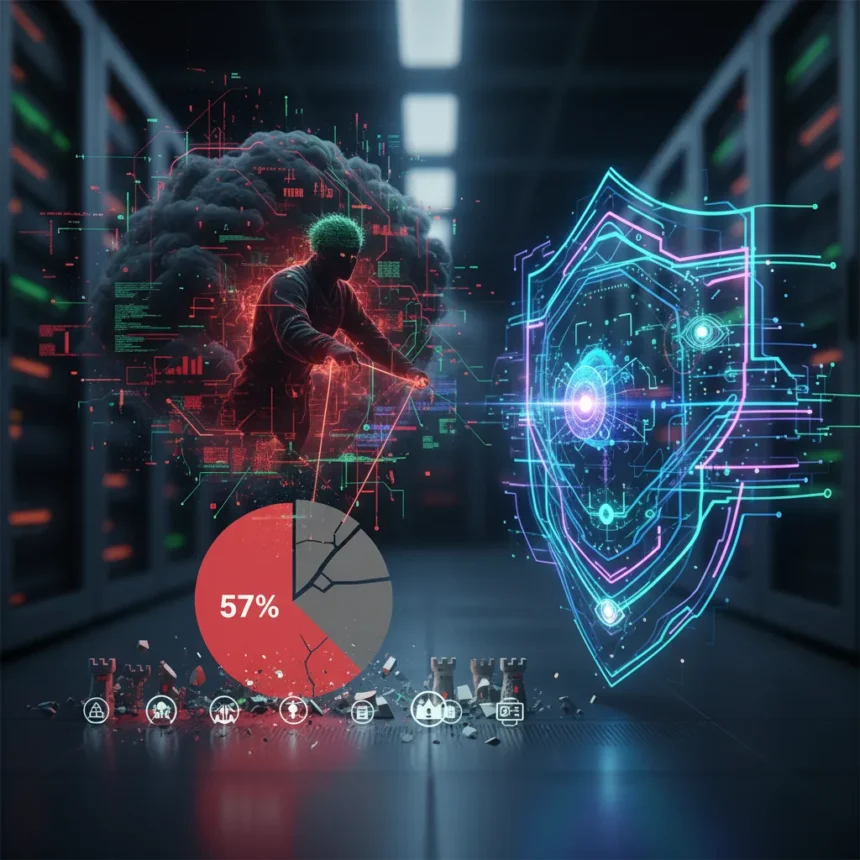
Malware-as-a-Service defense has become urgent as MaaS accounts for 57% of all threats, fundamentally changing how attackers operate. Unlike traditional malware requiring technical expertise, Malware-as-a-Service operates on a subscription model similar to ransomware-as-a-service, lowering entry barriers for even low-skill attackers. This shift means defenders can no longer rely on signature-based detection or static perimeter defenses—they need agility.
Key Takeaways
- Malware-as-a-Service represents 57% of all threats, enabling subscription-based attacks
- 82% of phishing sites now target mobile devices, requiring platform-specific defenses
- Traditional security models fail against MaaS because attackers abuse trusted platforms like Google Play Store and Chrome extensions
- State-sponsored actors and ransomware groups exploit vulnerabilities in critical infrastructure using AI-driven phishing and deepfakes
- AI-driven detection, zero-trust architecture, and network segmentation are essential countermeasures
Why Traditional Security Fails Against Malware-as-a-Service
Traditional security models rely on signature-based detection and static defenses, but Malware-as-a-Service exploits legitimate platforms to bypass these controls. Attackers distribute banking trojans through verified Chrome extensions, deploy malware via apps on the Google Play Store, and compromise supply chains—all without triggering legacy endpoint protection. The problem is speed: MaaS operators iterate faster than defenders can patch, and they weaponize tools organizations already trust.
State-sponsored actors like Silk Typhoon and Salt Typhoon demonstrate this vulnerability by targeting critical infrastructure with sophisticated exploits, while ransomware groups including SafePay and Scattered Spider leverage MaaS frameworks for multi-channel attacks. Meanwhile, 82% of phishing sites are now optimized for mobile devices, yet most organizations still focus defenses on desktop endpoints. The gap between attacker capability and defender readiness grows wider each quarter.
Malware-as-a-Service Defense Requires Agility, Not Signatures
Defending against Malware-as-a-Service means abandoning the assumption that you can identify and block every threat. Instead, organizations must adopt behavioral analytics, zero-trust architecture, and AI-driven detection systems that adapt in real time. This approach works because it does not rely on knowing what malware looks like—it identifies what malware does.


Concrete defensive priorities include mandatory encryption for cloud infrastructure, least-privilege access controls, and automated audits to prevent misconfigured storage from exposing sensitive data. Network segmentation isolates critical systems so that a compromised endpoint cannot laterally move to high-value targets. Offline backups and proactive threat hunting disrupt the entire ransomware kill chain, from initial encryption to data exfiltration and command-and-control communications. These measures assume breach and focus on containment rather than prevention alone.
Mobile Security and Cross-Channel Threats
Since 82% of phishing sites target mobile devices, Malware-as-a-Service defense must include phishing-resistant multi-factor authentication, real-time URL analysis, and targeted user training. Mobile-specific attacks exploit the same trust users place in app stores and browser extensions on desktop, but with weaker sandboxing and fewer security controls on phones.



Attackers are also leveraging AI-generated phishing and deepfakes to bypass email filters and social engineering defenses. This means security teams need cross-channel visibility—monitoring email, messaging apps, social media, and web traffic simultaneously. A single channel defended in isolation leaves the attacker free to pivot to another vector.
What Defenders Must Do Now
Organizations should prioritize urgent patching, credential rotation, and enhanced logging for memory-based attacks and authentication bypasses. Red-team simulations reveal gaps in detection and response before attackers exploit them. Collaboration with law enforcement and intelligence-sharing platforms helps track advanced persistent threats and emerging tactics in real time.
The shift from signature-based to behavioral defense is not optional—it is the minimum requirement to survive Malware-as-a-Service campaigns. Organizations that continue investing in static defenses will find themselves outpaced by attackers who have already moved on to the next evasion technique.
How does Malware-as-a-Service differ from traditional malware distribution?
Traditional malware required technical expertise and direct distribution channels. Malware-as-a-Service operates as a subscription service, allowing attackers with minimal skills to launch sophisticated campaigns using pre-built tools and frameworks. This democratization of attack capability is why the threat landscape has shifted so dramatically.


Can zero-trust architecture stop Malware-as-a-Service attacks?
Zero-trust alone is not sufficient, but it is essential. Combined with behavioral analytics, network segmentation, and AI-driven detection, zero-trust architecture makes lateral movement and privilege escalation significantly harder for attackers. No single defense stops all threats, but layered controls reduce the window of opportunity.
Why is mobile security critical for Malware-as-a-Service defense?
Mobile devices are now the primary vector for phishing and social engineering, with 82% of phishing sites optimized for mobile. If defenders ignore mobile, they leave the most accessible attack surface unprotected. Phishing-resistant MFA and real-time URL analysis on mobile are as important as endpoint detection on desktops.
Malware-as-a-Service defense is not about building bigger walls—it is about moving faster than attackers, detecting behavioral anomalies before they escalate, and assuming breach from day one. Organizations that embrace agility, automation, and cross-channel visibility will survive. Those clinging to signature-based detection will not.
Edited by the All Things Geek team.
Source: TechRadar