





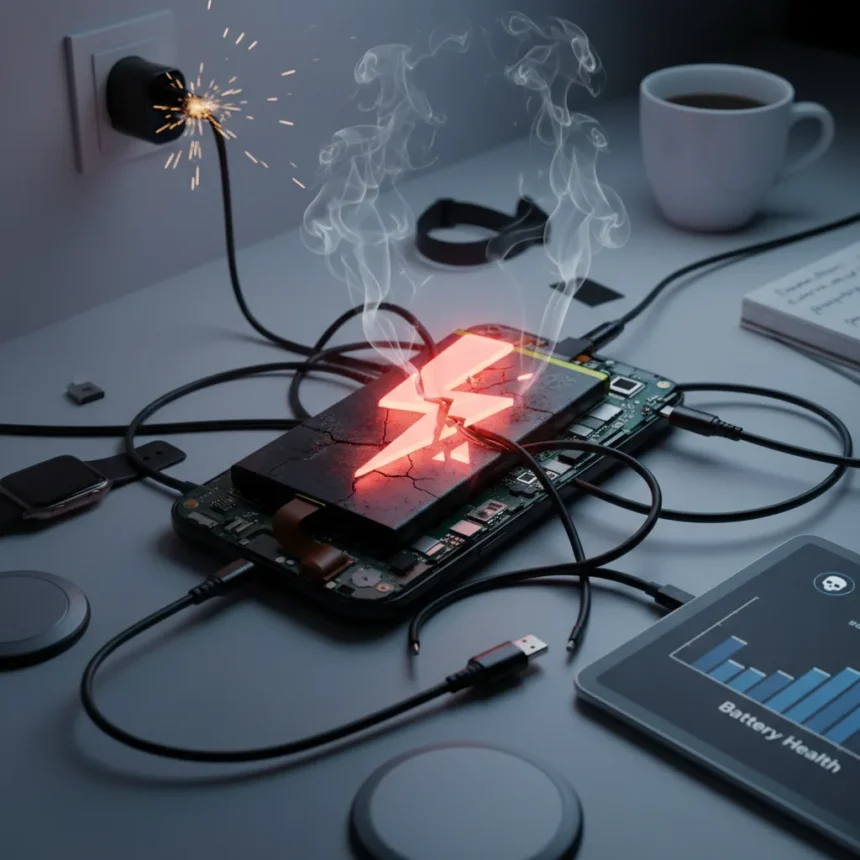
Phone battery habits are silently destroying your device’s longevity, and most of us are guilty of at least one damaging practice every single day. The habits we’ve developed around charging, usage, and thermal management are systematically degrading battery capacity faster than phone manufacturers designed them to fail. Understanding which behaviors harm your battery most is the first step toward actually keeping your phone usable for years instead of months.
Key Takeaways
- Daily phone battery habits are the primary cause of accelerated battery degradation in smartphones.
- Charging patterns, heat exposure, and usage while plugged in all significantly impact long-term battery health.
- Simple behavioral changes can extend battery lifespan by months or even years.
- Most phone users unknowingly practice multiple battery-damaging habits simultaneously.
- Manufacturer battery designs assume optimal usage conditions that most people never maintain.
Which Phone Battery Habits Damage Batteries Most
The most destructive phone battery habits fall into three categories: charging behavior, thermal stress, and simultaneous usage while charging. Heat is the primary enemy of lithium-ion batteries, and most daily phone battery habits either generate heat directly or trap it against the device. When you charge your phone while using it—texting, gaming, or streaming—you’re simultaneously adding electrical energy and creating processing heat, which compounds battery degradation. This dual stress accelerates chemical breakdown inside the battery cell far faster than either condition alone.
Charging patterns matter more than most users realize. Keeping your phone plugged in after it reaches 100 percent, charging overnight, or using fast chargers constantly all contribute to battery wear. Each of these phone battery habits creates conditions that push the battery beyond its optimal operating window. Lithium-ion chemistry degrades fastest at high charge levels and high temperatures—conditions that overnight charging and trickle charging both create. The battery is designed to handle this occasionally, not as your default behavior.
Physical heat exposure amplifies every other damaging habit. Leaving your phone in direct sunlight, using it in hot cars, or even keeping it in a back pocket while sitting all trap heat against the battery. When combined with charging or heavy usage, thermal stress becomes exponential rather than additive. A phone that charges at room temperature experiences minimal degradation; the same phone charging in a warm environment degrades at double or triple the rate.


The Charging Behavior That Kills Batteries Fastest
Using your phone while it charges is the single most damaging phone battery habit for most users. The combination of incoming electrical current and outgoing power demand forces the battery to manage conflicting states simultaneously. During normal charging, the battery accepts energy at a controlled rate. During normal usage, it discharges at a variable rate. Doing both at once creates internal stress that accelerates the chemical reactions responsible for battery wear.
Overnight charging ranks as the second most damaging habit. Your phone reaches 100 percent in 1–2 hours, but remains plugged in for 6–8 more hours while you sleep. During those extra hours, the charger delivers small trickle charges to maintain 100 percent capacity. The battery spends prolonged time at maximum charge level, which is the condition under which lithium-ion batteries degrade fastest. A battery at 100 percent for eight hours ages faster than a battery at 80 percent for the same duration.



Fast charging, while convenient, also accelerates degradation. Pushing electrical current into a battery at high rates generates heat and stresses internal structures. Occasional fast charging is acceptable; making it your default charging method compounds the damage. The difference between a phone charged slowly once daily and the same phone fast-charged twice daily becomes apparent within six months of use.
How to Fix Damaging Phone Battery Habits
The easiest fix is to stop using your phone while charging. Plug it in, put it down, and wait. This single change eliminates the compounding stress of simultaneous charging and power draw. If you must use your phone while charging, keep it on a table rather than in your hand—this allows heat to dissipate instead of being trapped against your palm and body.
Change your overnight charging routine. Charge your phone in the evening before bed, but unplug it once it reaches 100 percent or use a smart charger that stops delivering power at full capacity. If your charger lacks this feature, set a timer or reminder to unplug manually. Alternatively, charge to 80 percent and leave it unplugged overnight. A phone at 80 percent charge lasts through most nights and avoids the degradation caused by prolonged 100 percent charge states.
Reduce reliance on fast charging. Use standard chargers for daily charging and reserve fast chargers for emergencies when you genuinely need a quick top-up. Keep your phone cool while charging by removing thick cases, avoiding direct sunlight, and charging in air-conditioned spaces. If your phone gets warm during normal use, stop using it and let it cool before resuming activity.



Monitor battery health regularly. Most phones display battery health percentage in settings. If your battery capacity drops below 80 percent within the first year, your phone battery habits need immediate adjustment. Degradation accelerates as capacity decreases, so early intervention prevents catastrophic failure.
Phone Battery Habits Compared to Manufacturer Expectations
Phone manufacturers design batteries assuming moderate daily use, occasional charging, and normal temperature conditions. Real-world phone battery habits deviate significantly from these assumptions. Users charge overnight, use phones while charging, expose them to heat, and rely on fast charging—behaviors that compress years of designed lifespan into months of actual use.
Manufacturers rate batteries for 500–1000 full charge cycles before capacity drops to 80 percent. One full cycle means charging from 0 to 100 percent. If you charge your phone daily and use it while charging, you might complete 1.5 cycles daily instead of one, burning through your battery’s rated lifespan 50 percent faster. Add overnight charging and fast charging to this pattern, and you’re looking at a phone with 60–70 percent battery capacity after one year instead of the expected 80–90 percent.
Why Phone Battery Habits Matter Now
Phones are more expensive and harder to repair than ever. A battery replacement costs $50–$150 at most service centers, and many users simply replace the entire phone when battery capacity drops below 50 percent. Fixing your phone battery habits costs nothing and extends your device’s usable life by 1–2 years. That’s the difference between replacing your phone annually and keeping it for three or four years.
Environmental impact is another reason to care. Manufacturing a smartphone generates significant carbon emissions. Extending phone lifespan by two years eliminates the need for two additional devices, reducing your personal tech waste substantially. Your phone battery habits directly affect how many devices you’ll discard over a decade.
FAQ
What is the most damaging phone battery habit?
Using your phone while charging is the most damaging habit because it forces the battery to simultaneously accept incoming power and deliver outgoing power, creating internal stress that accelerates degradation. Heat generated during this dual state compounds the damage further.
Is overnight charging really that bad for batteries?
Yes. Overnight charging keeps your battery at 100 percent charge for hours after it reaches full capacity. Lithium-ion batteries degrade fastest at high charge levels, so prolonged time at 100 percent significantly accelerates battery wear compared to charging and immediately unplugging.
Can I fix phone battery damage that’s already happened?
Not directly—battery degradation is chemical and irreversible. However, changing your phone battery habits immediately stops further accelerated degradation. A phone with 70 percent capacity will degrade much more slowly if you stop using it while charging and stop overnight charging, compared to continuing those habits.
Your phone’s lifespan depends entirely on the habits you choose today. Stop charging overnight, stop using your phone while it’s plugged in, and keep it cool. These three changes alone will extend your device’s useful life and save you hundreds in replacement costs.
Edited by the All Things Geek team.
Source: Tom's Guide




