





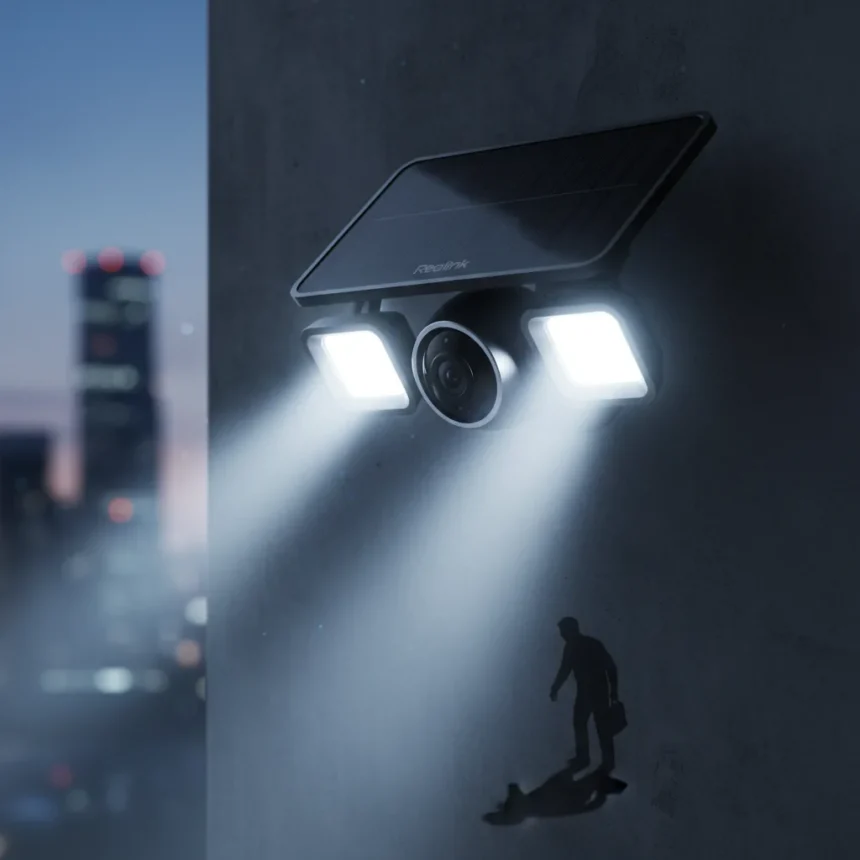
The Reolink Solar Floodlight Cam is a solar-powered security camera designed to flood your property with bright light while deterring would-be burglars, eliminating the need for constant battery charging or paid cloud subscriptions. Reolink’s floodlight models, including solar variants, represent a shift toward self-sufficient home security that prioritizes local storage and independence from recurring service fees.
Key Takeaways
- Solar power eliminates battery charging and reduces ongoing operational costs for outdoor security.
- Reolink floodlight cameras deliver bright illumination designed to deter intruders and improve nighttime visibility.
- No mandatory cloud subscription required—local SD card storage keeps footage private and accessible offline.
- Solar-powered Reolink models like the Go PT Plus+SP offer detachable solar panels for flexible installation.
- Floodlight cameras balance deterrence and power efficiency, making them practical for properties without electrical outlets.
Why Solar Power Changes Home Security Economics
Solar-powered security cameras eliminate the friction of battery maintenance. Traditional wireless cameras require regular charging or battery swaps—a chore that compounds across multiple devices. The Reolink Solar Floodlight Cam sidesteps this entirely by harvesting energy from daylight, keeping the camera operational year-round without manual intervention. This matters because dead batteries are the leading cause of security camera downtime, leaving gaps in coverage precisely when you need it most.
Reolink’s solar approach also removes the dependency on mains power, which is crucial for renters, property owners with limited electrical infrastructure, or anyone unwilling to run cables across walls. The detachable solar panel design used on models like the Reolink Go PT Plus+SP allows flexible placement—mount the panel where sunlight is strongest, not where the camera needs to be. This architectural choice gives installers genuine freedom.
Floodlight Brightness as a Burglar Deterrent
The core promise of any floodlight camera is illumination. Reolink’s floodlight models produce intense light output—comparable systems deliver up to 3,000 lumens—which transforms dark areas into well-lit zones that discourage criminal activity. Burglars prefer darkness; a property flooded with light becomes a liability. The psychological deterrent is immediate and measurable: intruders are far more likely to move to an easier, darker target.


Unlike passive infrared sensors that only trigger recording, floodlight cameras actively reshape the environment. Motion detection triggers both recording and light simultaneously, creating a one-two punch: the intruder is caught on camera and exposed in plain sight. This dual-layer approach is more effective than either mechanism alone, and it requires no subscription service to function. The camera records locally to an SD card, keeping footage under your control.
Local Storage and Subscription-Free Operation
Reolink’s commitment to subscription-free security is increasingly rare in the market. Most mainstream security camera brands—Ring, Wyze, Arlo—push cloud storage as a revenue stream, locking essential features behind monthly fees. Reolink floodlight cameras record to local SD cards instead, meaning you own your footage and pay nothing for ongoing access. This model appeals to privacy-conscious users and those fatigued by subscription creep.



Local storage does impose a trade-off: you cannot access footage remotely without additional setup, and storage capacity is limited by card size. But for property owners who prioritize ownership and offline reliability over convenience, this is the right choice. The camera functions fully without internet connectivity—it records, stores, and triggers lights independently. Internet is useful for remote monitoring but not required for core security operation.
Installation and Solar Panel Placement
Solar-powered Reolink cameras like the Go PT Plus+SP ship with detachable solar panels that can be positioned separately from the camera body. This flexibility is the key advantage over fixed solar-panel-integrated designs. You can mount the camera under an eave for weather protection while positioning the panel on a sunny roof or wall. Installers are no longer forced to choose between optimal camera angle and optimal solar exposure.
The trade-off is that you have two components to mount instead of one, requiring additional brackets and potentially more visible wiring. But the flexibility justifies the complexity for most installations. Reolink’s floodlight models also support standard mounting patterns, so aftermarket arms and brackets are widely available and affordable.
How Does the Reolink Solar Floodlight Cam Compare to Wired Alternatives?
Wired floodlight cameras—connected to mains power—deliver unlimited runtime and brightness without solar dependency. They are the gold standard for permanent installations on homes with accessible electrical infrastructure. But they require professional installation, trenching, or unsightly cable runs, and they lock you into a fixed location. The Reolink Solar Floodlight Cam sacrifices unlimited power for portability and installation simplicity. If your property has no convenient outlet near the target area, solar becomes the only practical option. If you have power available, a wired camera may be more reliable long-term, but solar offers genuine freedom.



Is the Reolink Solar Floodlight Cam worth buying?
Yes, if you want solar-powered security without subscription fees and your property receives adequate sunlight. The camera is ideal for renters, properties without outdoor electrical outlets, or users who reject recurring cloud storage charges. It excels at deterrence through bright illumination and stores footage locally. Buy it if independence from subscriptions and mains power matters more than remote cloud access or latest AI features.
Does the solar panel work in winter or cloudy climates?
Solar panels produce energy in winter and cloud cover, though at reduced efficiency. The camera will charge more slowly and may require supplemental power during extended dark periods. Extremely cloudy or northern climates may see seasonal performance dips, but the system is designed to function year-round in most regions. Check Reolink’s specifications for your climate zone before purchasing.
Can you access Reolink Solar Floodlight Cam footage remotely without a subscription?
Not through cloud storage. The camera records locally to an SD card, which you access by removing the card or viewing footage on-site. Remote access requires a separate setup (such as a local network connection or optional paid cloud service), but basic recording and motion-triggered lighting work offline. For true remote monitoring, you would need to add infrastructure or accept a subscription cost.
The Reolink Solar Floodlight Cam represents a deliberate design philosophy: prioritize independence, local control, and long-term cost savings over convenience and cloud integration. It is not the most feature-rich floodlight camera on the market, but it is one of the few that refuses to trap you in a subscription model. For security-conscious homeowners tired of recurring fees, that philosophy is worth the trade-offs.
Where to Buy
$87.99 at Amazon | $109.99 at Amazon | $109.99 at Amazon
This article was written with AI assistance and editorially reviewed.
Source: TechRadar