






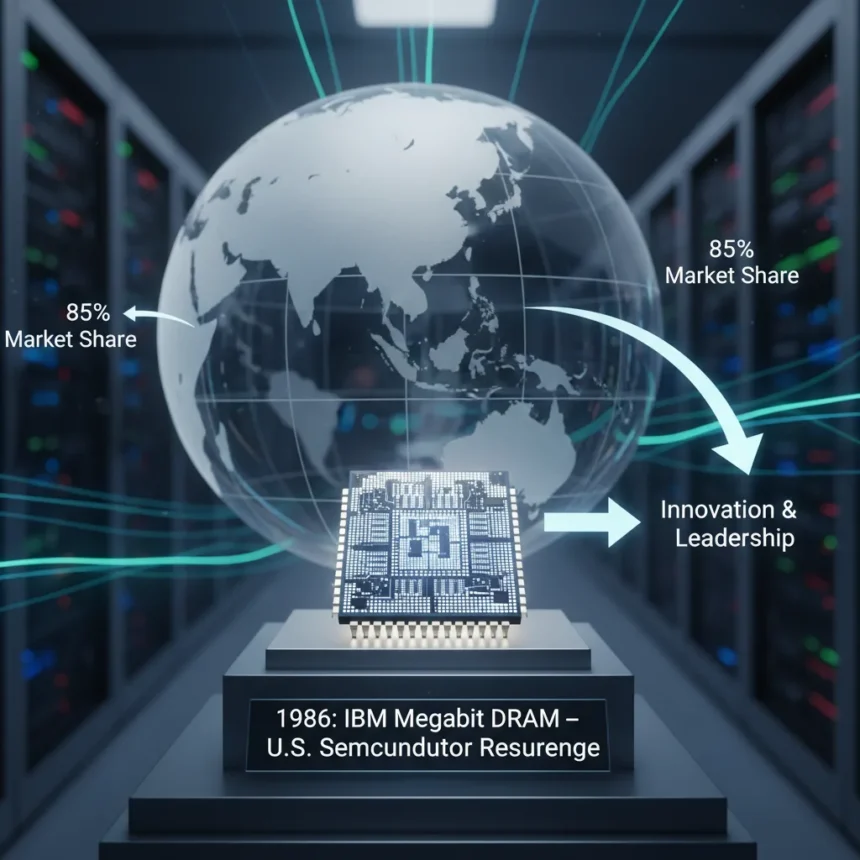
IBM’s megabit DRAM breakthrough on April 18, 1986, marked a pivotal moment when American semiconductor engineering reasserted itself against Japanese market dominance. The company announced the first commercial deployment of a 1-megabit (1Mbit) DRAM chip inside the IBM Model 3090 mainframe, a move designed to prove that U.S. firms could still lead in memory innovation.
Key Takeaways
- IBM deployed the first 1Mbit DRAM chip in a commercial product on April 18, 1986, in the Model 3090 mainframe.
- The 1Mbit chip stored 1 million bits, equivalent to roughly 100 double-spaced typewritten pages.
- Japanese firms held 85% of the global DRAM market share and were preparing their own 1Mbit shipments.
- The breakthrough enabled smaller, more power-efficient mainframes that reduced customer floor space costs.
- IBM countered perceptions of being slow and stodgy compared to nimble Japanese competitors.
The megabit DRAM breakthrough and its strategic importance
In 1986, when IBM announced the megabit DRAM breakthrough, Japanese companies—Fujitsu, Hitachi, Mitsubishi, NEC, and Toshiba—controlled 85% of the global DRAM market. This dominance represented a humbling shift for American semiconductor manufacturers. IBM’s move was not purely technical; it was a calculated statement of intent. The company wanted to demonstrate U.S. competitiveness and shed the reputation of being slow and stodgy in the face of faster-moving Japanese rivals.
The 1Mbit chip stored 1 million bits of data—roughly equivalent to about 100 double-spaced typewritten pages. This represented a four-fold increase over the 256-kilobit chips that powered contemporary mainframes and a massive leap beyond the 64-kilobit chips common in personal computers at the time. For mainframe customers, the practical benefit was immediate: denser memory enabled smaller, more compact systems that saved valuable floor space in data centers—a genuine cost advantage in an era when mainframe footprint directly affected facility expenses.
Why the megabit DRAM breakthrough mattered for hardware evolution
The megabit DRAM breakthrough did not exist in isolation. Japanese manufacturers were preparing their own 1Mbit shipments, meaning the technology race was tightening. IBM’s early deployment in a commercial product—rather than merely announcing lab prototypes—gave American engineers credibility at a moment when skeptics questioned whether the U.S. could keep pace. The mainframe market was IBM’s stronghold, and proving American memory superiority there sent a signal to the entire industry.



Beyond performance specs, IBM’s marketing approach revealed how seriously the company took the moment. The firm produced promotional buttons embedded with actual 1Mbit chips to highlight the achievement. It was a bold gesture—turning a semiconductor into a wearable artifact—designed to capture public imagination and reinforce the narrative of American technological resurgence. Whether the buttons succeeded as marketing or merely as curiosities, they underscored IBM’s determination to own the megabit DRAM breakthrough narrative.
The competitive landscape: Japan’s response and industry implications
The megabit DRAM breakthrough mattered precisely because it challenged Japanese market dominance. Fujitsu, Hitachi, Mitsubishi, NEC, and Toshiba were not far behind; they had their own 1Mbit products in development. What IBM achieved was not exclusive technological superiority but rather a psychological and strategic victory—being first to deploy 1Mbit memory in a real product, in a real customer system, on American soil.



The broader implication was that memory density would continue to accelerate. If 1Mbit represented a four-fold jump over 256Kbit, the industry could expect the same trajectory to repeat. This exponential growth in storage capacity would enable faster processors, more sophisticated operating systems, and applications that had previously been constrained by memory limits. IBM’s megabit DRAM breakthrough was not just about a single chip; it was a proof point that the semiconductor industry’s relentless march toward higher density and lower cost would persist.
Did IBM’s megabit DRAM breakthrough actually change the market?
IBM’s 1986 announcement energized American semiconductor pride, but the broader market dynamics shifted only gradually. Japanese firms continued their dominance in commodity DRAM production, and over subsequent decades, South Korean manufacturers (Samsung, SK Hynix) eventually became the largest DRAM suppliers globally. The megabit DRAM breakthrough proved that American engineering could innovate at the highest levels, yet it did not reverse the structural advantages Japanese and later Korean firms held in manufacturing scale and cost control.
What the breakthrough did accomplish was demonstrating that leadership in memory technology was not predetermined. IBM’s willingness to invest in latest DRAM design and deploy it in flagship products showed that American companies could compete on innovation, even if they could not match Japanese manufacturing volume. The Model 3090 with its 1Mbit chips became a symbol of that capability—proof that U.S. firms had not surrendered the semiconductor frontier.
What made the 1Mbit chip different from prior generations?
The jump from 64-kilobit to megabit-class memory was not merely incremental. A 1Mbit chip stored roughly 15 times more data than the 64Kbit chips common in personal computers. For mainframe designers, this density breakthrough meant they could build systems with significantly more memory in the same physical footprint. Smaller systems meant lower power consumption, reduced cooling requirements, and reduced facility costs—advantages that mainframe customers valued deeply. The megabit DRAM breakthrough was therefore not just a laboratory curiosity but a practical engineering win with direct business implications.

How did the megabit DRAM breakthrough influence later chip design?
IBM’s success with the megabit DRAM breakthrough in 1986 set expectations for continued density growth. Engineers across the industry understood that memory capacity would double roughly every 18 to 24 months—a pattern that would hold for decades. This predictability allowed system designers to plan roadmaps with confidence. The megabit chip proved the manufacturing techniques, design methodologies, and quality assurance processes needed to produce ultra-dense memory reliably. Later generations of DRAM—4Mbit, 16Mbit, 64Mbit, and beyond—followed similar architectural principles refined by the lessons learned in achieving 1Mbit density.
Was the megabit DRAM breakthrough really a turning point for IBM?
For IBM specifically, the megabit DRAM breakthrough was a moment of reassertion. The company had not invented DRAM technology, but it had mastered the discipline of deploying it in mission-critical systems. By choosing to showcase the 1Mbit chip in the Model 3090—a flagship mainframe—IBM signaled that American engineering remained competitive at the highest tiers of the market. Whether this single product announcement reversed the broader Japanese dominance in DRAM is debatable, but it proved that IBM could still innovate and lead when it chose to invest.
Did Japanese firms catch up to IBM’s megabit DRAM breakthrough?
Yes. Fujitsu, Hitachi, Mitsubishi, NEC, and Toshiba were preparing their own 1Mbit shipments and moved quickly to match and exceed IBM’s capabilities. The megabit DRAM breakthrough was not a permanent competitive advantage but rather a milestone that every major semiconductor firm would reach. The real competition was not about reaching 1Mbit first but about who could produce it most efficiently, most reliably, and at the lowest cost. On those metrics, Japanese and later Korean manufacturers ultimately prevailed, but IBM’s early deployment ensured the company remained a respected voice in memory technology for years to come.
What happened to IBM’s DRAM business after 1986?
IBM continued to develop advanced DRAM designs throughout the late 1980s. By 1989, the company had produced a 1Mbit DRAM variant with 22 nanosecond access time, pushing speed performance even as competitors pursued density. However, IBM eventually exited the commodity DRAM market entirely, focusing instead on specialty memory and processor design. The megabit DRAM breakthrough had served its purpose: proving American competence and establishing IBM’s reputation for advanced memory engineering, even if the company would not remain a long-term DRAM manufacturer.
Why does the megabit DRAM breakthrough still matter today?
The megabit DRAM breakthrough matters because it illustrates a critical lesson in technology competition: innovation and manufacturing scale are not the same thing. IBM could design and deploy a world-class 1Mbit chip, yet it could not compete with Japanese and Korean firms in high-volume, low-cost DRAM production. Today, as semiconductor supply chains face scrutiny and nations invest heavily in domestic chip manufacturing, the 1986 moment serves as a reminder that leading-edge design capability does not automatically translate to market dominance. The megabit DRAM breakthrough was a technical and strategic victory, but it did not reshape the global semiconductor hierarchy—a reality that shaped IBM’s long-term strategy in ways that echo today.
This article was written with AI assistance and editorially reviewed.
Source: Tom's Hardware