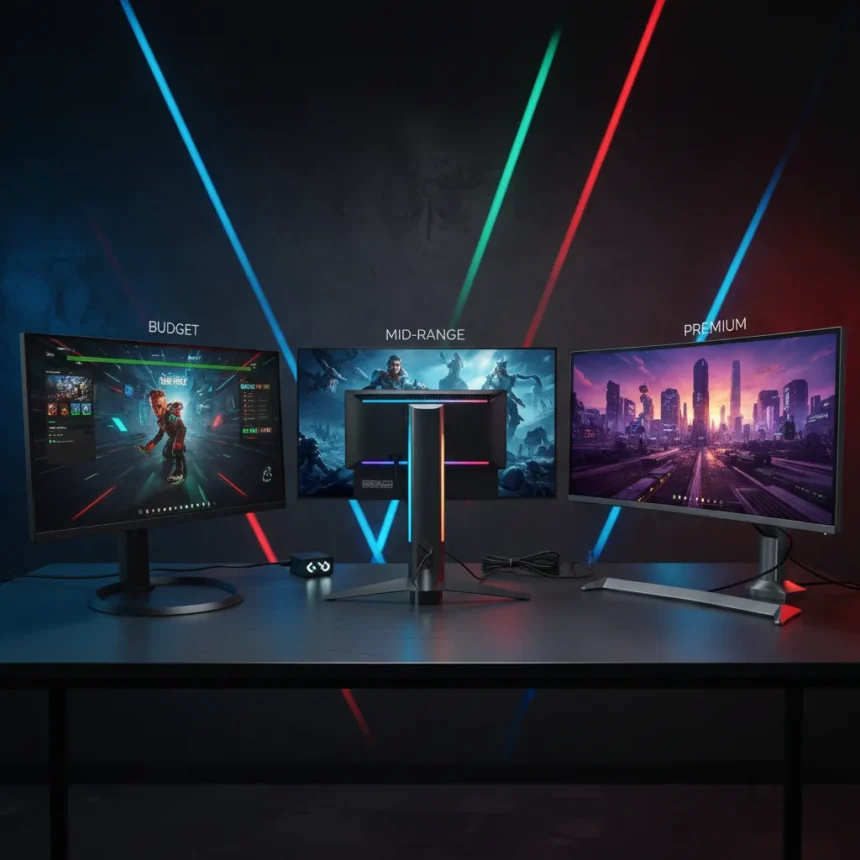
Finding the best gaming monitors requires balancing performance, features, and price across a crowded 2026 market. Whether you’re hunting for an accessible entry-level option or willing to invest in latest panel technology, the right monitor can transform your gaming experience. We’ve identified the top 3 gaming monitors spanning budget, mid-range, and premium categories to help you choose the model that fits your setup and wallet.
Key Takeaways
- The LG 27GL850-B delivers high-end gaming specs at an accessible price point, balancing size, performance, and value.
- High refresh rates, low response times, and HDR support are critical features for competitive gaming performance.
- Gaming monitors vary significantly by use case—fast-paced shooters demand different specs than strategy or single-player titles.
- The 2026 market includes emerging technologies like OLED panels and adaptive sync upgrades across multiple price tiers.
- Budget, mid-range, and premium options each offer distinct trade-offs in panel quality, resolution, and refresh rate.
What Makes the Best Gaming Monitors Stand Out
The best gaming monitors share a core set of performance criteria that separate them from general-purpose displays. High refresh rates—typically 144Hz or higher—reduce motion blur during fast-paced gameplay. Low response times, measured in milliseconds, determine how quickly pixels transition colors, critical for competitive shooters where every frame counts. HDR support and superior picture quality elevate visual fidelity, while adaptive sync technologies like G-Sync or FreeSync eliminate screen tearing. These features combine to create a gaming edge that generic office monitors simply cannot match.
Size and resolution present their own trade-offs. A 27-inch display at 1440p has become the sweet spot for many gamers, offering enough screen real estate without sacrificing frame rates. Larger ultrawide panels appeal to immersive single-player experiences, while smaller 24-inch 1080p monitors cater to competitive esports players prioritizing maximum refresh rates. The best gaming monitors don’t try to excel at everything—they make deliberate choices about which features matter most for their target audience.
The Best Gaming Monitors Across Price Points
The LG 27GL850-B remains a standout pick across multiple reviews, praised for its ability to deliver high-end gaming specs at a very accessible price. This 27-inch 1440p monitor hits the performance-to-value ratio that most gamers seek, with strong refresh rates and response times that handle demanding titles without requiring a premium price tag. The model frequently appears in deals, making it even more attractive for budget-conscious buyers.


For mid-range buyers, the MSI Optix MPG341CQR offers a different approach, expanding screen real estate with a curved ultrawide design. This category typically introduces higher refresh rates and more advanced panel technologies that justify the price increase over entry-level options.
Premium gaming monitors push into OLED territory and specialized designs. The MSI MPG 321URX QD-OLED represents the cutting edge, delivering a stunning OLED panel that offers superior contrast and color accuracy compared to traditional LCD technology. These high-end models appeal to players who demand the absolute best visual experience and are willing to pay for it.



Gaming Monitor Features That Actually Matter
Not every advertised feature delivers real value for gaming. Refresh rate and response time directly impact gameplay responsiveness—a 240Hz monitor with a 1ms response time will feel noticeably snappier than a 60Hz display in fast-paced action games. HDR support, when properly implemented, creates more vibrant visuals and better shadow detail in dark scenes, enhancing immersion.
Adaptive sync technology deserves particular attention. NVIDIA G-Sync and AMD FreeSync eliminate the stuttering caused by frame rate mismatches between your GPU and monitor, making gameplay feel smoother even when frame rates fluctuate. Emerging 2026 gaming monitors now bundle both technologies, removing the need to choose between NVIDIA and AMD ecosystems.
Panel type matters more than many gamers realize. IPS panels offer wider viewing angles and better color accuracy, while VA panels deliver superior contrast. OLED technology combines the strengths of both with exceptional contrast and near-instant response times, though at a premium price. The best gaming monitors match their panel choice to their intended use case rather than defaulting to whatever is cheapest to manufacture.
How to Choose Between Budget, Mid-Range, and Premium
Budget gaming monitors prioritize refresh rate and response time over everything else. If you play competitive shooters like CS2 or Valorant, a 144Hz 1080p monitor with a 1ms response time will serve you better than a 4K 60Hz display. The LG 27GL850-B sits at the intersection of budget accessibility and solid performance, making it the logical starting point for most new gaming monitor shoppers.


Mid-range options introduce resolution upgrades, larger screens, and specialized designs like ultrawides. These monitors suit players who want visual quality without sacrificing frame rates, or who value immersion in single-player games over competitive advantage.
Premium gaming monitors justify their cost through superior panel technology, higher refresh rates at higher resolutions, or both. OLED gaming monitors deliver motion clarity and color accuracy that LCD panels struggle to match, though they carry a significantly higher price tag. Choose premium only if you have a GPU capable of pushing the frame rates that justify the monitor’s refresh rate.
Frequently Asked Questions
What size gaming monitor should I buy?
27 inches at 1440p has become the standard for balanced gaming, offering enough screen space without sacrificing frame rates. Competitive players often prefer smaller 24-inch 1080p monitors to maximize refresh rates, while immersive single-player gamers may prefer larger or ultrawide displays.
Is OLED worth the premium for gaming monitors?
OLED gaming monitors like the MSI MPG 321URX deliver exceptional contrast, near-instant response times, and superior motion clarity compared to LCD panels. They’re worth the premium if you have a high-end GPU capable of pushing high frame rates, but they represent a significant investment beyond budget and mid-range options.
Do I need G-Sync or FreeSync for gaming?
Adaptive sync technologies eliminate screen tearing and stuttering caused by frame rate mismatches, creating noticeably smoother gameplay. They’re not essential for casual gaming, but they significantly improve the experience in fast-paced titles. Many 2026 gaming monitors now support both standards, removing the need to choose based on your GPU manufacturer.
The best gaming monitors aren’t always the most expensive ones—they’re the models that match your gaming style, GPU capability, and budget constraints. Whether you prioritize competitive advantage through high refresh rates or visual immersion through superior panel quality, the 2026 market offers strong options at every price point. Start with the performance features that matter most to your favorite games, then build outward to resolution, size, and panel technology. The right monitor transforms how games feel, not just how they look.
Where to Buy
View at Amazon | View at Amazon
Edited by the All Things Geek team.
Source: T3