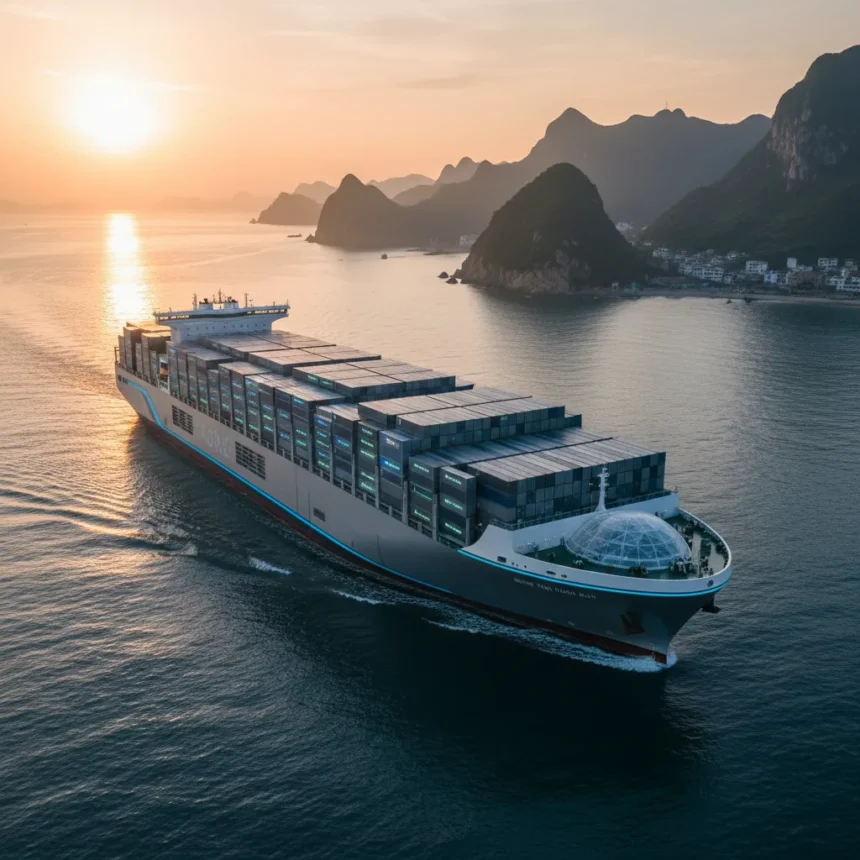
The Ning Yuan Dian Kun is the world’s largest electric container ship, a 10,000-tonne vessel built by Jiangxi Jiangxin Shipbuilding that entered commercial service in April 2026. At 127.8 metres long with a capacity of 740 twenty-foot equivalent units (TEU), this electric container ship represents a watershed moment for maritime decarbonisation—but only if you understand what it actually is and what it is not.
Key Takeaways
- The Ning Yuan Dian Kun is the world’s largest fully electric container ship, weighing 10,000 tonnes with 740 TEU capacity.
- The vessel carries 10 containerised batteries totalling 19 MWh of energy storage, charged via shore power or rapid battery swapping.
- Two 875 kW electric motors deliver approximately 11.5 knots maximum speed on the 70-nautical-mile Ningbo-Zhoushan to Jiaxing route.
- Annual CO2 reductions reach approximately 1,462 tonnes versus conventional fossil fuel ships on the same route.
- The ship features fully autonomous navigation with collision avoidance and integrated ship-shore-cloud control systems.
What Makes This Electric Container Ship Different
The Ning Yuan Dian Kun breaks the mould of electric shipping in three critical ways. First, it operates on a fixed coastal route of roughly 70 nautical miles between Ningbo-Zhoushan and Jiaxing, not long-haul oceangoing voyages. Second, it uses a dual-mode charging system: high-voltage shore power connection and rapid container battery swapping when docked, allowing vessels to maintain schedules without waiting for full recharges. Third, it combines massive battery capacity—19 MWh across 10 containerised units—with twin 875 kW permanent-magnet synchronous motors that deliver virtually instantaneous response with no propulsion delay.
This design matters because it sidesteps the energy density problem that has stalled electrification of larger cargo ships. A conventional 20,000+ TEU container ship crossing the Pacific cannot currently run on batteries; the energy required would exceed any battery pack feasible to install. The Ning Yuan Dian Kun avoids this trap by operating short distances with scheduled port stops, where battery swaps replenish energy in minutes rather than hours. It is not a competitor to transoceanic container vessels—it is a solution to a different problem entirely.
Autonomous Navigation Sets It Apart from Conventional Electric Ships
Beyond the battery pack, the Ning Yuan Dian Kun integrates fully autonomous navigation capabilities that distinguish it from purely battery-electric predecessors. The vessel features autonomous collision avoidance, high-precision tracking, and intelligent route planning that switches between sailing modes based on conditions. An integrated ship-shore-cloud control system allows remote monitoring and optimisation of engine operations, a feature absent from conventionally powered cargo ships.

The propulsion system itself reflects this intelligence. Electric motors are inherently more responsive than diesel engines—there is no fuel injection delay, no turbo lag, no warm-up period. The Ning Yuan Dian Kun exploits this responsiveness through software that continuously optimises thrust and energy consumption. Solar panels fitted to the deck contribute additional power for onboard systems, a minor but meaningful efficiency gain.
Environmental Impact and the Dual Carbon Goals
Operating this single route, the Ning Yuan Dian Kun eliminates approximately 1,462 tonnes of CO2 annually compared to a conventional diesel vessel on the same journey. It produces zero emissions, zero noise, and zero pollution during operation. For coastal cities like Ningbo and Jiaxing, where port congestion and air quality are chronic problems, even a single electric vessel reduces local pollution measurably.



The broader context matters here. Ningbo Ocean Shipping Co., which operates the Ning Yuan Dian Kun, already runs 32 energy-efficient or green vessels that account for 57 percent of its fleet. The company is not betting everything on this single ship; it is systematically transitioning its entire operation toward electrification and sustainable propulsion. A sister vessel, the Ning Yuan Dian Peng, entered service in June 2026 with identical specifications. Once both ships operate on fixed routes, they form the foundation of what Ningbo Ocean Shipping describes as a scaled green shipping operation.
The Reality Check: This is Not a Replacement for Global Shipping
Here is where clarity matters most. The Ning Yuan Dian Kun is the world’s largest electric container ship, but it is not the world’s largest container ship. Modern conventional boxships carry 20,000+ TEU and traverse oceans for weeks at a time. The Ning Yuan Dian Kun carries 740 TEU on a 70-nautical-mile coastal route. These are fundamentally different vessels solving different problems.
The technology for large oceangoing vessels with the energy requirements for long-haul voyages has not yet been developed. Battery density, charging infrastructure, and operational economics all remain prohibitive for deep-sea container shipping. The Ning Yuan Dian Kun does not solve that problem. What it does solve is the inefficiency and pollution of short-haul feeder routes that connect regional ports to major hubs—a problem that affects hundreds of thousands of cargo movements annually in Asia alone.
Design Features That Enable Efficiency
The hull itself reflects efficiency priorities. An open-deck design improves cargo handling efficiency compared to covered cargo holds, reducing port time and labour costs. A wind-reduction bow shape cuts air resistance by 15 to 20 percent, a detail that compounds energy savings over thousands of voyages. The vessel measures 21.6 metres in beam and 10.5 metres in depth, dimensions optimised for the Ningbo-Zhoushan to Jiaxing corridor where it operates.



Is the Ning Yuan Dian Kun truly the world’s largest electric container ship?
Yes, it is the first 10,000-tonne-class pure electric intelligent container ship built and operated commercially. No other electric container vessel in service approaches its size, capacity, or operational complexity. However, this title applies only within the electric container ship category—conventional ships are vastly larger.
How does battery swapping work on the Ning Yuan Dian Kun?
The vessel carries 10 containerised battery units that can be rapidly swapped at port using standard container handling equipment. When the ship arrives at dock, depleted battery containers are removed and replaced with fully charged units, allowing the vessel to depart within hours rather than waiting for onboard charging. This modularity is critical to maintaining schedule reliability on fixed coastal routes.
What routes will the Ning Yuan Dian Kun and its sister ship serve?
The Ning Yuan Dian Kun operates the 70-nautical-mile Ningbo-Zhoushan to Jiaxing route. Its sister vessel, the Ning Yuan Dian Peng, entered service with identical specifications and routes. Together, they form the core of Ningbo Ocean Shipping’s transition toward electric coastal shipping, a model that could scale to other Asian port regions with similar geography and cargo volumes.
The Ning Yuan Dian Kun proves that large-scale electric shipping is not a theoretical future—it is operational today. But it also proves that electrification of cargo shipping will not happen uniformly. Short-haul coastal routes will electrify first, where battery technology and charging infrastructure are feasible. Long-haul transoceanic shipping will remain fossil-fuelled for years, possibly decades, until energy density and supply chain challenges are solved. Understanding this distinction is crucial for anyone tracking the shipping industry’s transition toward sustainability.
Edited by the All Things Geek team.
Source: TechRadar