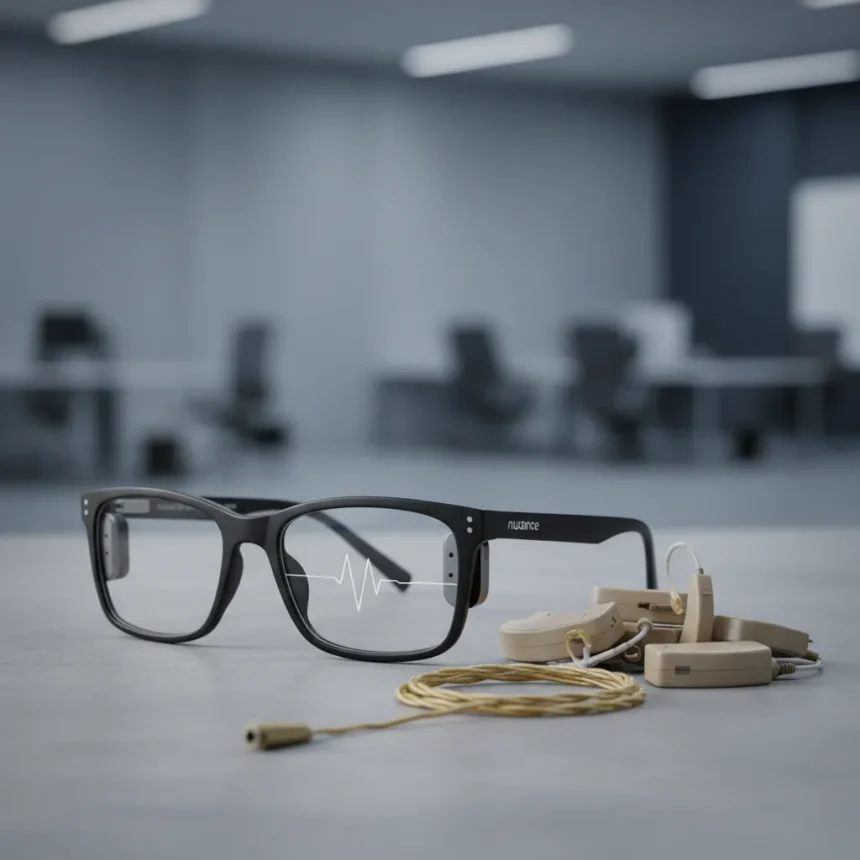
Nuance Audio hearing glasses are open-ear eyewear designed to amplify sound for people with hearing impairment, using beamforming microphones and directional focus to improve clarity in noisy environments. The device is currently awaiting FDA approval and has not yet reached commercial availability, but a hands-on test at CES 2025 reveals significant limitations beneath the stylish exterior.
Key Takeaways
- Nuance Audio hearing glasses use beamforming microphones to focus on speakers directly in front of the wearer.
- Open-ear speakers deliver amplified sound without blocking the ear canal, reducing listening fatigue compared to traditional hearing aids.
- The glasses pair via Bluetooth to a smartphone app offering multiple transparency modes and volume adjustment.
- Despite their name, the glasses provide straightforward amplification rather than nuanced, adaptive hearing assistance.
- FDA approval is still pending; no official price or release date has been announced.
The Promise vs. the Reality of Nuance Audio hearing glasses
The irony is baked into the product’s name. Nuance Audio hearing glasses are supposed to deliver sophisticated, context-aware hearing assistance, but in practice they function as a relatively simple directional amplifier. During testing at CES, the glasses made conversations sound as if the wearer was sitting in a quiet boardroom instead of a crowded booth with thousands of people, which is genuinely impressive for a first-generation device. Yet this clarity comes from a single trick: beamforming microphones that focus on sound from the direction the wearer is facing. It is effective, but it is not nuanced. The glasses lack the adaptive intelligence you might expect from a product carrying that name. There is no learning curve, no context awareness, no ability to distinguish between background noise and speech in the way a sophisticated hearing aid would. What you get is amplification with directionality, period.
The open-ear speaker design is where Nuance Audio actually delivers value. Unlike traditional in-ear hearing aids, which block the ear canal and can trigger feedback or discomfort during extended wear, these glasses use speakers built into the frame stems. Sound reaches the ear without occlusion, which meaningfully reduces listening fatigue. For someone who has worn conventional hearing aids for years, this distinction matters. The ear canal remains open, ambient sound still reaches you naturally, and the amplified signal simply enhances what you already hear. It is a different experience entirely from jamming a device into your ear.
How Nuance Audio hearing glasses actually work
Setup is straightforward: pair the glasses with a smartphone via Bluetooth, then open the companion app. The app offers various transparency modes—settings designed for different acoustic environments—and lets you adjust volume and noise-reduction behavior on the fly. In a noisy setting like CES, you select a mode optimized for conversation clarity. In a quieter space, you switch to a different profile. This is not adaptive; it is manual. You are the one deciding when to switch modes, not the device learning your preferences or adjusting automatically based on what it hears. The beamforming microphones do the heavy lifting, focusing on sounds coming from the direction you are facing. Point your head at someone speaking, and the glasses amplify their voice while suppressing what is happening to your sides and behind you. It works, but it is a blunt instrument, not a precision tool.


The glasses themselves look like normal eyewear, which is a genuine advantage over the medical-device appearance of traditional hearing aids. Aesthetics matter, especially for people who have resisted hearing aids because of stigma or vanity. Nuance Audio sidesteps that problem by not looking like a hearing device at all. You could wear them in public and most people would assume they are prescription glasses or blue-light blockers. That design discretion is valuable, but it does not compensate for the limited functionality.
Nuance Audio vs. traditional hearing aids and consumer earbuds
Nuance Audio hearing glasses occupy an awkward middle ground between serious hearing assistance and consumer-grade audio gadgetry. Traditional hearing aids, despite their stigma and ear-occlusion issues, offer far more sophisticated sound processing. They adapt to different environments automatically, suppress feedback more effectively, and work across a wider range of hearing loss severity. Nuance Audio does not claim to replace hearing aids for serious hearing impairment; it is positioned as a stylish alternative for mild to moderate cases. That honest positioning is important, because the glasses will not help everyone equally.



On the other end of the spectrum, consumer earbuds with hearing-assistance features—like the AirPods Pro 2’s hearing-aid mode—offer similar directional amplification in a form factor people already use. The key difference is that Nuance Audio is being regulated as a medical device pending FDA approval, which signals a more rigorous development process and higher safety standards. Consumer earbuds with hearing features are not medical devices; they are accessibility features bolted onto entertainment products. Nuance Audio is attempting to build a hearing device first and a fashion accessory second. That priority is commendable, but it also means the glasses will likely cost significantly more than either traditional hearing aids or consumer earbuds once they reach the market.
What is missing from Nuance Audio hearing glasses
The lack of adaptive intelligence is the biggest gap. A truly nuanced hearing device would learn your listening preferences, adjust automatically as you move between environments, and apply different amplification profiles to different frequencies based on your specific hearing loss pattern. Nuance Audio does none of this. You manually select a mode and adjust volume. It is effective for the moment, but it requires constant user intervention. Over a full day of wear, that friction adds up. You are not passively receiving better hearing; you are actively managing an amplification device.
Battery life, durability, and long-term comfort are also unknowns. The CES demo was a snapshot, not a weeks-long test. How do the glasses perform after eight hours of continuous use? Do the open-ear speakers cause ear fatigue? Does the Bluetooth connection drop in crowded spaces? These questions cannot be answered until the device is commercially available and real users have worn them in the wild. The fact that Nuance Audio is still awaiting FDA approval means these durability and safety questions have not yet been publicly resolved.
Pricing and availability for Nuance Audio hearing glasses
No official price or release date has been announced. The glasses are in FDA review, which is a regulatory requirement for medical devices in the United States. That approval process can take months or longer, and there is no guarantee of when—or if—Nuance Audio will reach consumers. The reviewer speculates the glasses will be significantly more expensive than regular prescription eyewear, but that is speculation. Without a price, it is impossible to evaluate value. A device that costs as much as a car is a very different proposition than one priced like premium earbuds, even if the functionality is identical.



Are Nuance Audio hearing glasses worth waiting for?
For people with mild to moderate hearing loss who are put off by the appearance or ear-occlusion of traditional hearing aids, Nuance Audio hearing glasses offer a genuinely appealing alternative. The open-ear speaker design and stylish frame solve real problems. But the straightforward amplification—lacking true nuance despite the name—means these glasses are not a universal solution. If you have significant hearing loss or need sophisticated, adaptive processing, traditional hearing aids or more advanced consumer solutions will serve you better. If you have mild hearing loss, dislike how hearing aids look, and value comfort over sophistication, the wait might be worthwhile. Just do not expect FDA approval and commercial availability anytime soon.
Will Nuance Audio hearing glasses work for all types of hearing loss?
No. Nuance Audio explicitly does not claim the glasses can fully replace hearing aids or work for all levels of hearing loss. They are designed as an alternative for mild to moderate cases, not as a universal hearing solution. Anyone with severe or profound hearing loss should stick with traditional hearing aids or consult an audiologist before assuming these glasses will meet their needs.
How do Nuance Audio hearing glasses compare to AirPods Pro 2 hearing aid mode?
Both use directional amplification to clarify speech in noisy settings. The key difference is regulatory: Nuance Audio is a medical device awaiting FDA approval, while AirPods Pro 2 is a consumer product with an accessibility feature. Nuance Audio is likely to cost more but offer a more serious hearing-assistance experience, while AirPods Pro 2 are cheaper and do double duty as entertainment earbuds. For someone who already owns AirPods, the hearing mode might be sufficient. For someone seeking a dedicated hearing device that also looks like regular eyewear, Nuance Audio is the only option in that specific form factor.
When will Nuance Audio hearing glasses become available?
There is no confirmed release date. The glasses are currently awaiting FDA approval, a process that can take considerable time for medical devices. Until that approval is granted, the device will not be commercially available. The CES 2025 demo was a preview, not a product launch announcement.
Nuance Audio hearing glasses represent a promising direction for accessible hearing technology, but they fall short of their aspirational name. The open-ear design and stylish appearance solve real problems with traditional hearing aids, and the beamforming microphones deliver genuine clarity in noisy environments. However, the lack of adaptive intelligence, unknown long-term performance, and regulatory uncertainty make these glasses a future possibility rather than a current solution. For now, people with hearing loss should not hold their breath waiting for approval and availability. When Nuance Audio finally reaches the market, it will be a solid option for a specific niche—but not the revolutionary hearing device the name suggests.
Where to Buy
Steve Jobs: A Biographic Portrait
Edited by the All Things Geek team.
Source: TechRadar