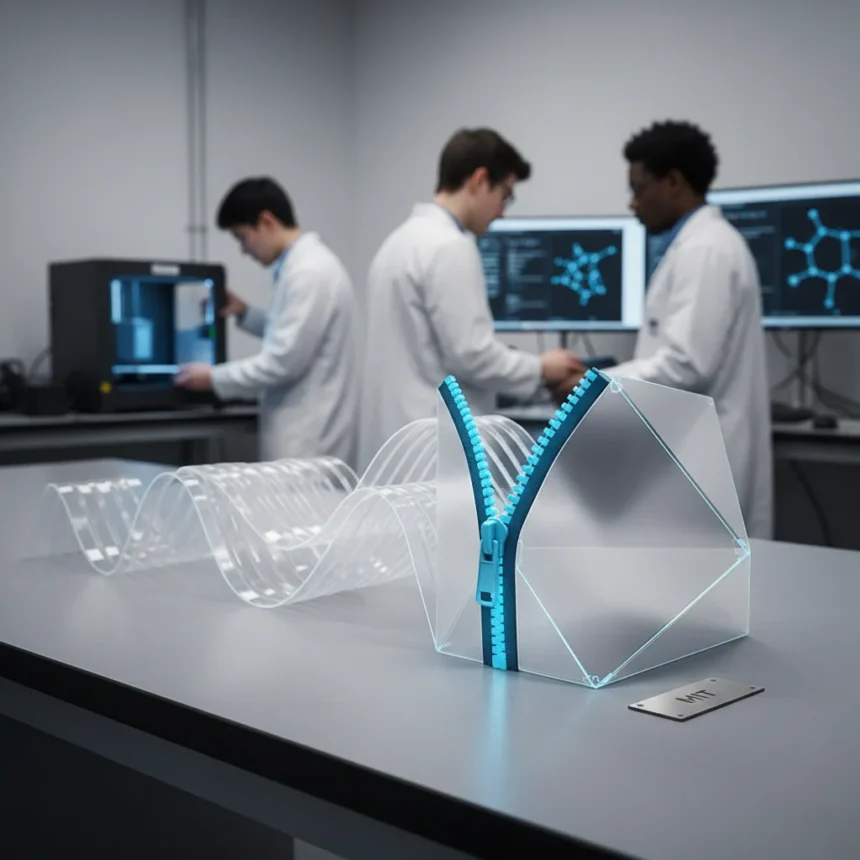
The 3D-printed Y-zipper is a three-sided fastener developed by MIT researchers that rapidly transitions objects between flexible and rigid states using multi-material 3D printing and custom design software. Based on a 1985 patent by MIT Professor Bill Freeman, the technology transforms a 40-year-old concept into a working system that could reshape how we assemble everything from camping tents to medical devices.
Key Takeaways
- Three-sided 3D-printed zipper structure enables rapid flexible-to-rigid transitions in seconds
- Survived 18,000+ zip/unzip cycles in durability testing before failure
- Reduces camping tent assembly from 6 minutes to 80 seconds using Y-zipper design
- Automated design software allows customization without specialized engineering expertise
- Applications span medical casts, robotic legs, and dynamic art installations
How the 3D-printed Y-zipper Works
Unlike traditional zippers designed for flat objects like jackets, the 3D-printed Y-zipper uses three interlocking flexible strips that transform into a rigid rod-like form when a specialized slider moves along the structure. The process is completely reversible—unzip it and the strips return to their flexible state. Jiaji Li, the MIT postdoc leading the research, explains the innovation: “Freeman ideated something more dynamic. Using current fabrication technology, his mechanism can transform more complex items”.
The researchers tested two common 3D-printing plastics: polylactic acid (PLA) and thermoplastic polyurethane (TPU). The elastic structure distributes stress from heavy loads across the entire mechanism, confirmed through 3D simulations. This design allows the Y-zipper to handle substantial weight while maintaining its reversible flexibility.
The software component is equally important. An automated design tool lets users customize the Y-zipper in straight, bent, coiled, or twisted configurations. The software then autonomously builds the design in a 3D printer, eliminating the need for specialized engineering expertise.

Real-World Performance and Durability
The 3D-printed Y-zipper demonstrates impressive durability in controlled testing. Researchers used an actuator to cycle the mechanism through repeated zip and unzip operations, and it survived over 18,000 complete cycles before failure. This validates the concept for real-world applications where reliability matters.
The practical advantages are significant. Assembling a camping tent with the Y-zipper takes 80 seconds compared to 6 minutes with manual assembly—a 75 percent reduction in setup time. For outdoor enthusiasts and emergency response teams, that speed advantage could be transformative. Medical applications show similar promise: adjustable casts could loosen during the day and tighten at night, adapting to changing swelling without removing the device entirely.



Robotic systems benefit from the dynamic height adjustment capability. Instead of manually reconfiguring robotic legs, the Y-zipper enables on-demand structural changes. Art installations can “bloom” at the push of a button, creating dynamic sculptures that shift between rigid and flexible forms.
The 40-Year Journey from Patent to Practice
The Y-zipper represents a rare case of academic research finally catching up to an inventor’s vision. Bill Freeman patented the core concept in 1985, but the technology remained impractical for four decades. Advances in 3D printing and software automation finally made the mechanism viable. Jiaji Li and the MIT Computer Science and Artificial Intelligence Laboratory (CSAIL) team have published their work as an open-access paper presented at CHI 2026, the premier computer-human interaction conference.
This timeline illustrates how emerging fabrication technologies can unlock dormant patents. Traditional manufacturing methods would have made the Y-zipper prohibitively expensive to produce. Multi-material 3D printing changed the equation, allowing researchers to test complex geometries and iterate rapidly without expensive tooling.
How the 3D-printed Y-zipper Compares to Alternatives
Traditional zippers excel at closing flat objects but cannot reversibly adjust stiffness. Prior methods for making objects stiffer required manual assembly or were difficult to reverse. The Y-zipper eliminates these limitations by using a single slider mechanism that can rapidly shift the entire structure between states. Other 3D-printed zipper research exists—including stretchable zippers fabricated via stereolithography for different engineering challenges—but the Y-zipper addresses a gap in reversible stiffness adjustment.



The accessibility advantage is worth emphasizing. Users do not need to be mechanical engineers to design a Y-zipper variant. The automated software handles the computational complexity, democratizing customization. This contrasts sharply with traditional fastening systems, which typically require manual design and manufacturing expertise.
What Comes Next for the 3D-printed Y-zipper
The research remains in the academic phase. No commercial launch date or pricing has been announced. The open-access paper and demonstration videos allow other researchers and makers to explore the technology independently. The real innovation may lie not in a single commercial product but in the framework itself—a template for designing reversible stiffness systems that others can adapt.
Material limitations have not been fully disclosed. While PLA and TPU were tested, long-term environmental degradation, UV resistance, and temperature limits remain unclear. Real-world durability under variable stress and environmental conditions differs from controlled laboratory testing. Scalability questions also remain—all demonstrated applications are relatively small-scale, and it is unclear whether the mechanism scales effectively to larger structures.
Does the 3D-printed Y-zipper actually work in the field?
The 80-second tent assembly time and 18,000-cycle durability test were conducted under ideal conditions. Real-world performance under variable stress, moisture, and temperature extremes has not been independently verified. The mechanism works in the lab, but field testing will determine whether it lives up to its promise.
Can you 3D-print a Y-zipper at home?
Yes. The automated design software allows anyone with access to a multi-material 3D printer to customize and fabricate a Y-zipper locally. This democratizes the technology beyond traditional manufacturing, though material quality and printer precision will affect durability.
What applications could the 3D-printed Y-zipper enable?
Beyond camping, medical, and robotics, the Y-zipper could transform emergency response equipment, adaptive clothing, deployable structures, and dynamic furniture. Any application requiring rapid, reversible stiffness adjustment becomes a candidate.
The Y-zipper proves that great ideas sometimes need decades to become practical. Freeman’s 1985 vision required 3D printing and software automation to become real. Now that it is, the mechanism is poised to unlock a new category of adaptive, reversible fastening systems. Whether it reaches mainstream adoption depends on whether manufacturers see the value in custom-printed fasteners over traditional alternatives—but for specialized applications like medical devices and emergency equipment, the Y-zipper has already won.
Edited by the All Things Geek team.
Source: TechRadar