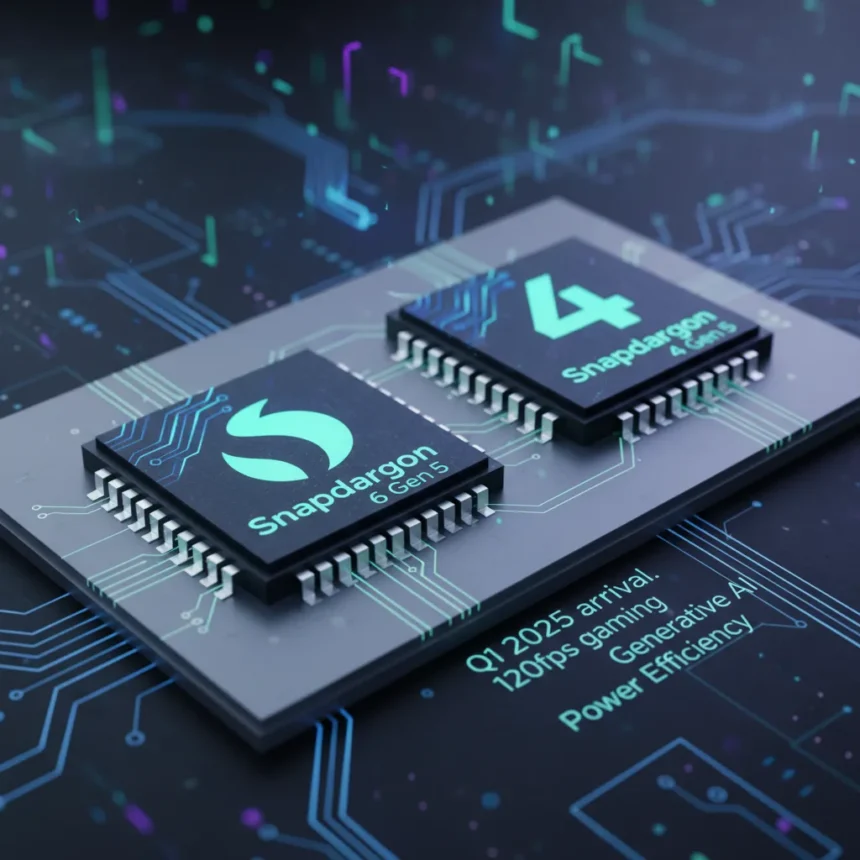
Snapdragon 6 and 4 Gen 5 chips are Qualcomm’s latest mobile processors designed to bring gaming and generative AI to mid-range and budget smartphones starting in Q1 2025. Both platforms, built on a 4nm process, target everyday users and mobile gamers who want flagship-level features without flagship pricing. Qualcomm’s VP and General Manager of Mobile Platforms, Ziad Asghar, emphasized the mission: “These new platforms deliver the AI and gaming experiences consumers want today, while providing the power efficiency needed for all-day usage.”
Key Takeaways
- Snapdragon 6 Gen 5 offers 25% better GPU performance and 50% improved gaming power efficiency versus the previous generation.
- Both chips support 120fps gaming, up to 108MP cameras, and FHD+ 120Hz displays on budget and mid-range devices.
- On-device generative AI runs up to 20% faster on Snapdragon 6 Gen 5, bringing AI features to affordable phones.
- Commercial devices from Motorola, realme, HMD Global, and FIH Mobile launch in Q1 2025.
- Snapdragon 6 Gen 5 includes Wi-Fi 6E and Snapdragon X63 5G modem; Snapdragon 4 Gen 5 uses the X61 modem.
Snapdragon 6 and 4 Gen 5 specs and architecture
Snapdragon 6 Gen 5 pairs two high-performance cores clocked at 2.4GHz with six efficiency cores at 1.8GHz, delivering a 25% CPU boost over its predecessor. The Adreno GPU jumps 25% in graphics performance, a meaningful leap for a mid-range chip. The AI Engine accelerates on-device generative AI by up to 20%, letting phones run language models and image generation without cloud dependency. Gaming gets its own power boost: the chip delivers 50% improved power efficiency during gameplay, meaning longer sessions before the battery drains.
Snapdragon 4 Gen 5 takes a slightly different approach. Its two performance cores run at 2.2GHz paired with six efficiency cores at 2.0GHz. While it skips the 25% GPU uplift, it still supports 120fps gaming and carries the same AI acceleration and gaming efficiency gains. Both chips max out at 108MP camera sensors, FHD+ 120Hz displays, and 4K video recording. The modem difference matters: Snapdragon 6 Gen 5 includes the X63 5G modem capable of 4.2Gbps downlink, while Snapdragon 4 Gen 5 uses the X61 at 2.9Gbps. For most users, the X61 is plenty; power users will feel the difference.
Gaming and AI: where Snapdragon 6 and 4 Gen 5 actually compete
Budget phones rarely nail gaming. Frame rates stutter, power drains fast, and thermals spike. Snapdragon 6 and 4 Gen 5 tackle this with Snapdragon Game Super Resolution, a technology that renders games at lower resolution then upscales them intelligently, maintaining visual quality while cutting GPU load. Paired with 50% better power efficiency on the Snapdragon 6 Gen 5, this means sustained 120fps performance on demanding titles without thermal throttling or rapid battery loss.


On the AI side, both chips embed generative AI capabilities directly on-device. The Snapdragon 6 Gen 5’s 20% faster AI Engine means text generation, image editing, and voice processing happen locally, not on Qualcomm’s servers. This addresses a real consumer frustration: AI features that require constant connectivity or cloud processing. Budget phone buyers rarely have premium data plans, so on-device AI is a genuine differentiator. The Snapdragon QuickSnap with Spectrum ISP handles computational photography—portrait mode, night mode, real-time filters—without eating battery. Camera AI across both chips supports up to 108MP sensors, bridging the gap between budget hardware and flagship capability.
How Snapdragon 6 and 4 Gen 5 compare to predecessors and rivals
The jump from Snapdragon 6 Gen 4 to Gen 5 is measurable: 25% CPU performance, 25% GPU performance, and 50% gaming efficiency. That is a meaningful generational leap. The Snapdragon 4 Gen 5, meanwhile, inherits the same architectural discipline as its bigger sibling, bringing 120fps gaming to the budget tier—something that was rare just two years ago. MediaTek’s Dimensity series, particularly the Dimensity 7300 and 6300, offer similar 4nm processes and gaming focus in the mid-range, but Qualcomm’s Snapdragon Game Super Resolution and dedicated AI Engine give the 6 and 4 Gen 5 a software advantage that benchmarks alone do not capture.



Flagship chips like the Snapdragon 8 Elite feature custom Oryon CPU cores that deliver raw performance no mid-range chip can match. Snapdragon 6 and 4 Gen 5 do not pretend otherwise. Instead, they optimize for what matters to their audience: gaming stability, everyday multitasking, and AI features that work offline. That is a smarter design philosophy than chasing flagship specs at mid-range prices.
Availability and OEM partners for Snapdragon 6 and 4 Gen 5
Qualcomm confirmed that commercial devices using Snapdragon 6 and 4 Gen 5 will arrive in Q1 2025 from major OEMs including Motorola, realme, HMD Global, and FIH Mobile. No specific phone models or launch dates have been announced, but Q1 means January through March 2025. Motorola’s Moto G series and realme’s budget lineup are likely candidates, as both brands rely heavily on Snapdragon processors in the mid-range. Global availability is expected, though specific regional pricing and carrier partnerships will vary by market.
Is Snapdragon 6 and 4 Gen 5 worth upgrading for?
If you own a Snapdragon 6 Gen 4 or older, the 25% GPU jump and 50% gaming efficiency on Snapdragon 6 Gen 5 justify an upgrade if gaming and AI features matter to you. For Snapdragon 4 Gen 2 users, moving to Gen 5 brings 120fps gaming support and on-device AI—genuine feature jumps. If your phone is less than two years old, wait for reviews of actual devices before deciding. Manufacturer optimization varies wildly; a poorly optimized Snapdragon 6 Gen 5 phone could underperform a well-tuned Snapdragon 6 Gen 4 device.
What devices will use Snapdragon 6 and 4 Gen 5?
Motorola, realme, HMD Global, and FIH Mobile are confirmed to launch commercial devices in Q1 2025. Motorola’s Moto G series, realme’s number series, and HMD’s revived Nokia brand are the most likely launch vehicles. FIH Mobile manufactures devices for multiple brands, so expect surprises. Specific model names and pricing have not been announced.



Snapdragon 6 and 4 Gen 5 chips represent a genuine effort to democratize gaming and AI. They are not flagship killers—that is not their job. They are tools for the billions of people who want a capable phone without paying flagship prices. If Qualcomm’s claims hold up in real-world testing, Q1 2025 should bring a wave of competent mid-range and budget phones that finally make gaming and generative AI accessible to everyone.
Edited by the All Things Geek team.
Source: Android Central