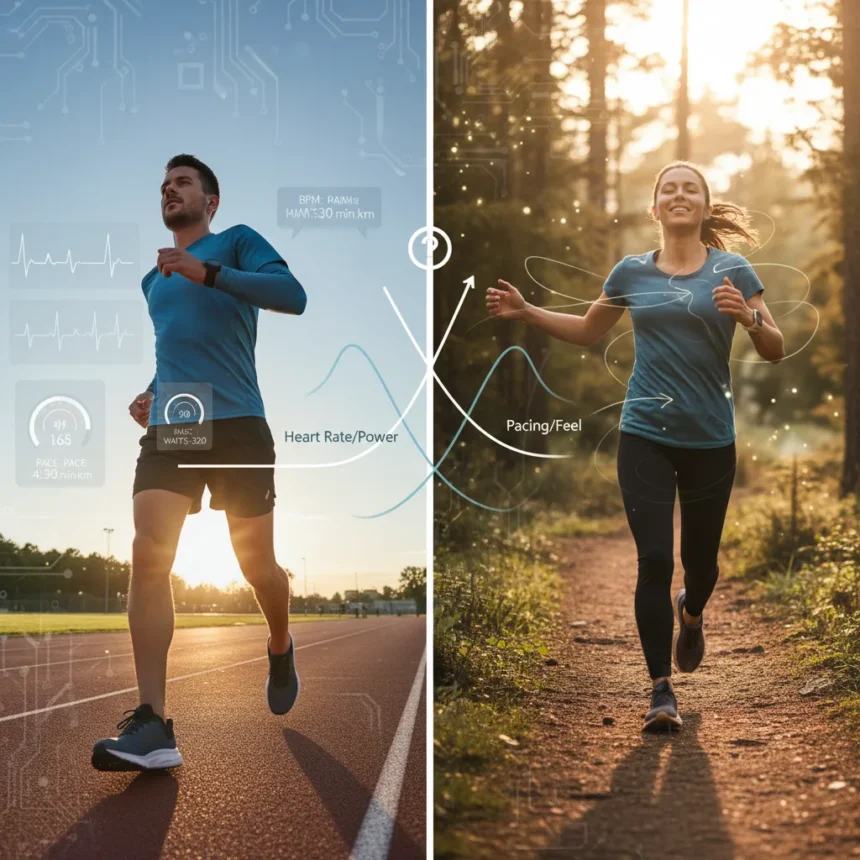
Running pace methods have evolved far beyond simply checking your watch. Today’s runners can choose between traditional pace-based training, heart rate zones, power metrics, or the timeless approach of running by feel. Each running pace method offers distinct advantages and limitations that shape how you train and race.
Key Takeaways
- Pace is intuitive but unreliable on varied terrain due to GPS errors up to 5-10 percent.
- Heart rate training reveals effort intensity but can be influenced by fatigue, heat, and caffeine.
- Power meters provide objective data but cost $235-280 and require specialized equipment like Stryd pods.
- Running by feel builds intuition through the Rate of Perceived Exertion (RPE) scale, needing no technology.
- Most runners benefit from combining two methods rather than relying on a single running pace approach.
Pace-Based Running: The Simplest but Trickiest Method
Pace remains the most intuitive running pace method because runners understand minutes per mile or kilometer instantly. You set a target pace in your GPS watch—say 8:00 min/mile for a tempo run—and follow the alerts when you drift faster or slower. Implementation is straightforward: calibrate your watch on a straight road before the run, then monitor splits every kilometer.
The problem? GPS accuracy varies wildly depending on where you run. Urban canyons, dense forests, and winding trails can produce errors of 5-10 percent, meaning your watch might record a 7:30 pace when you’re actually running 8:15. This becomes especially frustrating during hill repeats, where terrain changes make pace-based targets unreliable. On flat tracks and roads, pace shines. On anything else, it becomes a guessing game.
Pace also ignores effort. You can hit your target pace while coasting downhill on fresh legs, or miss it by seconds while grinding uphill on a tired day. Neither tells you whether you’re training the right energy system.

Heart Rate Training: Effort-Based Running Pace Methods
Heart rate training flips the equation by measuring how hard your cardiovascular engine is working, not how fast your legs are moving. This running pace method requires calculating your maximum heart rate—traditionally using the 220-minus-age formula, though a field test is more accurate—then training in zones like Zone 2 (typically 60-70 percent of max HR) for aerobic base building.
The advantage is clarity. Heart rate tells you whether you’re working at the right intensity regardless of terrain, weather, or fatigue. A Zone 2 run stays Zone 2 whether you’re on a flat road or climbing a mountain. This makes heart rate training superior for hill workouts and long efforts where pace becomes meaningless.



But heart rate lags behind reality. Your HR doesn’t spike instantly when you accelerate; it takes 30-60 seconds to catch up. In interval workouts, this delay means you’re already halfway through the hard effort before your watch confirms you’re in the right zone. Heat, caffeine, and fatigue can also elevate your HR by 5-10 beats per minute, throwing off your zones on hot days or when you’re tired. A chest strap (around $50-150) provides more accurate readings than wrist sensors, but adds another device to manage.
Power: The Most Objective Running Pace Method
Power meters measure running power in watts, accounting for terrain and gradient in ways pace and heart rate cannot. A Stryd foot pod ($235-280) pairs with your watch to calculate critical power (CP) from a ramp test, then lets you target power zones—say 85-95 percent CP for threshold work. You ignore pace and HR fluctuations and trust the power number.
Power is the gold standard for elite runners because it removes subjectivity. Wind, hills, fatigue—none of it matters. You’re training the actual energy you’re producing. For serious competitive runners, this precision is invaluable.
For everyone else, power is overkill. The equipment cost ($235-280 for a Stryd pod plus a compatible watch) and the learning curve of understanding power zones make this running pace method inaccessible to most amateur runners. Power also requires regular calibration and works best on consistent surfaces; soft ground like trails can skew readings. Unless you’re targeting a specific race with power-based pacing, the investment rarely pays off.



Running by Feel: The Tech-Free Running Pace Approach
Running by feel uses the Rate of Perceived Exertion (RPE) scale—typically 1 to 10, where 1 is rest and 10 is a maximum sprint. Easy runs sit at RPE 3-4 (you can talk easily), hard efforts at RPE 7-9, and recovery at RPE 1-2. The talk test offers a quick check: if you can hold a conversation, you’re in the aerobic zone; if you can only speak in short phrases, you’re working hard.
This running pace method builds intuition that technology cannot teach. Over time, you learn what true easy feels like versus what your watch calls easy. You develop the ability to pace races by internal signals rather than external metrics. For runners who find data overwhelming or who train primarily by feel, this approach removes the mental load of watching screens.
The downside is that RPE is subjective and can be wildly inaccurate, especially early in training. A runner might think they’re at RPE 5 when they’re actually at RPE 7, leading to overtraining. Consistency matters—you need dozens of runs to calibrate your sense of effort against known benchmarks.
Choosing Your Running Pace Strategy
Most runners benefit from combining two running pace methods rather than betting everything on one. A practical approach pairs pace for flat, predictable runs (tracks, roads) with heart rate for varied terrain (hills, trails). Another pairing uses heart rate zones for base building and running by feel for races, where watching your watch becomes a distraction.
On race day, start conservative—5-10 percent slower than your goal pace—and monitor your chosen running pace method every 5 kilometers. Adjust based on split times and energy levels rather than rigidly chasing a single metric. Your legs, not your watch, determine whether you can hold the effort to the finish.
FAQ
What is the most accurate running pace method for training?
Power is most accurate, but heart rate is more practical for most runners. Heart rate accounts for terrain and fatigue while remaining accessible and affordable. Pace works well only on flat, predictable surfaces where GPS error is minimal.
Can I use running by feel without a watch?
Yes. The talk test and RPE scale require no technology. You’ll need to calibrate your sense of effort over time by running known distances and comparing how you felt to your actual pace, but many runners train successfully this way.
How do I know which running pace method to start with?
Begin with pace on a track or flat road to establish baseline fitness, then add heart rate training for hill work. Once you understand how effort feels at different intensities, you can trust running by feel for easier sessions and use pace or heart rate only when you need precision.
Your choice of running pace method should match your goals, your terrain, and your tolerance for data. A runner training for a flat marathon might live by pace. A trail runner will gravitate toward heart rate or feel. An elite competitor might invest in power. There is no single best running pace approach—only the one that keeps you healthy, motivated, and improving.
Edited by the All Things Geek team.
Source: Tom's Guide