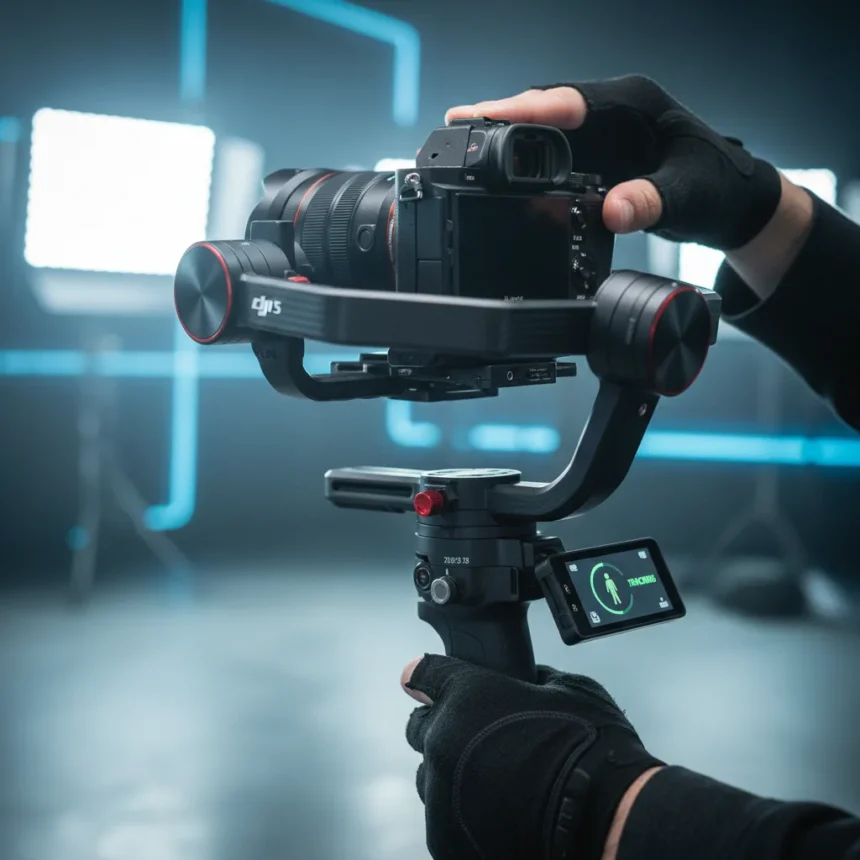
The DJI RS 5 gimbal is a stabilization system designed for mirrorless cameras, built on DJI’s established RS series platform and engineered to speed up setup while adding hands-free tracking capabilities. It represents a meaningful refinement over predecessors like the RS 4 Mini, which launched in June 2025 as the best portable gimbal for travel use.
Key Takeaways
- The DJI RS 5 gimbal cuts setup time and adds integrated tracking for hands-free operation.
- Compatible with professional mirrorless cameras, supporting substantial payload capacity.
- Builds on the RS 4 Mini design, which handles cameras like the Sony A7SIII with compatible lenses.
- Targets content creators who need faster workflows without sacrificing stabilization quality.
- Improves on earlier RS 3 Mini and RS 4 Mini designs with refined tracking integration.
What the DJI RS 5 Gimbal Does Better Than Its Predecessor
The DJI RS 5 gimbal distinguishes itself through faster setup and integrated tracking that the RS 4 Mini, despite its travel-focused design, required more manual adjustment to achieve. The RS 4 Mini was praised as the hands-free gimbal content creators had been waiting for, but the RS 5 takes that concept further by baking tracking directly into the system rather than treating it as an optional add-on. This architectural shift matters for creators working on tight schedules who cannot afford to spend setup time configuring tracking modes or calibrating manual movements.
The compact yet robust design carries forward from the RS 4 Mini, meaning the RS 5 does not sacrifice portability for its improved features. Content creators using mirrorless systems—whether Sony, Canon, Nikon, or Panasonic bodies—will find the payload capacity sufficient for professional work, a key differentiator from consumer-grade stabilizers that struggle with heavier lens combinations.
How the DJI RS 5 Gimbal Compares to In-Body Stabilization
A natural question for mirrorless camera owners is whether to invest in a gimbal when many modern cameras include in-body stabilization. The Panasonic Lumix S1R II, for example, delivers in-body stabilization that achieves roughly 90-95% of the stabilization quality you would get from a professional gimbal like the DJI RS 4 Mini. That sounds close, but the remaining 5-10% matters significantly in professional video work, particularly for complex camera movements, fast pans, or extended handheld shots where the gimbal’s active stabilization outperforms passive sensor-based systems.

The DJI RS 5 gimbal goes further than in-body systems by enabling smooth tracking movements that follow subjects automatically, a capability no camera sensor can replicate. For content creators shooting interviews, product demos, or dynamic vlogging, this hands-free tracking is a workflow significant shift that justifies the investment even if their camera already has solid in-body stabilization.
Who Should Buy the DJI RS 5 Gimbal
The DJI RS 5 gimbal is built for content creators using mirrorless cameras who prioritize faster workflows and integrated tracking. If you are shooting travel content, product reviews, or cinematic vlogging with a Sony A7SIII, Canon R5, Nikon Z9, or comparable mirrorless body, the RS 5 eliminates friction from your production process. The faster setup means less time fiddling with calibration and more time capturing shots, a meaningful advantage if you shoot multiple locations in a single day.



Creators already invested in the RS 4 Mini should evaluate whether the integrated tracking justifies an upgrade. If you frequently use tracking shots or find yourself manually configuring tracking modes, the RS 5 improves your workflow. If your current setup handles your content style adequately, the upgrade is optional. For new gimbal buyers, the RS 5 is the logical choice over the RS 4 Mini because you are not sacrificing portability or payload capacity while gaining faster setup and better tracking integration.
Is the DJI RS 5 gimbal worth buying for travel?
Yes, if you travel with mirrorless cameras and need stabilized video. The RS 5 gimbal maintains the compact design of the RS 4 Mini while adding faster setup, reducing the friction of airport security, hotel room prep, and location changes. Content creators who shoot vlogging, travel documentation, or location-based interviews will find the improved setup speed particularly valuable.
How does the DJI RS 5 gimbal handle heavy lenses?
The DJI RS 5 gimbal supports professional mirrorless camera and lens combinations within its payload capacity. The RS 4 Mini, for example, can handle a Sony A7SIII with a Sigma 24–70mm lens, though at the limit of its payload. The RS 5 maintains this capability with similar or improved payload specifications, making it suitable for professional work without requiring you to compromise on optics.
Can the DJI RS 5 gimbal track subjects automatically?
Yes. Integrated tracking is a core feature of the DJI RS 5 gimbal, enabling hands-free subject following without manual joystick input. This is a meaningful improvement over the RS 4 Mini, which required more manual configuration to achieve similar tracking results. For creators shooting interviews, product demonstrations, or any scenario where you need the camera to follow a moving subject, the built-in tracking saves significant setup time.



The DJI RS 5 gimbal represents a meaningful evolution in stabilization for mirrorless creators who value both speed and capability. Faster setup and integrated tracking address real pain points in professional video workflows, making it the logical choice for anyone serious about gimbal-stabilized content creation.
Where to Buy
$569 at Amazon | £485 | £485 | $749 | £619
Edited by the All Things Geek team.
Source: Tom's Guide