





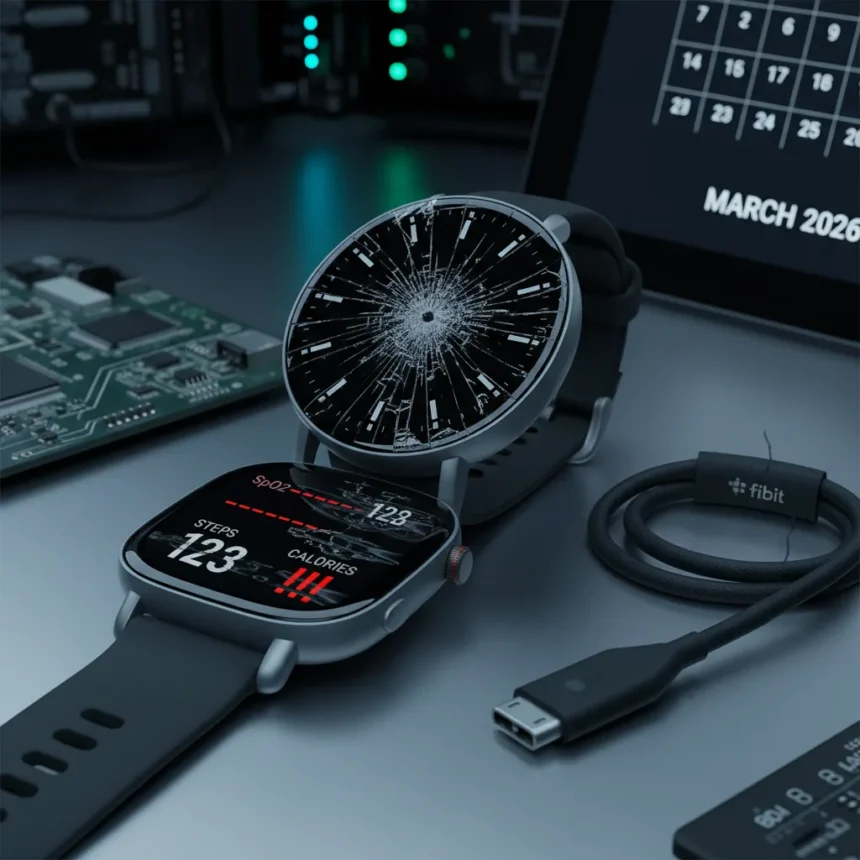
A Pixel Watch health sensor failure has rendered SpO2 and skin temperature tracking inoperative on both Pixel Watch 3 and Pixel Watch 4 models following the March 2026 Fitbit update. What appeared initially to be a hardware malfunction turned out to be a server-side and app-side problem requiring coordinated fixes from both Google and Fitbit.
Key Takeaways
- March 2026 Fitbit update disabled SpO2 and skin temperature sensors on Pixel Watch 3 and 4
- Step counts show severe inaccuracy, including cases where users recorded 14,000 steps while sitting at a desk
- Calorie burn calculations are inflated even during minimal activity
- Fitbit confirmed the issue and released a fix, though previously recorded data remains unchanged
- Factory resets do not permanently resolve the problem; issues resume after syncing
How the Pixel Watch Health Sensor Failure Unfolded
Users began reporting that their Pixel Watch devices had stopped tracking blood oxygen levels and skin temperature entirely. The immediate assumption was hardware failure—that the sensors themselves had malfunctioned or degraded. Google support initially suggested factory resets as a solution, but the problem persisted once watches synced back to paired phones, revealing the root cause was not hardware but rather a software defect in Fitbit’s backend systems and mobile app.
The scope of the Pixel Watch health sensor failure extended beyond the two disabled metrics. Step counting became wildly unreliable. One Reddit user documented their watch recording 14,000 steps while they remained seated at a desk. Others reported the opposite problem—undercounting actual movement. Calorie burn calculations inflated dramatically, showing significant energy expenditure during periods of minimal or no activity. These cascading errors suggested a systemic problem in how Fitbit’s servers were processing activity data from the affected watch models.
Data Integrity Issues and User Frustration
The Pixel Watch health sensor failure highlighted a critical vulnerability in wearable health tracking: the dependence on coordinated updates between device firmware and cloud services. When one breaks, the entire health data pipeline fails. Some users reported that Google support dismissed their complaints about inaccurate metrics, compounding frustration over losing core functionality they had relied upon. The lack of an official Google acknowledgment in public communications added to the sense that the company was slow to address a widespread problem affecting two current-generation devices.


Fitbit eventually confirmed the issue and stated they had deployed a fix. However, their statement included an important caveat: previously recorded data would remain unchanged, with the correction applying only to new activity going forward. This meant users could not recover the corrupted step counts, calorie data, and other metrics from the period when the Pixel Watch health sensor failure was active. Fitbit advised affected users to restart their Pixel Watch as a troubleshooting step for any lingering issues.
Pixel Watch Health Sensor Failure vs. Other Smartwatches
Most smartwatches rely on similar server-side processing for health metrics, making them vulnerable to the same class of software bugs that affected Pixel Watch devices. However, the Pixel Watch 3 and 4 occupy a unique position as Google’s first-party wearables, meaning users expect tighter integration and more reliable updates. The failure exposed a gap in Google’s quality assurance for Fitbit updates—a process that should catch data corruption before it reaches production. Competitors like Apple Watch maintain stricter controls over firmware rollouts, though no device is immune to software bugs entirely.


What Happened to Your Data?
If your Pixel Watch recorded 14,000 steps while you were inactive, that inaccurate data remains in your Fitbit history even after the fix. Fitbit’s decision not to retroactively correct corrupted metrics means users must manually delete affected data or accept the skewed records in their activity logs. This approach prioritizes system stability over user data accuracy—a trade-off that frustrated many who rely on Fitbit for fitness tracking and health insights.
Should You Trust Your Pixel Watch After This?
The Pixel Watch health sensor failure serves as a reminder that wearable health metrics should be treated as exploratory trends rather than definitive measurements. Your step count might be off by thousands. Your calorie burn might be inflated. SpO2 readings, when they return, may not be perfectly calibrated. Use your Pixel Watch to identify activity patterns and motivate movement, but do not rely on it for medical decisions or precise health monitoring. If you need accurate health data, consult a healthcare provider and proper diagnostic equipment.
Has Fitbit fixed the Pixel Watch sensor issue?
Fitbit confirmed they fixed the Pixel Watch health sensor failure and released an update that corrects step counting and calorie calculations going forward. However, data corrupted during the outage remains unchanged in your history. Restarting your Pixel Watch is recommended if you continue experiencing issues after the fix.
Why did factory reset not fix the problem?
A factory reset erased the watch’s local data but did not address the server-side problem in Fitbit’s systems. Once the watch synced with your phone, it reconnected to the same broken backend infrastructure, and the Pixel Watch health sensor failure resumed. Only Fitbit’s server-side fix resolved the underlying issue.

Can I recover my corrupted step data?
No. Fitbit’s fix applies only to new activity, leaving previously recorded data intact—even when that data is clearly wrong. You can manually delete affected entries from your Fitbit app, but there is no automatic correction or recovery tool.
The March 2026 Fitbit update and resulting Pixel Watch health sensor failure revealed how fragile the connection between hardware and cloud services can be. Google and Fitbit have since patched the problem, but the episode underscores why wearable health data should inform your fitness decisions rather than dictate them. Your Pixel Watch is a useful tool for tracking trends, not a medical device. Treat it accordingly.
Edited by the All Things Geek team.
Source: Android Central




