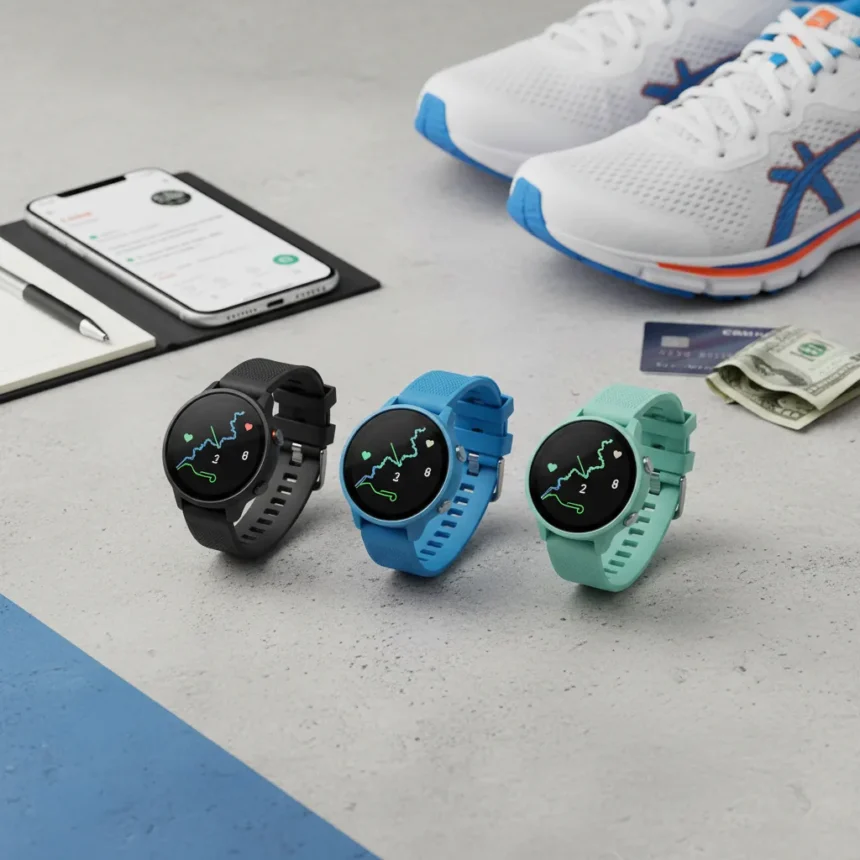
Budget running watches are GPS-enabled wearables designed to track pace, distance, and heart rate without the premium price tag of professional-grade devices. As running continues to grow in popularity heading into 2025 and 2026, a wave of new runners face the same dilemma: how much do you actually need to spend to get started? According to TechRadar’s buying guide, reliable options exist for under $250 — and for most beginners, that’s exactly where the smart money sits.
Key Takeaways
- Reliable budget running watches with GPS and heart-rate monitoring are available for under $250 / £230 / AU$400.
- The Garmin Forerunner 165, priced at $229 / £219 / AU$399, is a top pick for beginner runners seeking value and longevity.
- The Coros Pace 3 targets budget-conscious runners who want specialist fitness tracking without smartwatch bloat.
- Apple Watch SE and Samsung Galaxy Watch 8 are viable alternatives for runners who also want full smartwatch functionality.
- Dedicated running watches outperform general fitness bands for speed and stride tracking thanks to built-in gyroscopes and sport-specific software.
What do budget running watches actually need to do?
For a beginner runner, three metrics matter above everything else: pace, distance, and heart rate. That’s it. The expensive features — full-color topographic maps, deep recovery analytics, multi-sport training plans — are genuinely useful for experienced athletes, but they add cost and complexity that new runners simply don’t need yet. Starting simple isn’t a compromise; it’s the right call.
Beginner runners typically cover shorter distances and run in familiar environments, which means advanced navigation tools serve little practical purpose. What matters is building consistency, and a watch that clearly shows your pace and distance does that job just as well as one costing three times as much. The under-$250 category has matured significantly, with dedicated sensors, gyroscopes, and running-specific software now standard at this price point.
The best budget running watches worth buying right now
The Garmin Forerunner 165, priced at $229 / £219 / AU$399, sits at the top of most beginner shortlists for good reason. It tracks runs, monitors progress over time, and keeps the interface simple enough that you won’t spend your first few weeks decoding data instead of actually running. One genuinely useful feature: if GPS signal drops — say, in a tunnel — the watch uses automatic cadence and stride length calculation to keep tracking your run without a gap in the data.


The Coros Pace 3 takes a different approach, positioning itself as a pure running specialist at a budget price. It strips away smartwatch features to focus entirely on athletic performance, which suits runners who have no interest in notifications or app ecosystems. For anyone who wants a device that does one thing well, the Pace 3 is worth serious consideration.
The Fitbit Charge line rounds out the budget options, offering a more fitness-band-style form factor for runners who prefer something lighter on the wrist. It sits within the under-$250 threshold and covers the core tracking basics, though it’s worth noting that dedicated running watches with built-in GPS generally deliver more accurate pace and stride data than slimmer fitness bands.



Should beginners consider smartwatch alternatives instead?
The Apple Watch SE and Samsung Galaxy Watch 8 both deserve a mention here, though they serve a slightly different need. If staying reachable during runs matters to you — calls, messages, music controls — these smartwatches handle that better than any dedicated running watch. They also use phone-paired GPS effectively for shorter jogs, which covers most beginner use cases.
The trade-off is focus. Smartwatches are built to do many things adequately rather than one thing exceptionally well. Their running interfaces are functional, but the sport-specific software on a Garmin or Coros device is more refined for runners. If your primary goal is running improvement rather than general connectivity, a dedicated running watch is the stronger choice. If you want one device for everything, the Apple Watch SE or Galaxy Watch 8 won’t let you down on a casual 5K.
Are budget running watches actually better than fitness bands?
General fitness trackers and slim bands are cheaper, but they’re not optimised for running. Dedicated budget running watches include built-in gyroscopes and sport-specific algorithms that calculate speed and stride more accurately than a basic step-counting band. The difference shows up most clearly when you’re trying to improve — a watch that gives you reliable pace data helps you train smarter, while a band that estimates steps gives you noise.
That said, if someone is genuinely just starting out and wants to track basic activity before committing to running specifically, a fitness band is a reasonable entry point. The key is understanding what you’re buying: a fitness band tracks movement broadly, while a running watch tracks running specifically.



Is the Garmin Forerunner 165 worth it for a complete beginner?
Yes. At $229 / £219 / AU$399, the Garmin Forerunner 165 sits just under the $250 threshold and delivers the core features beginners actually use: GPS tracking, heart-rate monitoring, cadence calculation, and clear progress data. It’s not overloaded with advanced metrics that confuse rather than help, and Garmin’s software ecosystem grows with you if you stick with running long-term.
Do I need a running watch or will my phone do?
A phone with a running app covers the basics for very short, casual jogs — but it’s impractical to carry during most runs and less accurate for pace tracking without a wrist-based sensor. A dedicated running watch gives you real-time data on your wrist, tracks heart rate continuously, and doesn’t require you to strap a phone to your arm. For anyone serious about building a running habit, a watch is the better tool.
What is the difference between a fitness band and a running watch?
Fitness bands track general daily activity — steps, sleep, calories — using basic sensors. Running watches include dedicated GPS chips, gyroscopes, and sport-specific software that calculate pace, stride length, and distance with much greater precision. For running improvement specifically, a dedicated running watch delivers meaningfully more useful data than a general fitness band.
The case for budget running watches in 2025 is straightforward: the sub-$250 category now offers genuine running tools, not just stripped-down compromises. Beginners who start with the right watch — something like the Garmin Forerunner 165 or Coros Pace 3 — get accurate data, simple interfaces, and room to grow. Spending more on features you won’t use for months is a waste; spending less on a band that can’t track pace properly is a frustration. The sweet spot is right here, and it’s never been better stocked.
Where to Buy
20% OFFAmazfit Active 2$79.99$99.99shop now | Xiaomi Smart Band 10$47.99shop now | 30% OFFFitbit Inspire 3$69.95$99.95shop now | Garmin Vivosmart 5$147.90shop now | Polar Pacer Pro$299.99shop now
Edited by the All Things Geek team.
Source: TechRadar