





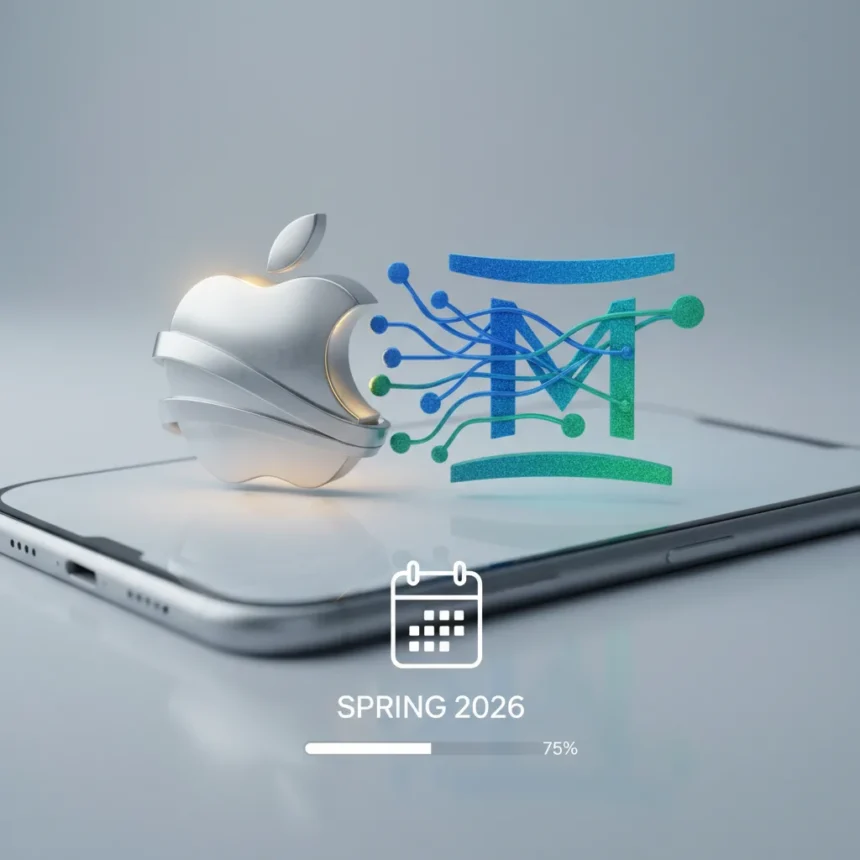
Apple Google Gemini Siri integration represents one of the most significant AI concessions in smartphone history. After nearly two years of delays since promising AI-upgraded Siri at WWDC 2024, Apple has reached a deal with Google to power future Apple Intelligence features using Gemini models rather than relying solely on its own AI capabilities. The partnership signals a fundamental shift: the company that built its reputation on vertical integration and proprietary technology is now outsourcing a core intelligence feature to its search rival.
Key Takeaways
- Apple reached a deal with Google to use Gemini models powering Apple Intelligence and a more personalized Siri in Spring 2026.
- Siri upgrade delayed nearly two years since WWDC 2024 announcement, originally promised for 2024 rollout.
- Google confirmed new Fitbit devices launching in 2026, marking overdue hardware refresh for compact fitness trackers.
- Apple’s concession to Google represents major shift in AI leadership dynamics within the smartphone industry.
- Spring 2026 launch ties Siri upgrades to iPhone’s seasonal update cycle, likely coinciding with iOS 18 features.
Why Apple Chose Google Over Its Own AI
Apple’s decision to rely on Google Gemini for Siri represents a pragmatic retreat from the company’s original vision. The joint statement from Apple and Google declared: “These [Gemini] models will help power future Apple Intelligence features, including a more personalized Siri coming this year.” Two years is an eternity in AI development. By the time Spring 2026 arrives, Gemini will have matured significantly beyond what Apple could deliver independently on the same timeline. Rather than launch an inferior Siri upgrade, Apple chose competitive advantage over pride.
This move exposes a critical weakness in Apple’s AI strategy. The company spent years building on-device machine learning capabilities, yet when it came time to deliver truly intelligent, conversational features comparable to ChatGPT or Claude, Apple fell short. Gemini’s large language model capabilities, trained on Google’s vast data infrastructure, simply outpace what Apple can offer. The partnership acknowledges this reality explicitly. For users, the outcome is positive: a smarter Siri powered by Google’s AI research rather than a delayed, mediocre version of Apple’s own technology.
Spring 2026 Timeline: What’s at Stake
The Spring 2026 launch window is crucial for Apple’s credibility. The company first announced AI-upgraded Siri at WWDC 2024, promising delivery within months. Instead, the feature vanished from timelines, reappeared in rumors, and faced repeated delays. Now, with Google backing the technology, Apple has a concrete deadline and external accountability. If Siri doesn’t launch in Spring 2026 as promised, both companies share the blame.


This timing also matters strategically. Spring 2026 likely precedes Apple’s fall iPhone event, meaning the new Siri will ship as a headline feature for the next iPhone generation. Users upgrading to new hardware will experience a genuinely transformed voice assistant—one that understands context, remembers preferences, and handles complex requests. The delay, while frustrating, allows Apple to integrate Gemini deeply into iOS 18 rather than tacking it on as an afterthought.
Google’s Fitbit Gamble: Wearables Refresh Long Overdue
While Apple stumbled on AI, Google is finally addressing its wearables neglect. A Google executive confirmed that new Fitbit devices will launch during 2026, marking a significant refresh for the compact, lightweight fitness tracker line. Fitbit Charge 6, the previous flagship, has aged without meaningful upgrades. The new devices represent Google’s commitment to the wearables market after years of incremental improvements.



Google’s Fitbit lineup competes in a crowded space dominated by Apple Watch and Garmin’s specialized trackers. Fitbit’s strength lies in simplicity and battery life—qualities that appeal to users who want fitness tracking without the complexity of a smartwatch. The 2026 refresh must capitalize on these advantages while adding modern features like improved health sensors and faster processors. Without concrete details on specifications or pricing, it’s unclear whether Google will position new Fitbits as premium devices or maintain the accessible, budget-friendly positioning that built the brand.
What This Means for the Smartphone AI Arms Race
The Apple-Google partnership reshapes the competitive landscape. Samsung, which has pursued its own AI strategy with Galaxy AI features, now faces a two-front challenge: competing with Apple’s Gemini-powered Siri and building its own differentiated AI experience. Meanwhile, smaller players like OnePlus and Motorola lack the resources to develop competitive AI features independently, making partnerships with OpenAI, Google, or other AI providers essential.
This consolidation around a few dominant AI providers—Google, OpenAI, Anthropic—has profound implications. Rather than a diverse ecosystem of AI implementations, smartphones increasingly rely on the same underlying models. Differentiation shifts from the AI itself to how companies integrate and present these models to users. Apple’s expertise in interface design and user experience becomes more valuable than raw AI capability. Google’s advantage lies in training data and model quality. The race is no longer about who builds the best AI, but who deploys it most effectively.
Will Apple’s Siri Finally Catch Up?
Siri has been a running joke in tech circles for years. Even Apple users acknowledge that Google Assistant and Alexa handle complex requests more reliably. The gap isn’t about voice recognition—Siri hears fine. It’s about understanding intent, maintaining context, and executing multi-step tasks. Gemini-powered Siri should address these shortcomings, assuming Google’s models integrate smoothly with Apple’s on-device processing and privacy safeguards.



One critical question remains: how much of Siri’s processing happens on-device versus on Google’s servers? Apple has long emphasized privacy by keeping data local. Relying on Gemini may require cloud processing, potentially compromising Apple’s privacy messaging. The company will need to communicate clearly about what Siri data flows to Google and what stays encrypted on the device. Users who chose iPhone partly for privacy protections will scrutinize this trade-off closely.
Is Apple paying Google for Gemini integration?
The research brief confirms Apple reached a deal with Google but does not specify financial terms. Whether Apple pays per query, per device, or via a licensing agreement remains undisclosed. Such partnership terms are rarely public, but the structure matters for long-term economics. If Apple pays per query, costs scale with Siri usage. If it’s a fixed licensing fee, Apple absorbs the expense regardless of adoption.
When will the new Siri launch?
Apple and Google confirmed a Spring 2026 rollout for the Gemini-powered Siri upgrade. This likely means availability by June 2026, tied to iOS 18 or a mid-cycle update. Users with compatible iPhones will receive the feature via software update, though Apple may reserve some capabilities for newer hardware.
What new Fitbit devices is Google launching in 2026?
Google has not yet revealed specific Fitbit models, specifications, or launch dates beyond confirming devices will arrive during 2026. Expect announcements at Google I/O in May 2026 or via press release closer to launch. The new trackers will likely target the fitness-focused segment currently served by Fitbit Charge 6 and Fitbit Sense.
The week’s biggest tech stories reveal a shifting power dynamic. Apple, once unassailable in device design and user experience, now outsources core intelligence to Google. Meanwhile, Google strengthens its ecosystem across software (Gemini), hardware (Fitbit), and services. This isn’t a disaster for Apple—Siri will genuinely improve, and users benefit from better AI. But it’s a humbling moment for a company that built its brand on doing everything better, not just differently. Spring 2026 will show whether the partnership delivers on its promise.
Edited by the All Things Geek team.
Source: TechRadar




