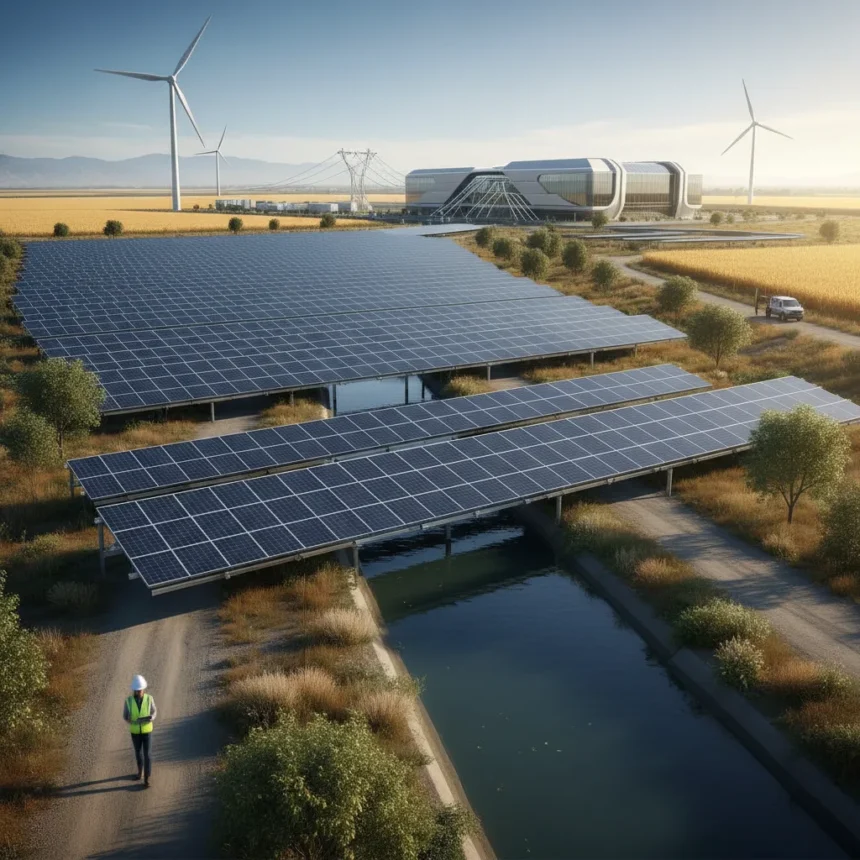
Solar canals California represent one of the state’s most promising—and most contentious—solutions to simultaneous energy and water crises. California’s canal network spans approximately 4,000 miles, transporting water to 35 million people and 5.7 million acres of farmland. Covering all 4,000 miles with solar panels could generate 13 gigawatts of clean energy capacity, enough to power about 2 million homes annually and representing over half of the new solar capacity needed by 2030 for California’s decarbonization goals.
Key Takeaways
- Solar canals California could generate 13GW of clean energy, representing over 50% of the state’s 2030 solar expansion needs.
- Water savings estimated at 63 billion gallons annually from reduced evaporation, equivalent to residential needs for 2 million people.
- Solar panels over water are cooled by underlying canals, boosting electricity production by up to 3% compared to ground-mounted systems.
- Governor Newsom invested $20 million in pilot projects; federal funding announced April 2024 for additional pilots in Central Valley.
- Environmental groups raise concerns about aquatic ecosystems, wildlife disruption, and unproven long-term scalability at full deployment.
Why Solar Canals California Matter Right Now
California faces a perfect storm. Data center demand is exploding as AI workloads surge, yet the state’s electricity grid and water supplies are already strained by drought and population growth. Solar canals California offer a rare dual-benefit solution: generate massive renewable capacity while simultaneously conserving water through reduced evaporation. The numbers are compelling. Covering the state’s canal network would save an estimated 63 to 65 billion gallons of water per year from reduced evaporation—enough to meet residential needs for 2 million people or irrigate 50,000 acres of farmland. That same infrastructure would deliver 13GW of clean generation capacity, fulfilling more than half of California’s solar expansion target for 2030.
The timing is critical. California must achieve 60% carbon-free electricity by 2030 and 100% renewable by 2045. Data centers—particularly those powering AI and cloud computing—consume enormous amounts of both electricity and water. Solar canals California address both constraints simultaneously, which is why state and federal officials have begun backing pilot projects. Governor Gavin Newsom invested $20 million in a solar-over-canals pilot in Turlock, Merced County, with additional federal funding announced in April 2024 for a pilot near Los Banos.
How Solar Canals California Beat Ground-Mounted Solar
Solar canals California outperform traditional ground-mounted systems in three critical ways. First, they require no land acquisition or disturbance—a massive advantage in a state where available undeveloped land is scarce and environmentally sensitive. Second, the underlying water cools the solar panels, reducing panel temperature by up to 10 degrees Fahrenheit and boosting electricity production by up to 3% compared to ground systems. Third, the panels mitigate aquatic weed growth and reduce water loss, creating multiple value streams in a single infrastructure investment.


Ground-mounted solar is cheaper upfront but demands land clearing and offers no water conservation benefits. Solar canals California have higher initial costs but superior lifecycle economics. As David DeJong, director of the Pima-Maricopa Irrigation project in Arizona, explained: “Why disturb land that has sacred value when we could just put the solar panels over a canal and generate more efficient power?” Arizona’s experience with similar projects demonstrates that solar-over-water systems can deliver both efficiency and community acceptance when designed thoughtfully. Prior pilots and studies confirm co-benefits including avoided land costs, aquatic weed mitigation, enhanced photovoltaic efficiency, making solar canals cost-competitive or cheaper over their lifecycle despite higher upfront costs compared to ground-mounted systems.
The Opposition Problem Blocking Solar Canals California
Despite the compelling case, solar canals California face substantial resistance. Environmental groups and activists raise legitimate uncertainties about long-term aquatic ecosystem impacts. Questions linger about algae growth patterns, fish habitat disruption, maintenance challenges in wet environments, and whether the technology can truly scale across thousands of miles without unforeseen consequences. Regulatory hurdles are equally daunting—permitting solar canals California requires coordination across water agencies, environmental regulators, local governments, and federal authorities, each with competing priorities and risk tolerance.



Some critics argue that promotional messaging around solar canals California overstates benefits and downplays complexity. The 13GW figure and 63-billion-gallon water savings are model-based estimates, not yet proven at full deployment scale. No complete 4,000-mile installation exists to validate performance assumptions across diverse canal types, climates, and operational conditions. Skeptics worry that enthusiasm for the concept may outpace genuine engineering readiness, leading to costly failures that could set back renewable energy projects generally.
What Research Institutions Are Doing Now
The USC-led California Solar Canal Initiative (CSCI), launched in 2025, is attempting to answer these questions systematically. Organized by USC Dornsife Public Exchange and Solar AquaGrid, the initiative studies scaling feasibility, costs, permitting frameworks, regulatory requirements, water and energy impacts, and community effects. This research effort signals that serious institutions recognize solar canals California as worthy of rigorous investigation, not mere hype.
The pilots in Turlock and Los Banos provide real-world test cases. Turlock’s $20 million project, funded by Governor Newsom, will generate operational data on panel durability, water savings, energy production, and maintenance requirements. Federal backing for the Los Banos pilot suggests the Biden Administration views solar canals California as aligned with national clean energy and water security priorities. Success in these pilots could unlock broader deployment and attract private investment.
Can Solar Canals California Actually Scale?
Scaling solar canals California from pilot projects to 4,000 miles of coverage faces three barriers: regulatory approval, environmental certification, and capital availability. Each canal system operates under different water law frameworks, ownership structures, and environmental protections. A solar panel system that works on one canal may face objections on another due to local ecosystem differences or water rights complexities. Permitting delays could stretch timelines by years, and cost overruns could make large-scale deployment economically marginal.



Capital is available—renewable energy investors are eager to fund projects meeting climate and water goals simultaneously. But they require proof of concept and regulatory certainty. The CSCI research effort and ongoing pilots should provide both by 2026 or 2027. If early results are positive and permitting pathways clarify, solar canals California could begin scaling within five years. If obstacles mount, the concept could stall despite its promise.
Is solar canals California the solution to data center power and water demands?
Solar canals California address the immediate problem—simultaneous electricity and water scarcity—but they are not a standalone solution. Data center demand will likely exceed even 13GW of solar-canal generation. A comprehensive strategy requires solar canals California alongside other renewables (wind, rooftop solar, geothermal), grid modernization, and data center efficiency improvements. However, solar canals California are uniquely suited to California’s geography and constraints, making them a critical component of any credible 2030 decarbonization plan.
What happens if solar canals California face environmental lawsuits?
Environmental litigation is a real risk. If aquatic ecosystem impacts prove more severe than models predict, lawsuits could halt projects mid-construction and trigger costly remediation. This uncertainty is why the CSCI research and pilot monitoring are essential—they generate defensible data that can withstand legal challenge. Transparent environmental review and community engagement now will reduce litigation risk later.
When will solar canals California actually be deployed at scale?
Full-scale deployment likely depends on pilot success by 2026 and regulatory clarity by 2027. If both conditions are met, expect phased rollout beginning around 2028, with significant capacity coming online by 2030 as California races toward its carbon-free target. However, permitting delays or environmental setbacks could push this timeline back by several years.
Solar canals California represent genuine innovation addressing real constraints, but they are not inevitable. Success requires sustained political commitment, rigorous environmental oversight, and realistic timelines. The next 18 months of pilot operations will determine whether this idea moves from promising concept to deployed infrastructure or becomes another California sustainability project that stalled in regulatory limbo.
Edited by the All Things Geek team.
Source: TechRadar