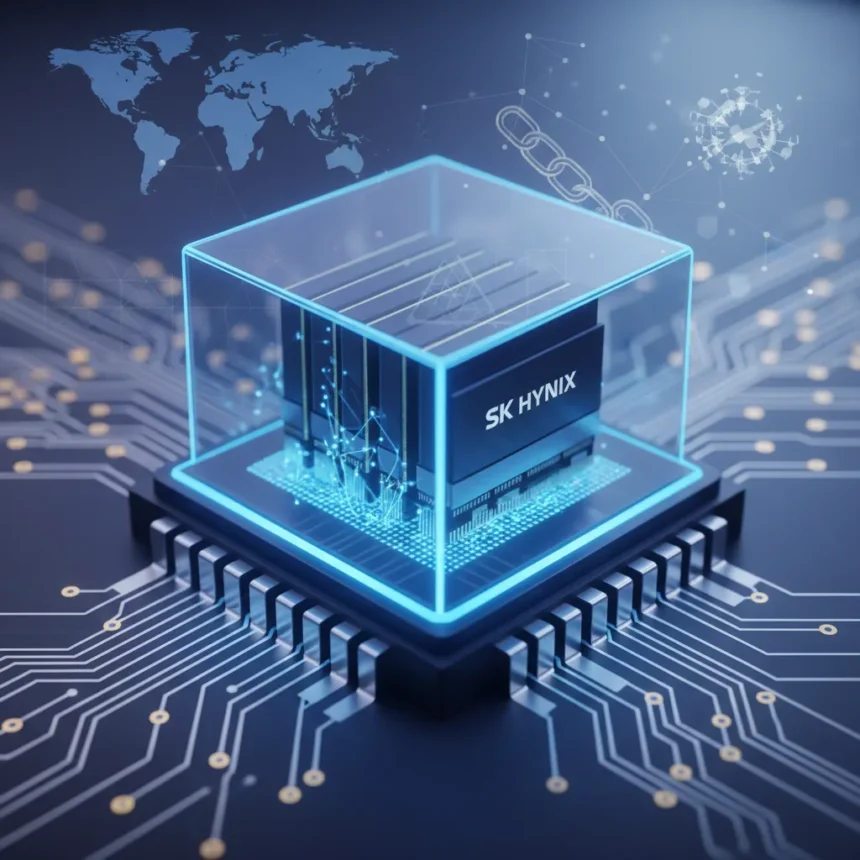
The Intel EMIB partnership between Intel and SK Hynix represents a significant shift in how the semiconductor industry approaches high-bandwidth memory packaging for artificial intelligence applications. On May 11, 2026, reports emerged that SK Hynix is testing Intel’s EMIB (Embedded Multi-die Interconnect Bridge) substrates specifically for 2.5D HBM (High Bandwidth Memory) packaging, triggering immediate market enthusiasm. Both SK Hynix and Intel shares surged to all-time highs following the announcement, signaling investor confidence in this collaboration to strengthen AI chip supply chain resilience.
Key Takeaways
- SK Hynix is actively testing Intel’s EMIB technology for advanced 2.5D HBM packaging solutions
- Reports of the partnership triggered stock surges for both Intel and SK Hynix on May 11, 2026
- EMIB enables direct interconnection between HBM and other chips via embedded bridges, improving performance and density
- The collaboration addresses supply chain diversification amid ongoing semiconductor trade disputes
- SK Hynix’s dominance in AI memory could be leveraged through EMIB to challenge integrated solutions from competitors
Why the Intel EMIB Partnership Matters for AI Supply Chains
The Intel EMIB partnership addresses a critical vulnerability in the global AI chip ecosystem. SK Hynix holds a commanding position as the highest-performing DRAM supplier for AI GPUs training systems like those powering large language models. By evaluating Intel’s 2.5D EMIB technology for HBM integration, SK Hynix gains access to advanced packaging methods that could diversify the supply chain beyond traditional solutions. This collaboration signals a strategic pivot: instead of relying on a single architectural approach, the industry is exploring multiple pathways to integrate memory with compute at the package level.
EMIB technology functions as an embedded interconnect bridge connecting HBM directly with other chips on a 2.5D substrate. This approach differs from conventional monolithic integration by allowing modular assembly of memory and logic components. For SK Hynix, testing EMIB substrates represents an opportunity to maintain its market leadership while reducing dependency on any single packaging methodology. The timing is deliberate—global semiconductor tensions and trade restrictions have made supply chain diversification a business imperative rather than a luxury.
Intel EMIB as a Competitive Differentiator
Intel’s EMIB technology has long been positioned as a solution for advanced packaging challenges, but its application to HBM represents a new frontier. Traditional packaging approaches from competitors like TSMC or Samsung have dominated the AI memory space, but they operate within architectural constraints that limit scalability. The Intel EMIB partnership allows SK Hynix to test whether Intel’s 2.5D approach can match or exceed the performance density of existing solutions while offering manufacturing flexibility.



SK Hynix’s evaluation of EMIB substrates is not merely a technical experiment—it is a hedge against supply chain concentration. If the testing proves successful, SK Hynix could license or manufacture EMIB-based solutions independently, reducing reliance on any single packaging partner. This diversification matters enormously in an industry where geopolitical factors increasingly influence technology access and manufacturing capacity.
Market Implications and Stock Reaction
The surge in SK Hynix and Intel share prices reflects investor recognition of the strategic value embedded in this partnership. Markets interpret supply chain resilience as a competitive advantage, particularly in memory and semiconductor sectors where concentration risk is high. SK Hynix’s dominant position in HBM for AI applications makes any technological advancement in packaging a potential unlock for market share and pricing power.



The timing of these reports—May 11, 2026—coincided with broader industry discussions about semiconductor self-sufficiency and regional production capacity. Companies and governments worldwide are incentivizing advanced packaging research as a counterbalance to geopolitical supply chain vulnerabilities. SK Hynix’s investment in EMIB evaluation aligns with this trend, signaling to investors that the company is not passively accepting existing packaging architectures but actively shaping the next generation of solutions.
What This Means for the Broader AI Chip Ecosystem
If SK Hynix successfully integrates Intel’s EMIB technology into HBM products, the implications extend beyond these two companies. Nvidia, AMD, and other AI chip designers depend on latest memory packaging to maximize performance per watt. A viable alternative to existing HBM packaging methods could accelerate innovation cycles and reduce costs across the industry. Conversely, if EMIB proves inferior to current solutions, the partnership becomes a research milestone with limited commercial impact.
The Intel EMIB partnership also reflects a broader industry shift toward modular, chiplet-based architectures. Rather than monolithic designs, advanced AI systems increasingly rely on specialized components—compute, memory, I/O—assembled at the package level. EMIB’s embedded bridge approach fits naturally into this paradigm, making it a logical technology for SK Hynix to evaluate as HBM requirements grow more demanding.
Is SK Hynix officially manufacturing EMIB-based HBM?
No. SK Hynix is currently testing Intel’s EMIB substrates for potential future integration. The reports describe ongoing evaluation, not production or commercial availability. Official confirmation from either company has not been announced as of May 2026.


How does EMIB compare to traditional HBM packaging methods?
EMIB uses embedded interconnect bridges to connect HBM directly with other chips on a 2.5D substrate, offering modular assembly flexibility. Traditional methods integrate memory more tightly but within fixed architectural constraints. EMIB’s approach potentially allows SK Hynix greater manufacturing flexibility and supply chain diversification.
Why does supply chain diversification matter for AI memory?
AI chip demand is growing faster than production capacity, and geopolitical tensions have made reliance on single suppliers or packaging methods risky. Multiple viable approaches to HBM packaging reduce the impact of any single disruption and give customers more sourcing options.
The Intel EMIB partnership represents a strategic bet by SK Hynix on technological optionality. By testing advanced packaging solutions from Intel, SK Hynix is not abandoning its current methods but building a portfolio of capabilities to serve evolving AI chip requirements. Whether this partnership yields commercial products or remains a research collaboration, it signals that supply chain resilience and technological diversification are now central to competitive advantage in semiconductors.
Edited by the All Things Geek team.
Source: Tom's Hardware