






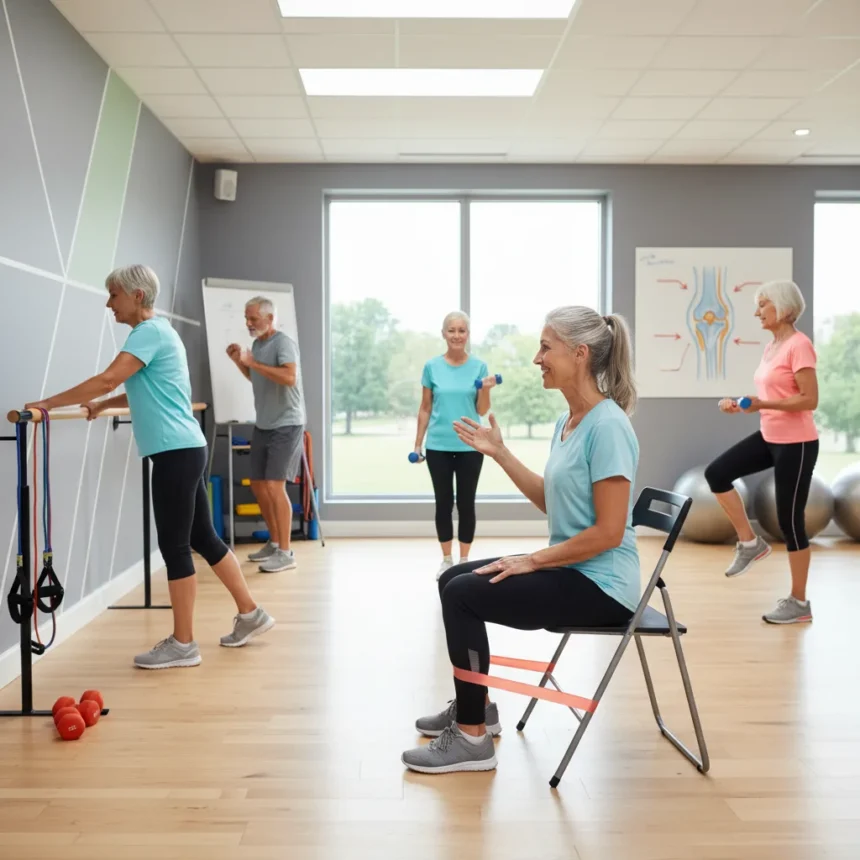
Knee-friendly exercises for seniors are reshaping how older adults approach lower-body strength training. Rather than defaulting to squats and lunges—movements that can aggravate joint pain or instability—a growing body of fitness guidance emphasizes gentler alternatives designed to build strength without compromising knee health. A 65-year-old personal trainer has popularized a five-exercise bodyweight routine that sidesteps these high-impact movements entirely, focusing instead on controlled, chair-based exercises that target leg stability and muscular endurance.
Key Takeaways
- Knee-friendly exercises for seniors avoid high-impact movements like squats and lunges that strain joints.
- Bodyweight chair exercises build leg strength while reducing knee pain and instability.
- A five-exercise routine requires no gym equipment and fits into a 10-minute session.
- Seniors should consult a medical professional before starting new exercises, especially with existing joint concerns.
- Stability and strength in the knees directly support balance, mobility, and fall prevention in older adults.
Why Squats and Lunges Fail Many Older Adults
Squats and lunges dominate mainstream fitness advice, but they are not universally appropriate for aging knees. These movements demand significant knee flexion and load-bearing at angles that can trigger pain, instability, or compensation patterns in people with arthritis, previous injuries, or naturally weak stabilizer muscles. Knee-friendly exercises for seniors take a different approach: they isolate the muscles that support the knee joint—the quadriceps, glutes, and hip stabilizers—without requiring deep knee bends or forward lunges that concentrate stress on the joint itself.
The appeal is straightforward. A senior performing a traditional squat must coordinate balance, control descent, and manage their body weight through a compromised or stiff joint. If the knee lacks stability or mobility, the movement becomes risky. Chair-based alternatives eliminate these variables. By using a chair for support or as a reference point, older adults can perform strength work with a controlled range of motion, reducing injury risk while still stimulating muscle growth and neuromuscular adaptation.
The Five-Exercise Routine: Strength Without Strain
The routine presented by the 65-year-old trainer consists of five bodyweight exercises specifically chosen to build knee strength and stability. While the exact exercise names and detailed form cues from the original article are not fully available here, the overarching principle is clear: each movement targets the muscles surrounding the knee without requiring deep flexion or load-bearing lunge mechanics. The routine is designed to be completed in approximately 10 minutes, making it accessible for seniors with limited time or energy.


Bodyweight exercise routines for older adults typically emphasize controlled tempos, full range of motion within a pain-free zone, and repetitions that build muscular endurance rather than explosive power. Chair-based variations allow seniors to adjust difficulty on the fly—holding the chair for balance if needed, or releasing it when confidence and stability improve. This scalability is critical for aging populations, where individual mobility, strength, and pain thresholds vary widely.
The focus on knee-friendly exercises for seniors reflects a broader shift in fitness culture away from one-size-fits-all programming. Rather than forcing older adults into movements designed for younger, more resilient bodies, trainers and therapists are now customizing routines around the specific vulnerabilities and goals of each client. For many seniors, that means prioritizing knee health above all else, since strong, stable knees are foundational to independent living, balance, and fall prevention.



Knee Strength as a Foundation for Aging Well
Knee strength and stability are not vanity metrics—they are essential to quality of life in older age. Weak knees contribute to shuffling gait, reduced stride length, and increased fall risk, all of which accelerate functional decline and loss of independence. Conversely, seniors who maintain strong, stable knees retain the ability to walk confidently, climb stairs, stand from a chair without assistance, and navigate uneven terrain. These seemingly simple tasks are the pillars of independent living.
Knee-friendly exercises for seniors build this foundation without the collateral damage of high-impact or high-load movements. By strengthening the quadriceps, glutes, and hip stabilizers through controlled, bodyweight work, older adults improve their neuromuscular coordination and proprioception—the body’s sense of where it is in space. This translates directly to better balance, fewer missteps, and lower fracture risk if a fall does occur.
The contrast with squats and lunges is instructive. While those movements can certainly build leg strength, they carry a higher injury risk for seniors with compromised knees, and they often require a level of mobility or pain tolerance that many older adults lack. Knee-friendly alternatives remove these barriers, allowing more seniors to engage in consistent strength training without fear or discomfort.
Who Should Try This Routine—and Who Should Wait
Knee-friendly exercises for seniors are broadly appropriate for older adults looking to maintain or improve leg strength, balance, and mobility. The routine is especially valuable for seniors who have experienced knee pain, stiffness, or instability in the past, or who simply find squats and lunges uncomfortable or risky. Because the movements are low-impact and bodyweight-based, they require minimal equipment and can be performed at home.



That said, anyone with a history of knee injury, arthritis, or other joint concerns should consult a qualified healthcare provider or physical therapist before starting any new exercise program. A medical professional can assess individual mobility, pain patterns, and structural concerns, and can recommend modifications or alternatives if needed. This is especially important for seniors taking medications that affect balance or joint function, or those recovering from surgery or injury.
Frequently Asked Questions
What makes knee-friendly exercises for seniors safer than squats?
Knee-friendly exercises for seniors typically use a chair for support, reduce the range of knee flexion, and avoid load-bearing positions that concentrate stress on the joint. Squats, by contrast, require deep knee bending and load management, which can aggravate pain or instability in aging knees. The controlled environment and reduced complexity of chair-based work lower injury risk.
Can seniors with arthritis do knee-friendly exercises?
Many seniors with arthritis can benefit from gentle, controlled strength work, but individual tolerance varies widely. A physical therapist or doctor can assess the severity of arthritis and recommend modifications or alternatives. Pain during exercise is a signal to stop—discomfort that lingers after a workout suggests the intensity or range of motion was too aggressive.
How often should seniors perform these exercises?
The research brief does not specify an exact frequency recommendation. Most fitness guidance suggests that older adults perform strength training at least two to three times per week, with at least one rest day between sessions to allow muscle recovery. Starting conservatively—once or twice per week—allows the body to adapt and reveals any pain or discomfort patterns before increasing volume.
Building knee strength and stability does not require the complexity or intensity of traditional strength training. Knee-friendly exercises for seniors prove that simple, bodyweight movements performed consistently can deliver meaningful results—stronger legs, better balance, and the confidence to move freely through daily life. For older adults tired of squats and lunges, this approach offers a practical, evidence-informed alternative that prioritizes joint health without sacrificing strength gains.
Edited by the All Things Geek team.
Source: Tom's Guide