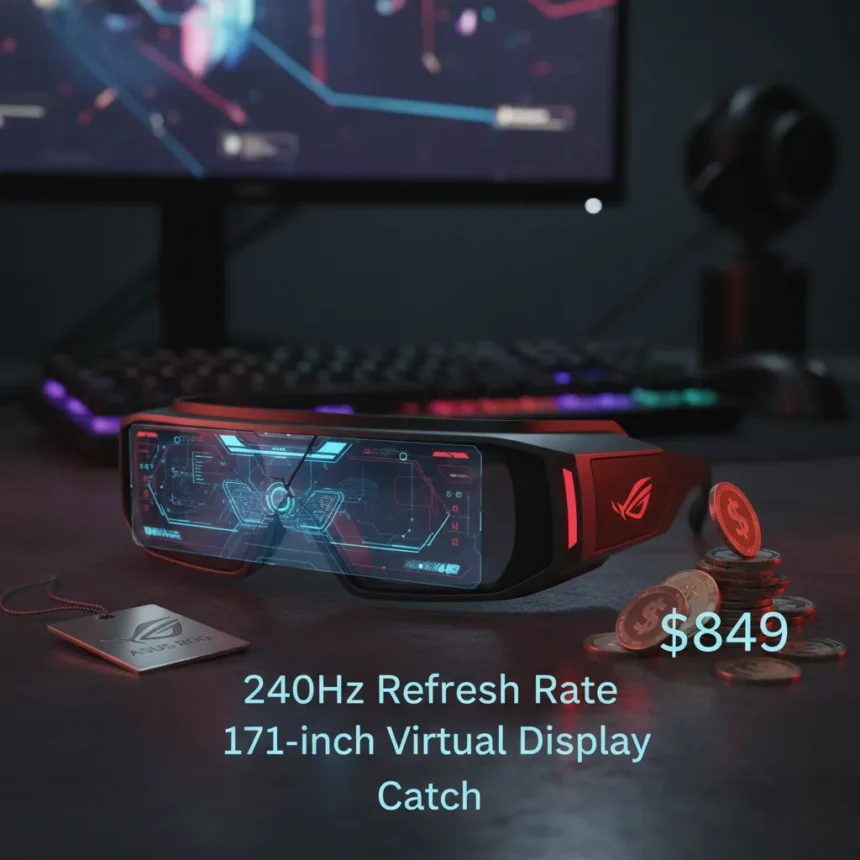
The Asus ROG Xreal R1 AR glasses are now available for pre-order at $849, marking a significant moment for gaming-focused augmented reality hardware. These aren’t casual smart glasses—they’re a high-end collaboration between Asus and Xreal designed to project a 171-inch virtual display at 240Hz refresh rate, promising console-quality gaming on your face.
Key Takeaways
- Asus ROG Xreal R1 AR glasses pre-orders are live at $849 for a premium gaming bundle.
- The glasses deliver a 171-inch virtual display with 240Hz refresh rate for fast-action gaming.
- The $849 price positions these as a luxury product, not a mainstream consumer device.
- Bundle contents determine whether the price justifies the entry cost for serious gamers.
- Availability and shipping timelines remain critical unknowns for potential buyers.
What Makes the Asus ROG Xreal R1 AR Glasses Stand Out
The Asus ROG Xreal R1 AR glasses distinguish themselves through raw gaming specifications that few competitors match at launch. A 240Hz refresh rate eliminates the stuttering that plagues lower-refresh AR displays, critical for fast-paced shooters and racing games where motion clarity determines competitive advantage. The 171-inch virtual screen size is substantial—equivalent to sitting 10 feet from a large television—without requiring you to wear a headset that blocks your surroundings.
This combination of high refresh rate and large virtual canvas addresses a genuine gap in the AR gaming market. Most existing AR glasses prioritize everyday utility (notifications, navigation, social media) over gaming performance. The Asus ROG Xreal R1 AR glasses flip that priority. They’re built for someone who wants to play Fortnite or Gran Turismo on their wrist or handheld device without compromise on visual fluidity or screen real estate.
Why $849 Feels Steep—And Maybe Justified
The $849 price tag immediately raises skepticism. That’s flagship smartphone money, or a solid gaming laptop budget. What justifies the cost? The answer depends entirely on what ships in the box and which devices the glasses actually support smoothly.


High-refresh AR displays are expensive to manufacture. The optics, the processing unit, and the battery all contribute to cost. A 240Hz refresh rate requires fast pixel switching and responsive tracking—technologies that don’t scale down cheaply. Without knowing the exact bundle contents—whether power adapters, carrying cases, or compatibility modules are included—it’s difficult to assess whether $849 is premium pricing or genuine value.
The glasses’ ecosystem matters too. If they work flawlessly with gaming handhelds, consoles, and PCs, the price becomes more defensible. If compatibility is patchy or requires additional purchases, the value proposition collapses. That uncertainty is the real barrier to recommendation right now.



Asus ROG Xreal R1 AR Glasses vs. Other Gaming Displays
Gaming AR glasses exist on a spectrum. Budget options like smartphone-based AR viewers offer minimal immersion and refresh rates below 60Hz. Premium gaming monitors deliver 240Hz+ but require a desk and don’t move with you. The Asus ROG Xreal R1 AR glasses attempt to bridge that gap—mobile, high-refresh, and screen-agnostic enough to work across multiple devices.
What separates them from lower-cost AR glasses is the refresh rate and screen size combination. Older Xreal products and competing AR glasses typically max out at 120Hz with smaller virtual displays. The jump to 240Hz and 171 inches is meaningful for gaming but comes with a price premium that consumers accustomed to $300–$500 AR glasses will need to justify to themselves. The question isn’t whether the Asus ROG Xreal R1 AR glasses are impressive—it’s whether they’re impressive enough to be worth three times the cost of a basic AR display.
What You Actually Need to Know Before Pre-Ordering
Pre-orders being live is the headline, but critical details remain unclear. What’s in the $849 package? Are there required accessories? Which gaming platforms are officially supported at launch? What’s the actual shipping timeline? These questions matter more than specs because they determine real-world usability.
The gaming AR market is still immature. Early adopters of the Asus ROG Xreal R1 AR glasses are betting on a product category that hasn’t yet proven mainstream appeal. That’s not necessarily a deal-breaker—premium gaming hardware has always been a niche market—but it’s a risk worth acknowledging. If Asus and Xreal nail the software integration and developer support, these glasses could define a new gaming category. If they stumble on compatibility or performance, $849 buyers will feel that mistake acutely.



Should You Pre-Order the Asus ROG Xreal R1 AR Glasses?
Pre-ordering makes sense only if you’re already invested in gaming handhelds or portable gaming devices and you want the absolute highest-refresh AR experience available. If you’re a casual gamer or skeptical about AR glasses generally, wait for real-world reviews and user reports. The Asus ROG Xreal R1 AR glasses are a first-generation premium product in an unproven category—that’s exciting for early adopters, risky for everyone else.
The $849 price is real, the 240Hz spec is real, and the 171-inch display is real. What’s unknown is whether those features translate to the gaming experience Asus and Xreal are promising. That’s the gap between impressive on paper and impressive in your hands.
What devices are compatible with the Asus ROG Xreal R1 AR glasses?
The research brief does not specify which gaming devices the glasses officially support at launch. Compatibility details should be confirmed directly with Asus or Xreal before pre-ordering, as this will determine whether your existing gaming hardware works with the glasses or if additional purchases are required.
When will the Asus ROG Xreal R1 AR glasses ship?
The research brief does not confirm a specific shipping date or launch window. Pre-orders are live now, but the actual delivery timeline remains unannounced. Check the official pre-order page for estimated shipping dates before committing.
How do the Asus ROG Xreal R1 AR glasses compare to VR headsets?
AR glasses show your real environment while overlaying digital content; VR headsets block your surroundings entirely. The Asus ROG Xreal R1 AR glasses prioritize gaming without full immersion, making them better for portable play but less cinematic than high-end VR. The choice depends on whether you want to stay aware of your physical space while gaming.
The Asus ROG Xreal R1 AR glasses represent a bold bet on gaming AR becoming a real category. Whether that bet pays off depends on execution, compatibility, and developer support—factors that won’t be clear until units reach hands-on reviewers and real gamers. For now, they’re an impressive specification sheet at a premium price, waiting to prove they’re worth it.
Edited by the All Things Geek team.
Source: Tom's Guide