






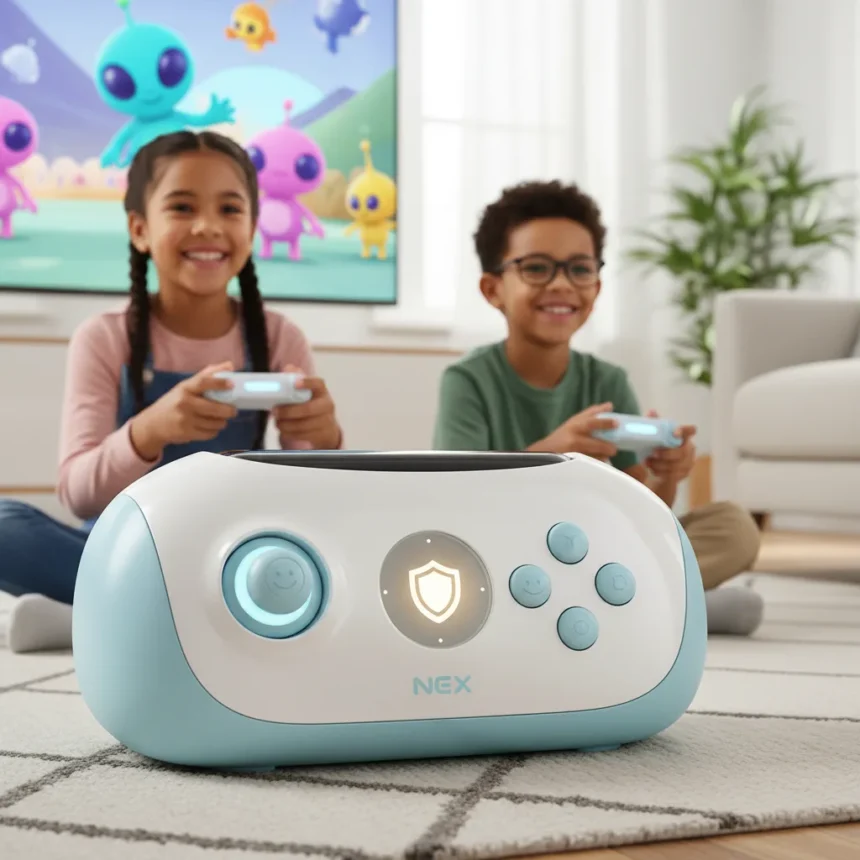
Nex’s kid-friendly console safety strategy represents a deliberate shift away from minimum regulatory compliance toward industry leadership. In an exclusive interview with TechRadar Pro, Nex leadership argued that the company is positioning itself as a proactive Trust and Safety innovator, not merely an organization meeting the UK’s Online Safety Act requirements.
Key Takeaways
- Nex frames its approach as leadership-driven rather than compliance-driven in Trust and Safety design
- The kid-friendly console is built to exceed the UK Online Safety Act’s minimum standards
- The company’s strategy centers on Trust and Safety as a competitive differentiator, not just a regulatory obligation
- Nex leadership stated directly: “We’re not a compliant organization, we’re a leading organization”
- The interview reveals a deliberate positioning against the perception of reactive regulatory response
Nex’s Kid-Friendly Console Safety Strategy
Nex’s kid-friendly console safety approach reflects a broader industry tension between meeting legal minimums and setting higher voluntary standards. The company’s leadership made clear in their TechRadar Pro interview that Trust and Safety design is not an afterthought bolted onto a gaming device—it is foundational. This positioning matters because the UK Online Safety Act creates a baseline of obligations for platforms hosting user-generated content and facilitating online interaction, but it does not prescribe how companies should exceed those requirements.
The distinction between compliance and leadership is subtle but consequential. A compliant organization builds features that satisfy regulatory auditors. A leading organization anticipates user harm before regulators identify it, designs controls that users actually want to use, and treats safety as a product advantage rather than a cost center. Nex’s public stance suggests the company believes the latter approach will resonate with parents and guardians evaluating gaming devices for children.
Positioning Beyond Regulatory Minimums
The headline quote from Nex leadership—”We’re not a compliant organization, we’re a leading organization”—signals a strategic decision to distance the brand from reactive regulatory posturing. This messaging is important because gaming platforms aimed at children have historically faced criticism for treating safety as an afterthought, adding parental controls and content filters only after public pressure or legal action forced their hand.



By framing Trust and Safety as a leadership issue rather than a compliance checkbox, Nex is attempting to reshape how parents and industry observers evaluate kid-friendly gaming hardware. The company is betting that consumers will value proactive, thoughtful safety design over the minimum required by law. Whether that bet pays off depends partly on whether the kid-friendly console’s actual features and enforcement mechanisms justify the leadership rhetoric.
Trust and Safety as Competitive Differentiation
The interview reveals that Nex sees Trust and Safety not as a cost of doing business but as a potential competitive moat. In a crowded gaming market, safety-conscious parents represent a specific, motivated audience. If Nex can credibly demonstrate that its kid-friendly console offers superior protections, transparency, and user control compared to competitors, the company gains a defensible market position.



This approach also shifts the conversation away from pure hardware specs—processing power, graphics, game library—toward governance and accountability. For a new entrant or challenger brand, that shift can be advantageous. Established gaming platforms may have larger libraries and stronger network effects, but they also carry legacy baggage around safety failures and slow regulatory responses. A new kid-friendly console built from the ground up with Trust and Safety as a core principle has a cleaner slate.
Regulatory Context and Market Implications
The UK Online Safety Act creates legal pressure on platforms to address harmful content and protect children from exploitation and inappropriate material. Nex’s decision to position itself ahead of those requirements reflects confidence that the baseline will rise over time, either through regulatory tightening or through market demand as parents become more safety-conscious.
The company’s messaging also acknowledges a broader shift in how technology regulation is evolving. Rather than waiting for rules to tighten and then scrambling to comply, forward-thinking platforms are building safety infrastructure proactively. This approach reduces future compliance risk, avoids the reputational damage of reactive fixes, and positions the company as trustworthy in the eyes of regulators and consumers alike.
Does Nex’s kid-friendly console actually deliver on its safety promises?
The research brief does not provide specific details about the console’s actual safety features, parental controls, content moderation systems, or enforcement mechanisms. Nex’s leadership made clear statements about their strategic positioning, but the technical implementation and real-world effectiveness of the kid-friendly console safety design remain unverified from the available source material.



How does Nex’s approach compare to other gaming platforms for children?
The research brief does not include detailed comparisons between Nex’s kid-friendly console and other gaming platforms or parental control ecosystems. The article focuses on Nex’s internal positioning and philosophy rather than competitive benchmarking or feature-by-feature analysis against rivals.
What is the UK Online Safety Act and why does it matter for gaming?
The UK Online Safety Act establishes legal obligations for platforms that host user-generated content or facilitate online interaction to protect children from harmful material and exploitation. For gaming consoles and online services, this means implementing age verification, content moderation, reporting mechanisms, and parental controls. Nex’s strategy is to exceed these baseline requirements rather than simply meet them.
Nex’s positioning as a leadership-driven rather than compliance-driven organization reflects a calculated bet that parents and regulators will reward proactive safety thinking over minimum legal adherence. Whether the kid-friendly console delivers on that promise depends on the actual implementation—features, transparency, and accountability mechanisms that matter in real households. The interview demonstrates strategic intent, but execution will determine whether Nex’s safety leadership claim holds up under scrutiny.
Edited by the All Things Geek team.
Source: TechRadar