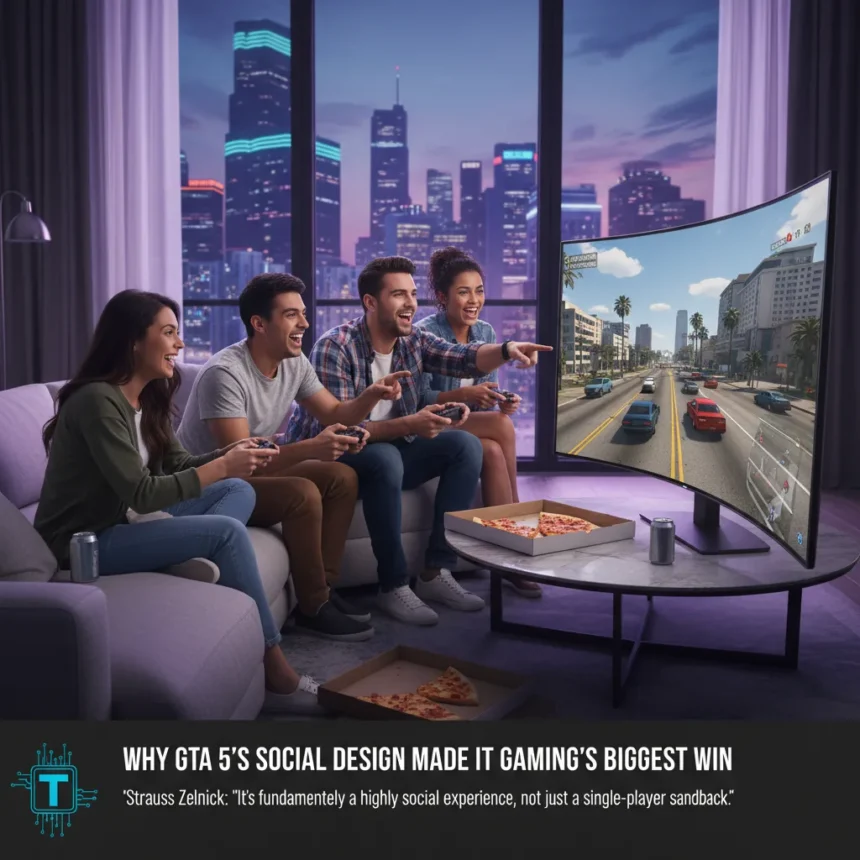
Grand Theft Auto 5’s enduring dominance in gaming comes down to one thing: it is fundamentally a highly social experience, according to Take-Two Interactive CEO Strauss Zelnick. In a recent interview, Zelnick articulated why a game released over a decade ago continues to generate revenue, player engagement, and cultural relevance that most studios can only dream about.
Key Takeaways
- Strauss Zelnick credits GTA 5’s success to its design as a highly social experience rather than purely single-player gameplay.
- The game’s longevity defies typical industry cycles, remaining commercially dominant a decade after launch.
- Social connectivity in game design drives retention and cultural staying power more than technical specs alone.
- GTA 5’s multiplayer integration fundamentally shaped how modern open-world games approach community engagement.
- Zelnick’s perspective signals that Take-Two views social design as core to franchise strategy going forward.
The Social Design Philosophy Behind GTA 5’s Dominance
Strauss Zelnick’s explanation cuts through the usual industry noise about graphics, performance, and processing power. The reason GTA 5 has sustained its grip on the gaming market for over a decade is not primarily technical—it is architectural. Zelnick argues that GTA 5 succeeds because Rockstar built it as a social platform first and a single-player story second. That design choice, made years before live-service games became industry orthodoxy, proved prescient.
The distinction matters. A single-player game, no matter how polished, has a natural lifecycle. Players complete it, shelve it, move on. But a highly social experience creates reasons for players to return. Friends play together. Communities form. New content drops and existing players log back in to experience it alongside their peers. GTA 5’s Online mode transformed the game from a finite narrative into an ongoing social space—and that shift explains why it has outearned and outlasted competitors with superior graphics or more innovative mechanics.
Zelnick’s framing reflects a fundamental truth about modern gaming that many publishers still misunderstand: technical excellence is necessary but insufficient. A game can have the best engine in the world and still fail if it does not give players reasons to gather, collaborate, compete, and share the experience with others. GTA 5 nailed that social component early, before the formula became standardized.


How Social Design Differs from Multiplayer Mechanics
There is a critical difference between adding multiplayer modes to a game and designing a game around social experiences from the ground up. GTA 5 Online was not a tacked-on afterthought—it was built as an integral part of the product vision. Players could smoothly transition between single-player and shared worlds. The progression systems, the economy, the content updates, all reinforced the idea that GTA 5 was a shared space where your choices and status mattered to others.
Compare this to games that bolted multiplayer onto single-player frameworks as an aftermarket addition. Those games often feel disjointed. The economies do not balance. The progression feels artificial. GTA 5’s integration is so seamless that many players do not consciously recognize they are playing in a fundamentally social system—they just know the game keeps drawing them back. This architectural cohesion is what separates a game with multiplayer from a game that is inherently social.



Zelnick’s comments suggest that Take-Two learned a crucial lesson from GTA 5’s success: social design is not a feature to add later—it is a foundational pillar. Every decision about progression, content, economy, and player interaction should reinforce the social dimension. That philosophy will likely shape how Rockstar approaches its next generation of titles and how Take-Two evaluates future acquisitions and development priorities.
Why Social Experience Outperforms Hype and Graphics
The gaming industry has a tendency to obsess over technical specifications. Which console has the faster GPU? Whose ray-tracing implementation is superior? These metrics matter, but they do not explain GTA 5’s sustained dominance. A game with marginally better graphics but weaker social infrastructure will lose players faster than a game with solid visuals and a thriving community.
Zelnick’s perspective aligns with observable market behavior. Games with robust social ecosystems—shared progression, competitive rankings, community events, cooperative missions—retain players far longer than technically superior competitors that lack those systems. The social experience creates network effects. Each new player makes the game more valuable for existing players. Each friend who joins pulls in more friends. The game becomes self-reinforcing.
This insight has profound implications for how the industry should evaluate success. Revenue alone does not capture it. Player counts alone do not capture it. The metric that matters is player longevity and the depth of community engagement. GTA 5 wins decisively on those measures because Rockstar understood, perhaps intuitively at first, that people do not return to games for mechanics or graphics—they return for connection. The social experience is the product.


What This Means for the Industry Going Forward
Strauss Zelnick’s public articulation of why GTA 5 succeeded is significant because it signals how Take-Two will approach future development. If the CEO is publicly crediting social design as the primary driver of success, internal development teams are likely being briefed to prioritize social architecture in their planning. This could influence how GTA 6 is designed, how future live-service elements are integrated, and how Take-Two evaluates whether to acquire or invest in other studios.
The gaming industry is crowded with technically impressive games that failed commercially because they underestimated the social dimension. Conversely, games with modest technical ambitions but strong community features often outperform expectations. Zelnick’s comments give explicit permission for developers to invest heavily in social infrastructure, even if it means allocating resources away from marginal graphical improvements or feature bloat.
For players, this means the next generation of major franchises will likely prioritize how you experience the game with others over how the game looks in isolation. That shift is already underway in the industry, but having the CEO of the world’s largest independent game publisher state it explicitly accelerates the trend. Social experience is no longer a nice-to-have—it is the primary product.
Why Does GTA 5 Still Matter More Than Newer Games?
GTA 5 is older than most current console generations, yet it outsells and outengages games released last year. The reason is not nostalgia or brand loyalty alone. It is that GTA 5 built a social ecosystem so robust that the switching costs for existing players are enormous. Your friends are there. Your progress is there. The community events, the shared experiences, the ongoing narrative of the game world—all of that creates gravity that newer, shinier alternatives cannot overcome.
This dynamic explains why live-service games with weak social infrastructure fail despite massive marketing budgets, while older games with strong communities persist. The social experience becomes the primary barrier to entry for competitors. To dethrone GTA 5, a new game would need not just better mechanics or graphics, but a more compelling social ecosystem. That is an extraordinarily high bar.
Is GTA 5’s Social Model Sustainable Long-Term?
Zelnick’s comments do not address whether the social experience can sustain GTA 5 indefinitely. At some point, the game will age beyond the point where new content can keep it fresh. Player bases eventually migrate. The question is when that inflection point arrives—and whether Take-Two’s next flagship title can replicate the social magic that made GTA 5 permanent.
The fact that Zelnick is publicly emphasizing the social dimension suggests Take-Two is confident in its ability to transfer this philosophy to future projects. GTA 6 will launch with social design as a core pillar, not an afterthought. If executed well, that could mean another decade of dominance for Rockstar’s flagship franchise.
What Makes a Game’s Social Experience Genuinely Compelling?
A genuinely compelling social experience requires more than just multiplayer lobbies. It requires seamless integration between single-player and shared spaces, balanced progression systems that reward both solo and cooperative play, regular content updates that give players reasons to return, and community features that facilitate friendship and rivalry. GTA 5 checks all these boxes. Most games check only some of them, which is why most games lose players faster than GTA 5 does.
Could Smaller Studios Replicate GTA 5’s Social Success?
The barrier to replicating GTA 5’s success is not just design philosophy—it is scale and resources. Building and maintaining a robust social ecosystem requires continuous investment in servers, content creation, community management, and live operations. Smaller studios can design games around social experiences, but sustaining that experience at GTA 5’s scale is prohibitively expensive. This dynamic gives large publishers like Take-Two a structural advantage that smaller competitors cannot easily overcome.
Strauss Zelnick’s public endorsement of social design as the primary success factor for GTA 5 is a watershed moment for the industry. It legitimizes what savvy developers already knew: the game itself is secondary to the ecosystem around it. Players do not return for graphics or mechanics—they return for connection. That insight, applied consistently across future projects, could reshape how the gaming industry approaches development and investment. GTA 5 will eventually fade, but the lesson it teaches about social experience will define gaming for decades to come.
Edited by the All Things Geek team.
Source: TechRadar