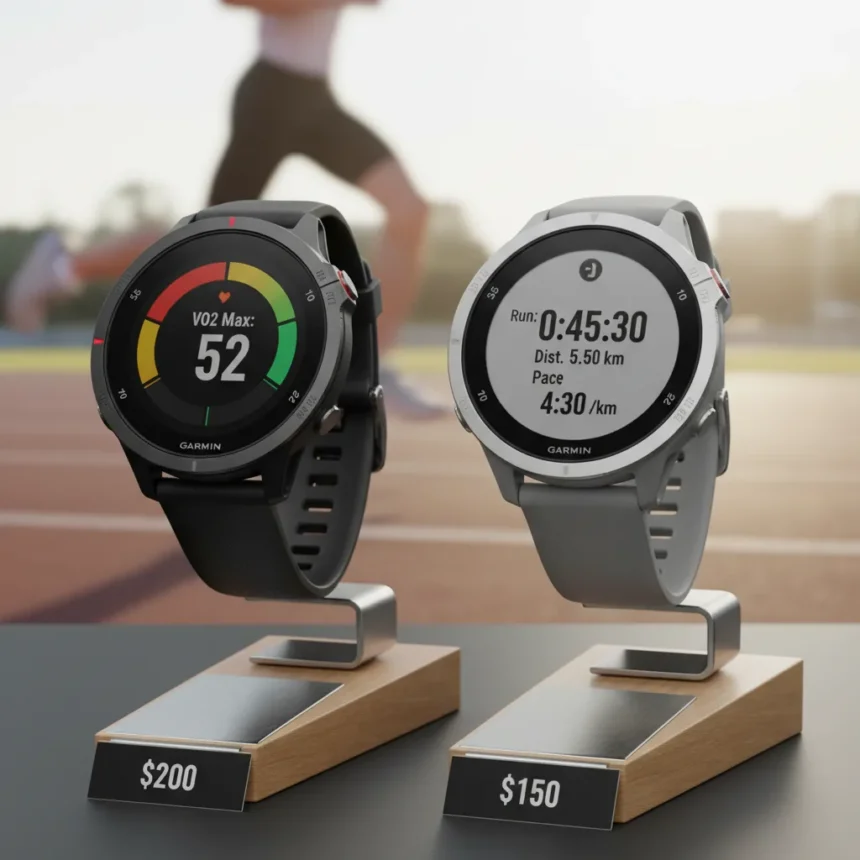
The Garmin Forerunner 70 vs Forerunner 55 comparison matters because Garmin just refreshed its entry-level running watch lineup after five years, and the new model costs significantly more. The Forerunner 70 is Garmin’s latest entry-level running watch, launched at $249, replacing the Forerunner 55 which debuted in June 2021 at $199. For beginner runners deciding whether to upgrade, the question is straightforward: do the new features justify a $50 price jump?
Key Takeaways
- Forerunner 70 costs $249 versus Forerunner 55’s original $199 launch price, though the older model sold closer to $169 recently.
- AMOLED display on Forerunner 70 offers brighter, more vibrant visuals than Forerunner 55’s older MIP screen technology.
- Forerunner 70 adds training load, training status, personalized workout plans, and race time predictions—features previously reserved for pricier models.
- Forerunner 70 includes Garmin Run Coach for 5K, 10K, half marathon, and full marathon training plans.
- Forerunner 70 omits barometric altimeter found on higher-end Forerunner 170 and 170 Music models.
Display and Hardware: The Most Visible Change
The most obvious upgrade in the Garmin Forerunner 70 vs Forerunner 55 is the screen. The Forerunner 70 switches to a bright AMOLED display, replacing the Forerunner 55’s less-vibrant MIP (memory-in-pixel) technology. This matters for daily usability—AMOLED screens deliver sharper text, deeper blacks, and better visibility in sunlight, which runners notice immediately when checking splits during a workout. The older MIP display, while battery-efficient, looks washed out by comparison.
Beyond the screen, the Forerunner 70 uses one of Garmin’s newer health sensor arrays, though not the absolute latest. This is a deliberate positioning choice—Garmin reserves its most advanced sensors for premium models. The sensor upgrade still delivers meaningful improvements in metrics like heart rate variability and VO2 max tracking, but don’t expect the same precision you’d find on a Forerunner 170.
Training Features: Where the Forerunner 70 Pulls Ahead
The Garmin Forerunner 70 vs Forerunner 55 shows the biggest gap in training intelligence. Garmin pushed advanced training tools down to the entry-level tier with this release. The Forerunner 70 includes training load and training status insights—metrics that tell runners whether they’re overtraining, maintaining fitness, or ready for a hard effort. It also adds personalized workout plans through Garmin Run Coach, supporting race training for 5K, 10K, half marathon, and full marathon distances.


Race time predictions are new to entry-level runners too. The watch analyzes your fitness data and predicts realistic finish times for upcoming races, which helps with pacing strategy. The Forerunner 70 also tracks running dynamics including ground contact time, vertical oscillation, vertical ratio, and stride length—granular data that coaches and serious hobbyists use to improve form. It captures VO2 max, heart rate variability, running power, and recovery time as well. These were previously locked behind the price of mid-range Garmin watches.
The Forerunner 70 supports over 80 workout types, so runners aren’t confined to basic running profiles. You can pre-download and sync running courses for race-day navigation, which is handy for destination marathons or unfamiliar routes.



What the Forerunner 70 Leaves Out
The Garmin Forerunner 70 vs Forerunner 55 comparison isn’t all wins for the new model. Garmin deliberately omitted several features to maintain the entry-level price point. Most , the Forerunner 70 lacks a barometric altimeter for precise elevation tracking—something found on the pricier Forerunner 170 and 170 Music. If you run mountainous terrain and care about precise elevation data, this is a real limitation. The watch estimates elevation from GPS, which is less accurate.
The price increase also stings in context. The Forerunner 55 launched at $199 in 2021, but had been selling closer to $169 for over a year before the Forerunner 70 arrived. Adjusted for inflation, that original $199 price is roughly equivalent to $240 in 2026 dollars, so the new $249 asking price isn’t outrageous in real terms—but it feels steeper when you could grab a Forerunner 55 clearance unit for significantly less.
Should You Upgrade from the Forerunner 55?
The upgrade decision depends on what you care about. If you’re a casual runner who logs miles and checks pace, the Forerunner 55 still works fine. Its core running tracking is solid, and you’ll save money buying used or on clearance. But if you want personalized training plans, race predictions, and access to Garmin’s training analytics—features that help runners improve—the Forerunner 70 is the better choice. The AMOLED screen alone justifies the jump for many people.
For new buyers, the Forerunner 70 is the obvious pick. Garmin positioned it as the new entry point, and it delivers more features than the five-year-old Forerunner 55 could offer. The Forerunner 165 starts at $249 as well, so compare both if you want a slightly different feature set at the same price.



Is the Garmin Forerunner 70 worth the price jump?
Yes, if you value training intelligence and a modern display. The jump from $169 (recent Forerunner 55 pricing) to $249 is noticeable, but you’re getting AMOLED, personalized training plans, race predictions, and advanced running metrics that didn’t exist on the older model. For runners serious about improvement, the features justify the cost.
Can the Forerunner 55 still compete in 2026?
The Forerunner 55 is five years old and shows its age next to the Forerunner 70’s AMOLED screen and training features. That said, it remains a capable running watch if you find it heavily discounted. Don’t buy one new—the Forerunner 70 is the better value at the same price point.
What’s the difference between Forerunner 70 and Forerunner 165?
Both start at $249, but the Forerunner 165 offers a slightly different feature mix. The Forerunner 70 is positioned as the new entry-level model, while the Forerunner 165 sits just above it in Garmin’s lineup. Check the full specs to see which aligns with your training priorities—they’re close enough that personal preference matters more than raw specifications.
The Garmin Forerunner 70 vs Forerunner 55 tells a familiar story: a five-year-old watch was overdue for a refresh. Garmin delivered meaningful upgrades—a better screen, smarter training tools, and modern sensors—but at a higher price. For runners upgrading from an older Garmin or buying their first running watch, the Forerunner 70 is the clear choice. For Forerunner 55 owners, the decision hinges on whether advanced training analytics matter enough to justify the jump.
Edited by the All Things Geek team.
Source: Tom's Guide