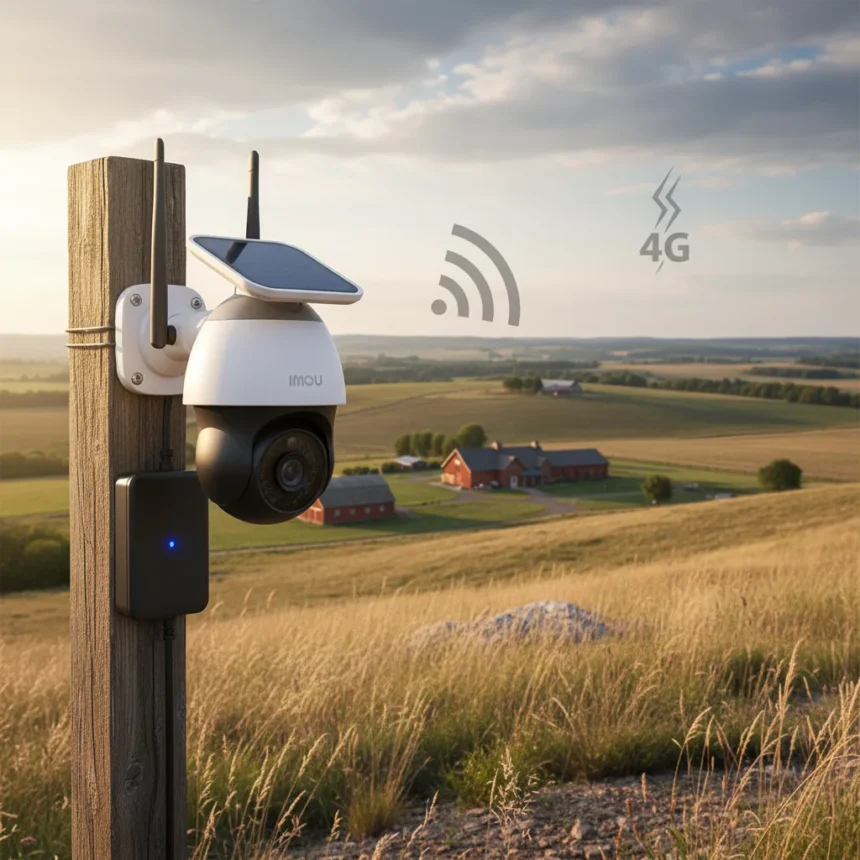
The IMOU AOV PT security camera is an outdoor surveillance device combining Wi-Fi and 4G connectivity, designed for properties where traditional wireless networks leave blind spots. Solar charging eliminates battery maintenance, while optional on-board storage gives users flexibility beyond cloud-only systems. For large properties where Wi-Fi coverage is inconsistent or nonexistent, this dual-connectivity approach solves a genuine problem.
Key Takeaways
- 4G connectivity ensures monitoring continues when Wi-Fi signals fail or are unavailable.
- Solar charging removes the need for regular battery replacement on outdoor cameras.
- Optional local storage lets users store footage on the device itself, independent of cloud services.
- Designed specifically for large properties with multiple coverage zones.
- Dual-connectivity approach addresses Wi-Fi dead zones that plague traditional outdoor cameras.
Why 4G Connectivity Matters for IMOU AOV PT Users
Most outdoor security cameras rely entirely on Wi-Fi, which creates a critical vulnerability on large properties. A house with an acre of land, a detached garage, or a sprawling garden often has areas where the router’s signal simply does not reach. The IMOU AOV PT solves this by adding 4G as a backup connection method, meaning the camera keeps transmitting footage even when Wi-Fi is unavailable. This is not a minor convenience—it is the difference between continuous monitoring and coverage gaps that thieves and vandals actively exploit.
The dual-connectivity design means users can position the IMOU AOV PT anywhere on their property without worrying about proximity to their home network. If a location has cellular signal but weak Wi-Fi, the camera switches to 4G automatically. For properties in rural areas or on the edge of suburban coverage zones, this flexibility is transformative. Traditional cameras in those scenarios either fail to connect or require expensive mesh network expansion.
Solar Charging and Local Storage Reduce Dependency
Outdoor security cameras typically face two operational headaches: depleting batteries and reliance on cloud storage. The IMOU AOV PT addresses both through solar charging and optional on-board storage. Solar panels keep the battery topped up continuously, eliminating the twice-yearly maintenance cycle that plagues standard outdoor cameras. Users no longer need to climb ladders, remove cameras, charge them indoors, and reinstall them—a task that discourages regular upkeep.


Local storage on the device itself gives users another layer of independence. While cloud storage offers remote access and automatic backups, it also means trusting a third-party server with footage and paying subscription fees. The IMOU AOV PT lets users store video directly on the camera using an SD card or internal memory, creating a physical backup that exists entirely under their control. For privacy-conscious users or those in areas with unreliable internet, this option is valuable.
IMOU AOV PT vs. Wi-Fi-Only Outdoor Cameras
The standard outdoor security camera market is dominated by Wi-Fi-only devices. Brands like Ring, Arlo, and Wyze all rely on wireless connectivity, which works perfectly in suburban homes with strong coverage. But they fail on large properties, farms, or homes with spotty Wi-Fi. The IMOU AOV PT does not replace these cameras for typical use cases—it targets a specific problem that Wi-Fi-only systems cannot solve. If your property is small and your Wi-Fi reaches every corner, a simpler Wi-Fi camera may be sufficient. If you have dead zones, the IMOU AOV PT becomes essential.



The addition of 4G also means the IMOU AOV PT works during internet outages that affect Wi-Fi but not cellular networks. A downed router or ISP outage leaves Wi-Fi cameras blind, but the IMOU AOV PT continues recording and transmitting via 4G. This resilience is especially valuable for security-conscious users who view monitoring as non-negotiable.
Who Should Buy the IMOU AOV PT?
The IMOU AOV PT is purpose-built for specific scenarios. Large property owners—those with multiple acres, detached structures, or sprawling gardens—are the primary audience. Farmers, rural homeowners, and properties on the edge of suburban coverage zones all benefit from 4G fallback. Users who distrust cloud-only storage or want to minimize subscription costs will appreciate the local storage option. Anyone who has struggled with Wi-Fi dead zones knows the frustration of having a camera in the perfect location but no way to connect it.
For typical apartment dwellers or suburban homeowners with strong Wi-Fi throughout their property, the extra cost and complexity of 4G connectivity may not justify the investment. The IMOU AOV PT is not a universal security camera—it is a targeted solution for a real problem that affects a specific subset of users. The question is not whether it is good, but whether your property actually needs what it offers.
Does the IMOU AOV PT require a separate 4G plan?
Yes, 4G connectivity requires an active cellular plan, typically through a mobile carrier. This adds an ongoing monthly cost beyond the camera purchase price. Users should factor in this subscription when evaluating total cost of ownership compared to Wi-Fi-only alternatives.



Can the IMOU AOV PT work with only 4G and no Wi-Fi?
Yes. The camera can operate entirely on 4G if Wi-Fi is unavailable or disabled. This makes it genuinely independent from home network infrastructure, which is the core advantage for large properties or remote locations.
How long does the solar panel keep the battery charged?
Solar charging is designed for continuous operation in outdoor conditions with regular sunlight exposure. The exact duration depends on weather, seasonal daylight hours, and camera usage patterns. In ideal conditions with adequate sun, the battery should remain continuously charged without manual intervention.
The IMOU AOV PT fills a gap that mainstream security cameras ignore. Large properties deserve surveillance systems that do not depend on perfect Wi-Fi coverage or constant battery maintenance. By combining 4G, Wi-Fi, solar charging, and local storage, this camera gives users genuine flexibility and independence. If your property has coverage dead zones, this is worth serious consideration.
Where to Buy
Edited by the All Things Geek team.
Source: TechRadar