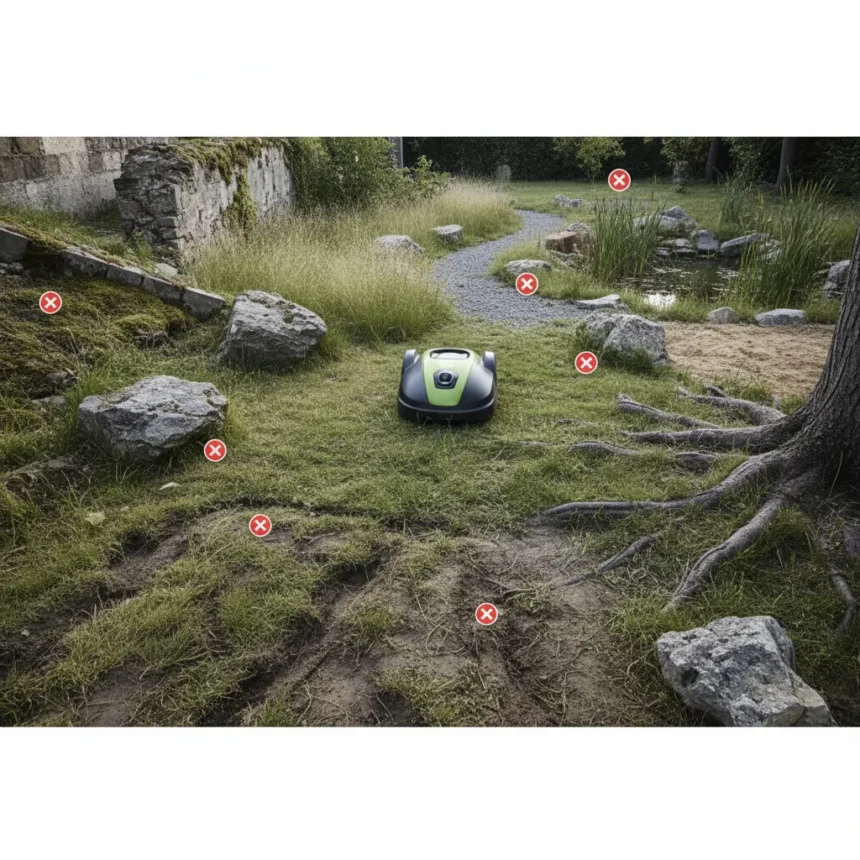
Robot lawnmower suitability depends on specific yard characteristics that many buyers overlook before spending thousands on automation. The technology promises to eliminate weekend yardwork, but it fails spectacularly on lawns that don’t match its narrow operational requirements. Understanding these seven warning signs can save you from a costly investment that sits unused in your garage.
Key Takeaways
- Robot mowers require flat, open lawns with clear boundaries to function effectively.
- Steep slopes, narrow passages, and complex obstacles create navigation failures.
- Poor Wi-Fi connectivity and uneven terrain cause unreliable performance.
- Heavy shade, tree cover, and wet conditions damage mowers and reduce cutting effectiveness.
- Setup complexity can consume an entire weekend with extensive app mapping and calibration.
Robot Lawnmower Suitability Requires Specific Yard Conditions
Robot lawnmower suitability refers to whether your lawn’s physical layout, terrain, and environmental conditions allow autonomous mowers to operate safely and effectively. These machines are engineered for flat, open lawns with minimal obstacles and strong wireless connectivity. The Yarbo Pro, for example, handles massive lawns up to 6.2 acres with a 38.4Ah battery and 20-inch cutting width, but demands strong Wi-Fi, app-based mapping for up to 100 areas, no-go zone configuration, and extensive setup time that can stretch across an entire weekend. If your yard deviates significantly from these baseline requirements, a robot mower becomes a financial liability rather than a labor-saving investment.
Steep Slopes and Uneven Terrain Disable Most Models
Steep slopes represent one of the most common reasons robot lawnmower suitability fails. These machines rely on wheels designed for flat or gently rolling surfaces, and gravity-induced slipping on inclines causes navigation errors, battery drain, and potential tipping. Uneven terrain compounds this problem—rocks, ruts, and compacted soil create obstacles that confuse sensors and strand the mower mid-yard. If your lawn features significant elevation changes or a surface that isn’t consistently level, a traditional cordless or corded mower remains the more reliable choice.
Narrow Passages and Complex Obstacles Block Navigation
Robot mowers struggle with tight spaces between trees, garden beds, or property features. Narrow passages force the machine to execute complex maneuvers that exceed its turning radius, while intricate obstacle patterns confuse boundary mapping. Advanced models like the Dreame Roboticmower A1, which manages up to half an acre using 3D LiDAR mapping, still require careful setup to avoid collision loops. If your yard contains multiple tight passages, dense tree clusters, or scattered garden structures, the mower will waste battery power attempting navigation rather than cutting grass.


Poor Boundary Definition and Weak Wi-Fi Connectivity
Robot lawnmower suitability collapses without clear boundary definition and reliable wireless connectivity. These machines depend on perimeter wires or app-based geofencing to understand where to mow and where to stop. Weak or inconsistent Wi-Fi signals prevent the mower from receiving navigation updates, receiving commands, or uploading lawn maps. The Yarbo Pro requires military-level navigation fine-tuning through its app, which proves impossible without strong, stable connectivity. If your yard sits at the edge of your Wi-Fi range or experiences frequent signal drops, autonomous mowing becomes frustratingly unreliable.
Heavy Shade and Dense Tree Cover Reduce Effectiveness
Shade from mature trees creates two problems for robot mowers. First, grass under heavy shade grows differently—slower, thinner, and more irregularly—making consistent cutting difficult. Second, falling leaves and branches accumulate on the lawn, creating debris that clogs cutting decks and confuses sensors. If your yard features extensive tree cover or remains shaded for most of the day, a robot mower cannot maintain the lawn quality you expect, and manual or professional mowing becomes necessary.



Wet, Muddy, or Poorly Drained Conditions Damage Equipment
Robot mowers are not waterproof in the way traditional mowers can tolerate wet conditions. Mud cakes onto wheels and sensors, drainage systems fail, and electrical components corrode. If your lawn stays wet after rain, sits in a naturally boggy area, or lacks adequate drainage, a robot mower will accumulate damage rapidly. Waiting for your yard to dry before each mowing session defeats the purpose of automation and shortens the machine’s lifespan significantly.
Setup Complexity Requires Patience Most Owners Don’t Have
Even when a yard theoretically suits robot lawnmower suitability, the setup process itself eliminates many owners. The Yarbo Pro, marketed as an all-season yard master for massive lawns, requires QR code scanning, app-based mapping, no-go zone configuration, and manual control calibration that can consume an entire weekend. If you just want your grass cut without turning your weekend into hours of trial and error, a traditional mower or even a less expensive robot lawnmower proves happier. The Ecovacs GOAT A3000 serves as an ultimate time-saver for big yards, but only if you have the patience to configure it properly.
Should I Buy a Robot Lawnmower for My Yard?
Only if your lawn is flat, open, well-drained, has strong Wi-Fi coverage, clear boundaries, minimal shade, and you have patience for weekend-long setup. If any of these factors is missing, a traditional cordless or corded mower delivers better results for less money and frustration.
What Size Lawn Works Best for Robot Mower Automation?
Smaller lawns under half an acre suit entry-level models, while larger properties benefit from advanced systems like the Yarbo Pro, which handles up to 6.2 acres. Size alone doesn’t guarantee suitability—terrain, obstacles, and connectivity matter equally.



Can Robot Mowers Handle Wet Grass or Muddy Yards?
No. Wet conditions damage electrical components, clog sensors, and corrode metal parts. Wait until your lawn dries completely before using a robot mower, which defeats the automation advantage if your yard drains poorly.
Robot lawnmower suitability is not a binary choice—it exists on a spectrum determined by your specific yard’s characteristics. Before spending thousands on automation, honestly assess whether your lawn meets the baseline requirements. A machine sitting unused in your garage is far more expensive than the traditional mower gathering dust beside it.
Where to Buy
$2,299 at Amazon | 13% OFFAmazonSegway Navimow I210 Awd Robot Lawn Mower $1,299$1,498.99shop now | 8% OFFAmazonHusqvarna 410iq Automower Robotic Mower$2,399.99$2,599.99shop now | 27% OFFAmazonGreenworks 24v 13“ Brushless Cordless Lawn Mower$189.99$259.99shop now | AmazobLawnmaster Meb1216k Electric Lawn Mower$134.99shop now
Edited by the All Things Geek team.
Source: Tom's Guide