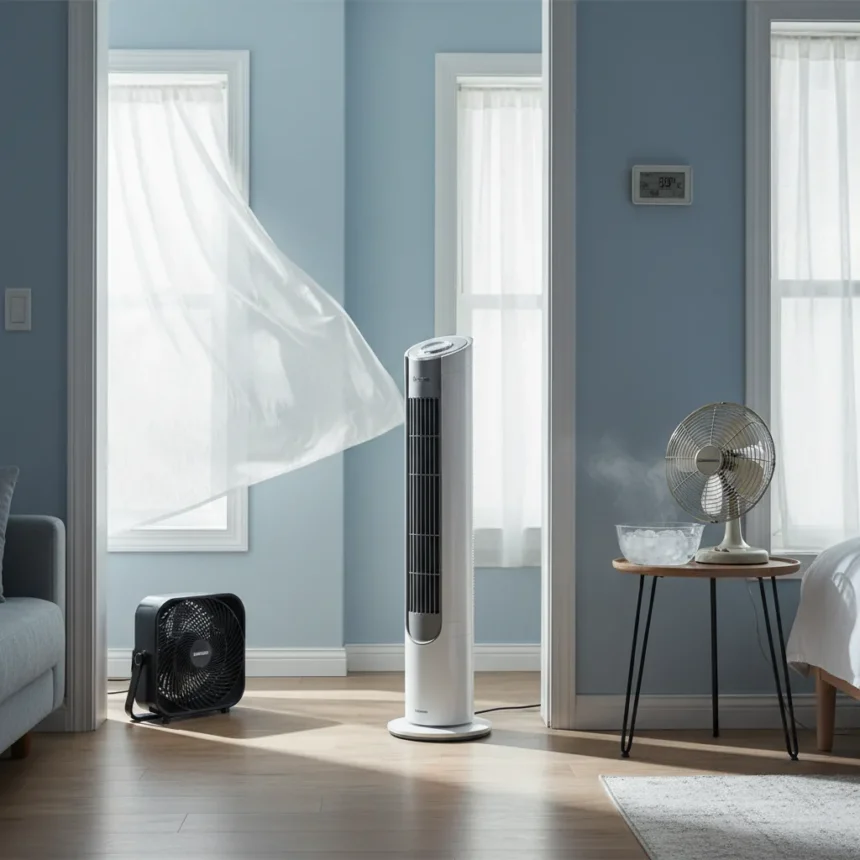
Most people use their fans wrong during a heatwave. A cheap electric fan can make a real difference to the temperature in your home — but only if you use it the right way. The problem is timing, placement, and airflow strategy. Get these three elements right, and your fan becomes far more effective than most people realize.
Key Takeaways
- Fans cool people through airflow and sweat evaporation, not by lowering room temperature
- Use fans at night when outdoor temperatures have dropped below indoor levels
- Open windows on opposite sides of your home to create cross-ventilation with your fan
- Negative pressure ventilation (NPV) draws cooler outside air in by pointing fans outward
- Proper placement beats expensive air conditioning for moderate climates
Fans Don’t Cool Rooms—They Cool You
Here’s the fundamental mistake most people make: they expect fans to lower room temperature. They don’t. Fans work by moving air across your skin, which accelerates sweat evaporation and creates a cooling sensation on your body. This is why a fan feels refreshing when you’re in front of it but doesn’t actually change the thermometer reading. Understanding this distinction changes everything about how you should deploy your fan during a heatwave.
Air conditioners actively remove heat from the air. Fans simply redistribute it. This means fans work best in moderate climates or as part of a layered cooling strategy, not as a standalone solution in extreme heat. If you’re trying to cool an entire room for comfort rather than spot-cooling yourself, your fan needs help from windows and timing.
Fan Cooling Heatwave Strategy: Use Fans After Dark
The single biggest timing mistake is running your fan during the day when outdoor air is hotter than indoor air. During daylight hours, an open window with a running fan actually pulls warm air into your home, making things worse. Wait until evening, when outside temperatures have dropped below indoor levels. This is when fans do their best work.


At night, open your windows and run your fan to pull that cooler outdoor air inside. The temperature difference between outside and inside becomes your fan’s greatest asset. In many climates, the overnight temperature drop is dramatic enough to cool your entire home if you start early in the evening and keep windows open for several hours. Close windows again in the morning before the heat returns.
Cross-Ventilation and Negative Pressure Ventilation Maximize Airflow
The most effective fan setup uses negative pressure ventilation (NPV), a technique that turns your fan into an air-pulling system rather than just an air-blower. Here’s how it works: place your fan about 3 to 6 inches from a bedroom or living room window, pointing outward. Set it to maximum speed. This creates low pressure behind the air column, which encourages cooler air to rush in through other open windows or doors on the opposite side of your home.


The key is keeping all other doors and windows closed except the ones you need for airflow. If you open every window in your house, you lose the pressure differential that makes NPV effective. Instead, open windows on opposite sides of the home to create a clear path for cool air to flow through. The outward-pointing fan acts as an exhaust, pulling fresh outdoor air in through the entry point and pushing stale indoor air out. This cross-ventilation strategy works because it forces air movement in a controlled direction rather than letting it drift randomly.
Placement matters as much as direction. A fan mounted near a window can pull cooler air more efficiently than one sitting in the middle of a room. If you don’t have a window-mounted option, position your fan as close to a window as safely possible, angled outward. The smaller the gap between the fan and the window frame, the stronger the pressure effect.
Why Fans Beat Nothing—But Not Always AC
Fans cost far less to run than air conditioners and require no installation. For people managing a heatwave on a budget, a fan with proper technique can genuinely improve comfort and sleep quality. The strategy works best in climates where nighttime temperatures drop significantly, or where you’re only trying to cool one or two rooms rather than an entire house.
However, fans have limits. In humid climates where overnight temperatures stay high, or during extreme heat events, a fan alone won’t provide enough relief. AC units actively remove moisture and heat; fans cannot. If you’re in a region with sustained 40°C+ temperatures and high humidity, a fan is a supplement, not a replacement. For moderate climates or seasonal heatwaves with cool nights, proper fan technique can be sufficient.



Does fan placement really affect cooling performance?
Yes. A fan pointing inward from the center of a room creates random air circulation. A fan positioned near a window pointing outward, with windows open on the opposite side, creates directed airflow that pulls cooler air through your home efficiently. The difference in cooling effect is significant enough to justify the setup change.
Can I run my fan all day during a heatwave?
Running your fan during the day when outdoor air is hotter than indoor air will pull warm air into your home and make cooling harder at night. Save fan use for evening and night hours when outside temperatures have dropped. During the day, keep windows closed and blinds drawn to trap cool air inside.
Is a fan cheaper to run than an air conditioner?
Yes, fans use a fraction of the electricity that AC units require. However, fans and air conditioners serve different purposes—fans cool people through airflow, while AC units cool entire rooms by removing heat and humidity. For moderate climates with cool nights, a fan is more cost-effective. For extreme or sustained heat, AC provides relief that a fan cannot match.
The real takeaway is this: most people waste their fan’s potential by ignoring timing and placement. A nighttime strategy using cross-ventilation or negative pressure ventilation can transform a cheap fan into an effective cooling tool. It won’t replace air conditioning in extreme heat, but for seasonal heatwaves and moderate climates, proper technique makes a genuine difference in comfort and sleep quality without the expense of running an AC unit.
Where to Buy
Edited by the All Things Geek team.
Source: TechRadar