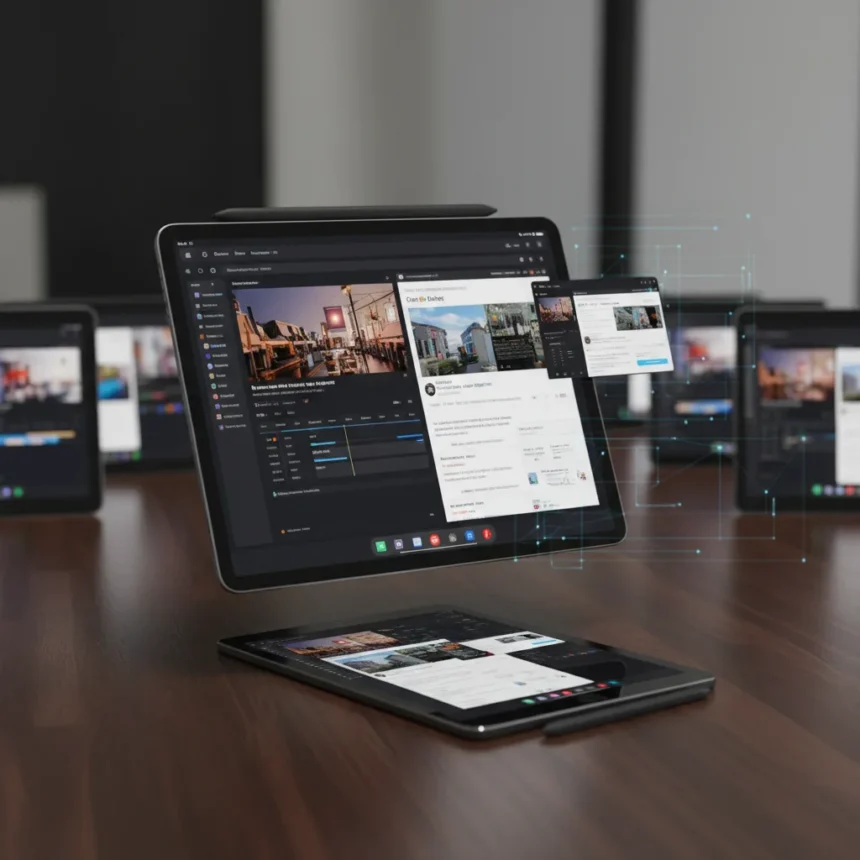
iPad multitasking advantage is real—but it is not permanent. While iPads still handle split-screen workflows and app switching more elegantly than Android tablets, Apple’s lead depends entirely on whether the company can fix the rest of iPadOS before competitors catch up.
Key Takeaways
- iPads outperform Android tablets at multitasking and window management today.
- Samsung Galaxy Tab devices offer feature-packed alternatives with strong multi-window capabilities.
- Apple’s ecosystem strength—app quality and accessories like the Magic Keyboard—reinforces its tablet dominance.
- Android tablets provide a more open ecosystem for users seeking flexibility.
- iPadOS must improve beyond multitasking or risk losing its competitive edge.
Why iPad Multitasking Still Leads Android Tablets
Apple arguably dominates the tablets world with its excellent iPads that mix solid specs and a really good app and accessory ecosystem. The company’s multitasking implementation—the way iPads handle multiple windows, app switching, and workspace management—remains smoother and more intuitive than what Android tablets offer. This is not a marginal advantage; it is the kind of usability gap that justifies the iPad’s premium pricing for professionals who juggle spreadsheets, design tools, and communication apps simultaneously.
The iPad’s desktop-class processor means the hardware can handle demanding workloads. But hardware alone does not explain the multitasking lead. iPadOS itself is engineered around the assumption that users want to see and interact with multiple apps at once. Gesture controls feel natural. Window resizing is responsive. The experience does not feel bolted-on, the way multitasking can feel on Android tablets where the feature set is impressive but occasionally clunky.
Samsung Galaxy Tab and Android Tablets Are Closing In
Android tablets have improved substantially in recent years, and Samsung Galaxy Tab devices are a credible threat to iPad dominance. The Samsung Galaxy Tab will be feature-packed, with some of the best multi-window features and productivity tools on any mobile device. In raw capability, Samsung’s implementation rivals Apple’s—users can stack windows, snap apps to custom grid layouts, and run multiple instances of the same app. On paper, the feature list is comprehensive.


The difference is execution. TechRadar’s tablet analysis notes that Apple does not make it easy to keep multiple windows and multiple apps open at the same time in practice, yet the company’s overall approach still feels more cohesive than Android’s fragmented multitasking experience. Android tablets offer a more open ecosystem for users who want flexibility, file system access, and customization that iPadOS does not permit. For power users comfortable with Android’s quirks, that openness is a genuine advantage. For casual multitaskers, it is noise.
The iPad’s Ecosystem Moat Is Weakening
Apple’s real advantage has never been purely technical—it has been ecosystem lock-in. The iPad benefits from a vast library of apps optimized for tablet screens, from design software to productivity suites. Accessory support, particularly the Magic Keyboard, creates a compelling reason to stay within Apple’s ecosystem. Yet this moat is eroding. Android tablets now have solid app support, and third-party keyboard manufacturers have closed the quality gap. Samsung’s own keyboard accessories are credible alternatives, even if they lack the polish of Apple’s offerings.



More troubling for Apple: the broader iPadOS experience is stagnating. Apple does not make it easy to keep multiple windows and multiple apps open at the same time, and beyond multitasking, iPadOS lacks features that would justify the iPad’s premium pricing. File management remains clunky. Customization is limited. The operating system feels designed for consumption rather than creation—a contradiction when the iPad Pro is marketed as a laptop replacement. Samsung, by contrast, is aggressively adding productivity features that appeal to people who actually work on tablets.
Apple’s Window for Fixing iPadOS Is Closing
The iPad will be much more simple, but also much more powerful, with a desktop-class processor. That power is wasted if iPadOS does not evolve to match it. Apple needs to rethink file management, add more granular window controls, improve keyboard shortcuts, and stop treating the iPad like an oversized iPhone. Without these changes, the company’s multitasking advantage will become a footnote—a legacy of past dominance rather than a reason to buy an iPad today.
Android tablet makers are not standing still. Samsung‘s commitment to multi-window features and productivity tools suggests the company understands that professionals want real work capability, not just entertainment. If Apple treats iPadOS as a secondary platform—a simplified iOS variant rather than a first-class operating system—it will lose users to Android tablets that actually feel like they were designed for work.
Does iPad multitasking really outperform Android tablets?
Yes, but the margin is narrowing. iPads handle split-screen workflows and app switching more smoothly than Android tablets today, particularly with gesture controls and window responsiveness. However, Samsung Galaxy Tab devices now offer comparable multi-window features and productivity tools, so the gap is no longer as decisive.


What makes the Magic Keyboard expensive for iPad users?
Apple’s Magic Keyboard is pricey because it combines a mechanical keyboard, trackpad, and iPad stand into a single accessory, plus Apple’s premium pricing strategy. Android tablet users can find cheaper keyboard alternatives, though they may not match Apple’s build quality.
Can Android tablets replace an iPad for work?
For multitasking workflows, Android tablets are increasingly viable, especially Samsung Galaxy Tab models with their feature-rich multi-window capabilities and open ecosystem. However, the iPad’s app ecosystem and multitasking polish still give it an edge for professionals who rely on specific software or prefer a more streamlined experience. The choice depends on whether you prioritize raw feature count or seamless usability.
Apple’s iPad multitasking advantage is real but fragile. The company has built a lead through thoughtful software design and ecosystem strength, yet this lead is temporary if iPadOS does not evolve beyond window management. Android tablets are improving faster than Apple is innovating, and within two to three years, that gap could close entirely. Apple needs to remember that the iPad is not just a big iPhone—it is a tablet that should compete on tablet terms, not smartphone simplicity. Without that shift, the iPad’s reign as the dominant tablet will end not with a bang, but with a slow fade as users realize Android offers more for less.
Where to Buy
Apple iPad Pro 11-inch (M5) | Apple iPad (A16) 11” | Apple iPad Mini (2024)
Edited by the All Things Geek team.
Source: TechRadar