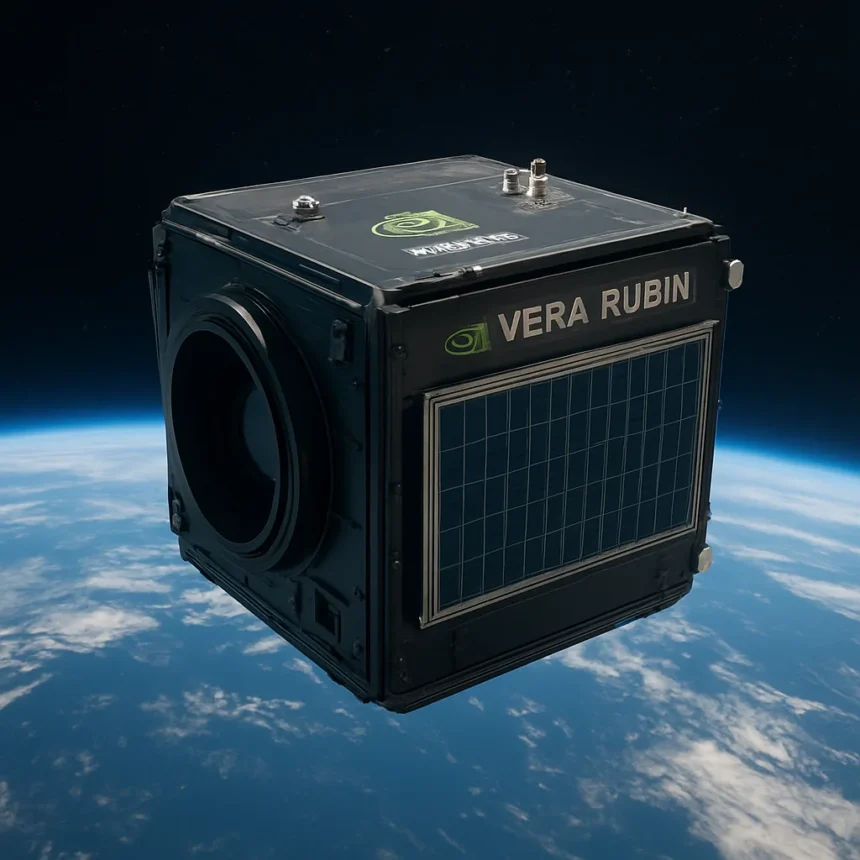
Nvidia’s Vera Rubin Space Module represents a fundamental shift in how AI compute reaches orbit. The Vera Rubin Space Module delivers up to 25 times the AI inference power of the H100 GPU, engineered specifically for orbital data centers and space-based AI workloads. This is not a marginal upgrade—it is a purpose-built architecture designed to handle the unique thermal, radiation, and power constraints of space deployment.
TL;DR: Nvidia announced the Vera Rubin Space Module at CES 2026, delivering 25x the H100’s inference performance for orbital use. The platform includes the NVL72 rack with 72 Rubin GPUs and 36 Vera CPUs, achieving 3.6 NVFP4 ExaFLOPS for inference workloads.
What makes the Vera Rubin Space Module different from terrestrial Rubin
The Vera Rubin Space Module is optimized for environments where conventional data center assumptions break down. Space-grade hardware must survive extreme temperature swings, handle radiation exposure, and operate within tight power budgets—constraints that terrestrial Rubin systems do not face. The module’s engineering prioritizes reliability and efficiency over raw clock speeds, a trade-off that makes sense when a hardware failure means losing access to an orbital asset worth millions.
The standard Vera Rubin platform, which launched at CES 2026, includes the NVL72 rack configuration with 72 Rubin GPUs and 36 Vera CPUs, delivering up to 3.6 NVFP4 ExaFLOPS for inference tasks. The Space Module variant takes these core components and hardens them for orbital deployment, with modified power delivery, thermal management, and radiation shielding. This is engineering-first design, not marketing spin.



Vera Rubin Space Module performance and specifications
The Vera Rubin Space Module achieves its 25x H100 performance advantage through architectural improvements and optimized inference precision. The NVL72 configuration delivers 3.6 NVFP4 ExaFLOPS, a metric that reflects Nvidia’s focus on inference workloads rather than training. For orbital applications—satellite image analysis, real-time earth observation, edge AI processing—inference performance matters far more than training throughput.
The platform’s dual-CPU design, pairing 72 Rubin GPUs with 36 Vera CPUs, creates a balanced system for mixed workloads. This is where Vera Rubin diverges from older GPU-centric architectures. The Vera CPUs handle orchestration, data movement, and non-GPU tasks, reducing bottlenecks that would otherwise limit overall system throughput. For space-based systems where every watt counts, this co-design approach eliminates wasted compute cycles.



Why orbital AI compute matters now
Satellite operators and space agencies face a data problem. Modern earth observation satellites collect terabytes daily, but transmitting all that data to ground stations is expensive and slow. Processing inference on-orbit—identifying objects, detecting changes, filtering relevant data—reduces transmission costs and latency dramatically. The Vera Rubin Space Module makes this economics work at scale.
Competitors in space computing have focused on smaller, less capable systems designed for specific missions. The Vera Rubin Space Module’s 25x H100 advantage means orbital operators can run complex AI models—object detection, semantic segmentation, time-series analysis—that were previously impossible on space-grade hardware. This shifts the economics of earth observation and creates new use cases for space-based AI that ground stations simply cannot match on latency or cost.
Integration challenges and deployment reality
Announcing a space-grade GPU is one thing; deploying it is another. The Vera Rubin Space Module must integrate with existing satellite buses, power systems, and thermal management infrastructure—no small feat. Launch costs, radiation testing, and certification timelines add months or years to deployment cycles. Nvidia is addressing this by working with space operators and integrators, but real-world orbital deployments will lag the announcement by 12-24 months.
The power envelope is critical. Space platforms have limited solar panel area and battery capacity, so the Vera Rubin Space Module’s efficiency advantage over previous space-grade GPUs directly translates to mission duration and capability. Without seeing detailed power specifications, we cannot confirm whether the module meets the strictest power budgets for small-satellite constellations, but Nvidia’s track record suggests they have engineered for this constraint.



Is the Vera Rubin Space Module a significant shift for orbital AI?
Yes, but with caveats. The 25x performance advantage over H100 is real and meaningful for inference workloads. For earth observation, space-based AI, and real-time satellite analytics, this is a step forward. However, deployment timelines, certification costs, and the relatively small addressable market for space-grade hardware mean adoption will be measured in years, not quarters. Early adopters—large satellite operators, government agencies, and space-focused startups—will see the benefit first. Smaller players may wait for second-generation versions or alternative platforms.
Can the Vera Rubin Space Module work in smaller satellites?
The NVL72 configuration is large and power-hungry, designed for full-scale orbital data centers rather than individual small satellites. Nvidia may release smaller variants for CubeSats and other compact platforms, but the announced module targets constellation operators and large government missions. Smaller satellites will likely continue using specialized, lower-power GPUs for the foreseeable future.
How does the Vera Rubin Space Module compare to ground-based Rubin systems?
The Vera Rubin Space Module uses the same core Rubin GPU and Vera CPU architecture as terrestrial Vera Rubin systems, but with space-grade modifications for radiation tolerance, thermal extremes, and power efficiency. Ground-based systems can push higher clock speeds and raw throughput because they do not face the same environmental constraints. For orbital deployment, the Space Module trades some peak performance for reliability and longevity—a worthwhile trade for mission-critical hardware.
The Vera Rubin Space Module signals that Nvidia is serious about space computing as a distinct market, not a side project. The 25x H100 advantage is substantial, and the engineering work required to make it space-qualified is real. Early adopters in satellite operations and space agencies should watch closely for availability timelines and certification milestones. For everyone else, this announcement confirms that orbital AI is becoming practical—and that competition for space-grade compute is about to heat up.
Edited by the All Things Geek team.
Source: Tom's Hardware